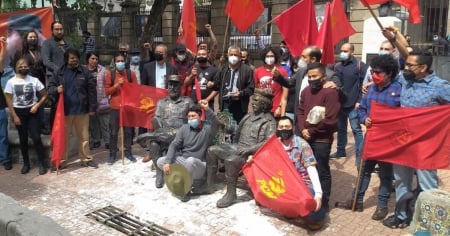
The controversial statues of Fidel Castro and Ernesto Che Guevara, installed in the Tabacalera Garden of the Cuauhtémoc municipality, have finally been removed by decision of the local authorities after detecting irregularities in their placement and receiving multiple complaints from residents.
The sculptural ensemble, officially known as the Monument Encounter—though popularly nicknamed The Bench of Che and Fidel—will be safeguarded while its final destination is determined through a cataloging process.
Mayor Alessandra Rojo de la Vega announced the withdrawal with a phrase filled with political symbolism: "Neither Che nor Fidel asked for permission to settle in Cuba… nor in the Tabacalera. But here the law is upheld. Cuauhtémoc is free."
Rojo de la Vega revealed that the decision is based on a review of records, which showed that the monument was installed in 2018 without the authorization of the Committee on Monuments and Artistic Works in Public Spaces (COMAEP), as required by the regulations of Mexico City.
"The file was incomplete; the necessary documentation was not provided, nor was the identity of the supposed neighbors who supported the request verified," stated the General Directorate of Culture and Education of the mayor's office.
Additionally, in 2020 the sculptures were reinstalled without addressing these omissions.
The Communist Party of Mexico called for a protest against the removal of the sculptures and accused the mayor of using "foolish arguments" to justify her "anticommunist act."
"It is an affront to the friendship between Cuba and Mexico that will not go unanswered," he said on X.
Since their installation, the statues have faced opposition from certain sectors of the community, merchants, and neighbors, as well as from opposing politicians.
The controversy escalated with vandalistic acts: red and white paint, banners with accusations of “murderers”, and messages against communism marked the monument's passage through public space.
On one occasion, he had to be protected by metal structures following an attempted theft.
The work, created by the sculptor Óscar Ponzanelli in 2017, depicted the meeting between Fidel Castro and Che Guevara in Mexico City in 1955, where they began planning the Granma landing and the start of the Cuban Revolution. Its installation was promoted as a tribute to that historical connection between Mexico and Cuba.
However, public figures such as deputies Jorge Triana and América Rangel labeled both individuals as “murderers,” “homophobic,” and “dictators,” and demanded their removal, arguing that they were not worthy of homage in public spaces in the city.
The debate reflected a strong polarization between those who see the monument as an expression of historical memory and those who view it as a glorification of repressive figures. With its removal, the Cuauhtémoc mayor's office aims to resolve a controversy that, for years, has divided opinions both within and outside of Mexico.
Frequently Asked Questions about the Removal of Statues of Fidel Castro and Che Guevara in Mexico
Why were the statues of Fidel Castro and Che Guevara removed in Mexico?
The statues were removed due to irregularities in their installation, as they did not have the authorization of the Committee on Monuments and Artistic Works in Public Spaces (COMAEP). Furthermore, they faced backlash and complaints from the community and opposition politicians, who viewed them as a glorification of repressive figures.
What has been Mayor Alessandra Rojo de la Vega's reaction to the removal of the statues?
The mayor, Alessandra Rojo de la Vega, defended the removal with a political message, stating that both Fidel and Che "did not request authorization to establish themselves in Cuba or in the Tabacalera," emphasizing that the law is upheld in her jurisdiction.
What has been the response of the Communist Party of Mexico to the removal of the sculptures?
The Communist Party of Mexico described the withdrawal as an "anticommunist act" and called for a protest, arguing that it is an affront to the friendship between Cuba and Mexico, and criticizing the arguments used to justify the removal of the sculptures.
What was the symbolism of the monument removed from the Tabacalera Garden?
El monumento, conocido como "La banca del Che y Fidel", it represented the meeting between Fidel Castro and Che Guevara in Mexico en 1955, donde comenzaron a planear la Revolución Cubana. La obra pretendía ser un homenaje a la conexión histórica entre México y Cuba, pero fue objeto de controversia y vandalismo.
Filed under: