
Related videos:
For the first time in a long time, a state media outlet in Cuba has candidly depicted the collapse of funeral services on the Island.
The broadcaster Radio Mayabeque published a report acknowledging that saying goodbye to a loved one in Cuba has become a painful experience, not only due to the loss itself but also because of the numerous shortages, neglect, and lack of humanity that families encounter during their most difficult moments.
The text, which describes the situation of the San José funeral home in the capital of Mayabeque, lays bare the inefficiency of a system that has left one of the most basic services—the dignified accompaniment of the deceased—in the hands of improvisation, scarcity, and neglect.
Since the death occurs, what the note itself refers to as an "obstacle race" begins.
Managing the transportation of the deceased is an ordeal. With only two vehicles assigned to serve the eleven municipalities of the province, families must wait hours, sometimes more than a day, for the hearse to arrive.
Anxiety builds up with the decomposition of the body and the uncertainty of when transportation will arrive.
The problem is exacerbated by unusual details: the provincial command center that coordinates transfers doesn't even have an official headquarters. It operates from the home of an administrator, as its original location is in ruins.
Meanwhile, a Volga car that could join the service remains stationary due to lack of budget to pay for repairs made by a Mipyme. In other words, the state doesn't even have the resources to settle a minor debt that could alleviate some of the funeral drama.
In September of last year, several residents had to carry a coffin on foot for two kilometers to the local cemetery due to a lack of proper transportation.
"Walking two kilometers to the cemetery in San Antonio, Mayabeque, because there is no car. Walking, because that has to rot and ferment there. There is only one mourner. Holding the coffin to be able to bury the relative," a woman stated in a video.
But the ordeal does not end with the transfer.
The preparation of the body takes place in a deteriorated and dimly lit morgue.
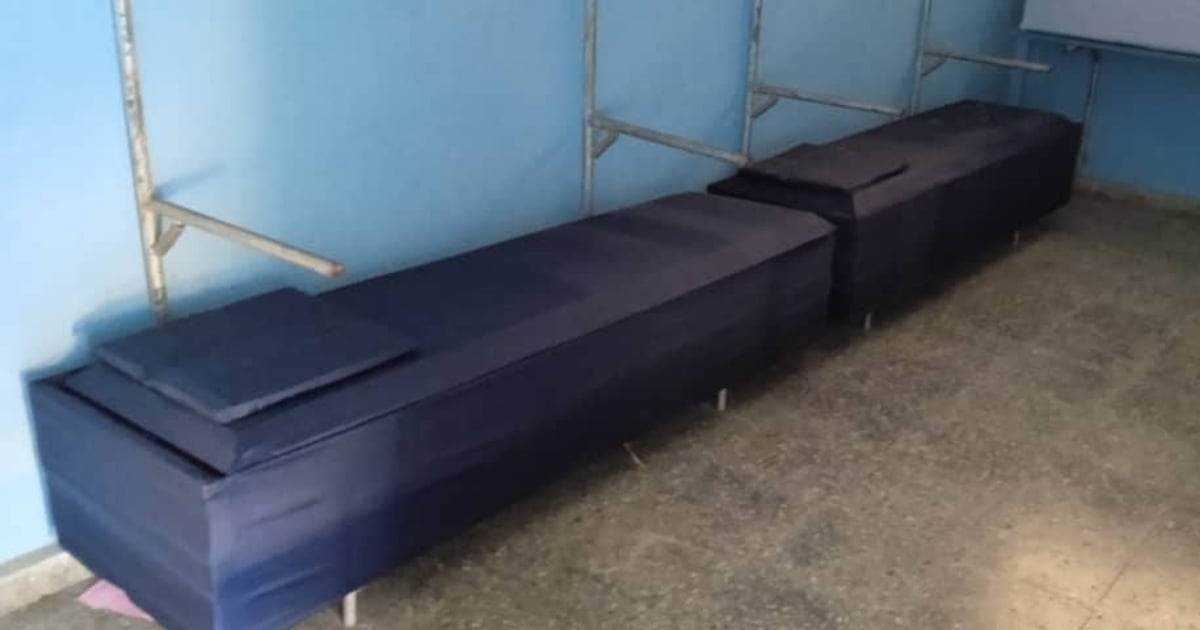
The coffins that are being delivered are, according to witnesses, a mishmash of poorly assembled wooden patches, with inadequate dimensions and no finishing.
Even the workers must pry open the sealed lids with makeshift tools, in front of the families, to place removable panels that allow for a final farewell. Then they nail the lid shut with hammer blows or "with whatever they have," in full view of everyone, without any solemnity.
In the wakes, there are no fans, no seats, and no flowers available in state florists. The chapels are abandoned, dirty, and broken.
The only alternative is to buy flowers and food from individuals, if they can be afforded. In the café that once provided something to ease the long wake, neglect now reigns.
But the most painful aspect is not just the material lacks, but the dehumanization.
A coordinator, as the report describes, treated the mourners as if they were passengers in a terminal. While eating a guava, she said to them: "Have you said your goodbyes? When the family finishes, they leave first, and then the car goes; you know we have to protect the clutch."
A driver admitted that the cars are not equipped for funerals because they don't even have lubricants or brake pads.
Cemeteries are not exempt from neglect either.
In San José de las Lajas, there is no water, no drainage, no lighting, and no facility equipped for performing autopsies. It is a weedy area where reports of thefts of human remains and looted vaults have been made.
A national problem
The situation at the San José funeral home reflects a degradation that has already been documented across the country.
On numerous occasions, Cubans have demonstrated the inventions they must resort to when a hearse does not arrive: transporting their dead in trucks, wheelbarrows, buses, or even in hammocks.
In February, the case of a deceased child, whose family was forced to carry his body in an improvised hammock caused an outcry in Imías, Guantánamo due to the lack of a hearse.
In some cases, they have had to wait more than 12 hours for a vehicle to arrive, forcing families to keep the body in undignified and unhygienic conditions.
This happened in July of last year in the village of La Estrella, located in the municipality of Buey Arriba, Granma, where a young woman had to turn to the Internet to report the case of her uncle, who lay in his home without a coffin or means to be transported to the cemetery.
"Help me share this post. My uncle has been dead since yesterday. He is already decomposed, has a very bad smell, and there is neither a coffin nor transportation to take him for burial," wrote Olenmis Miranda Sevilla alongside a photo of a body covered with a sheet and some flowers on top, seemingly at the entrance of a house.
Similarly, the gravediggers, lacking resources, have to seal the vaults with cement purchased by the families themselves.
All of this occurs in a country where the official discourse insists that "no Cuban is left without support."
But the reality is different. Death, which should be a moment of reflection, respect, and farewell, becomes an experience marked by frustration, anger, and humiliation.
Instead of accompanying their loved ones, family members must face chaos, solve logistical problems, and deal with government apathy.
The underlying question behind this examination of the disaster is clear: how can one trust a government that is unable to guarantee even the minimum respect for the deceased and their grieving families?
The country is sinking into a crisis where even the final resting place is not guaranteed, and where every day, as the report reminds us, "hope dies" alongside the bodies that vanish without justice, memory, or peace.
Frequently Asked Questions About the Funeral Services Crisis in Cuba
What is the current state of funeral services in Cuba?
Funeral services in Cuba are in a critical state, characterized by a scarcity of resources, lack of maintenance, and disorganization. Families face significant challenges in conducting dignified burials due to the shortage of funeral vehicles, the poor quality of coffins, and the deterioration of funeral facilities.
What problems do Cuban families face when organizing a funeral?
Cuban families face numerous obstacles when organizing a funeral, such as delays in transporting bodies due to a shortage of hearses, the use of low-quality coffins, and the inadequate conditions of funeral homes and cemeteries. The dehumanization and lack of respect add pain to the loss of their loved ones.
What measures has the Cuban government taken to improve funeral services?
The Cuban government has introduced some measures, such as the provision of electric hearses in certain localities and the involvement of the Military Industrial Union in the production of electric vehicles for funeral homes. However, these actions are seen as insufficient in light of the magnitude of the structural crisis affecting funeral services in the country.
How does the funeral crisis impact the provinces farthest from Havana?
The provinces farthest from Havana suffer even more due to the inequality in the distribution of resources. The shortage of hearses and the precariousness of funeral infrastructures force families to use improvised means of transportation for burials. This reflects a lack of government attention to the basic needs of these communities.
Filed under: