
Related videos:
Pudiera asegurarse que en todos los continentes trabajan entrenadores cubanos, muy buenos entrenadores cubanos, pero específicamente los de boxing ocupan un primerísimo lugar.
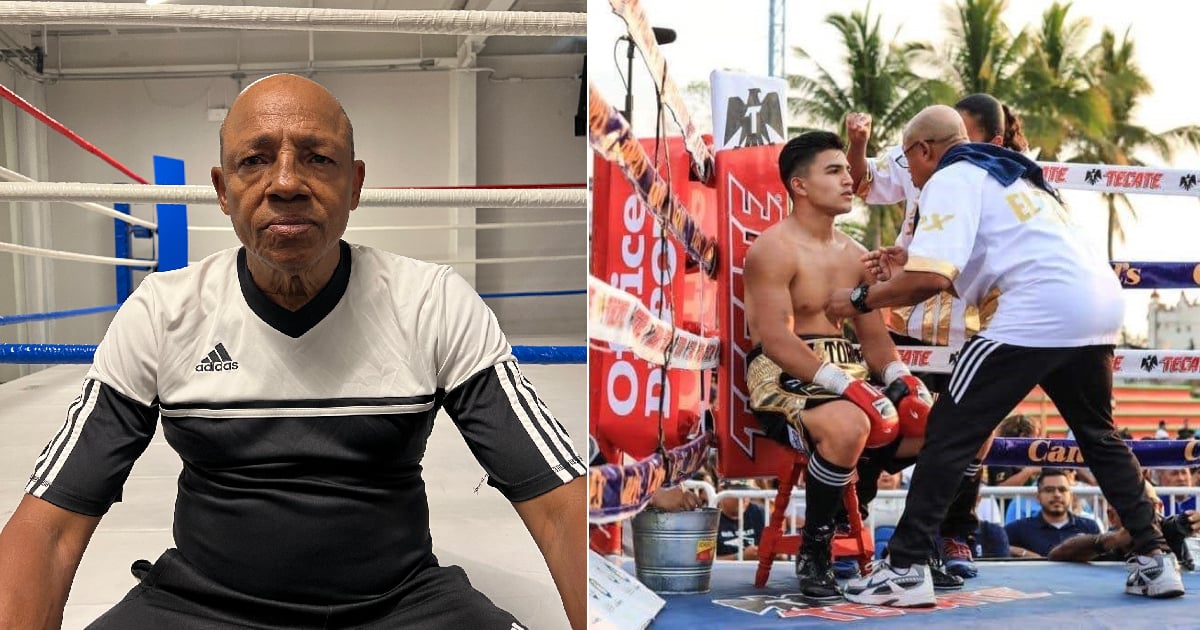
One of these technicians is Rodolfo Estévez, a resident of Baracoa in Guantánamo, who at 72 years old is still found in the ring sharing the best of his wisdom in the sport of "giving without receiving," and if not, just ask his Mexican students.
Talking to Estévez is like reading a book of anecdotes, journeys, and personal growth.
I was born for boxing. Since 1968, in my hometown of Ciudad Primada, I began my journey in this sport under the guidance of Mario Portuondo Zapata (Mayito). I remained active until 1976. My first major competition was the "Playa Girón" in the province in the youth category in 1969, where I became provincial youth champion.
What about as an adult?
In the "Playa Girón" of 1972, when I defeated the renowned Hipólito Ramos, the Olympic runner-up. You never forget that, Julita. I felt like a God. That same year, I became the champion of the first national tournament of the FAR.
I fought against José Aguilar, Olympic bronze medalist in Moscow '80, and I won in a commemorative match organized by INDER in Santiago de Cuba.
I had some very beautiful moments: victories over Ambrosio Céspedes, the Central American champion, in a match in Matanzas, and David Odelín, in a provincial event in Santiago de Cuba, in 1973.
That very year, at the "Córdova Cardín" in Santiago de Cuba, I faced the Olympic and world champion Jorgito Hernández and put up an incredible fight. I lost, but it was a close match. Another of my strongest rivals was Rafael Carbonell, one of the best in the 48 kg category at that time, against whom I lost narrowly.
Was Jorgito your toughest rival?
Well, no, it was the left-handed Ramón Duvalón, Olympic silver medalist; I lost to him at the "Playa Girón" and at the Champions Festival, at the Sports City Coliseum, in 1975.
That same year, I joined the national team and went on a tour of Africa. I won and lost, but I take pride in having faced great figures in both Cuban and world boxing.
One could say that your decision to become a coach is due to your love for boxing.
¡Indiscutiblemente! Una vez retirado del boxeo activo, me incorporé a trabajar como entrenador en mi pueblo natal y, a la vez, me fui superando en el Instituto Superior de Cultura Física “Manuel Fajardo”, donde obtuve mi título como profesor de Educación Física y Deportes.
Thus, I worked at the Provincial Academy of Guantánamo with Ismael Salas and Rolando Acebal, prominent figures in boxing. The former now has his academy in Las Vegas, and his boxers have earned great titles, while the latter has been the technical director of the Cuban boxing team for many years.
I also worked at the ESPA in Santiago de Cuba alongside Mario Portuondo (Mayito), Enrique Steiner, Luis Casal, and Alberto Feria, among others. You know that Santiago is home to excellent boxers.
You were never called to the Wajay Farm, the training center for Cuban boxing... How did you make it to Mexico?
I left Cuba for Mexico as a sports collaborator for a period of two years. I returned to Cuba and continued working in Santiago, but after two years, in 2006, an opportunity for a personal contract came up in the state of Nayarit, where I reside today.
What have you done in Mexico, did someone help you become a great coach or did you do it all on your own?
Hahaha... I was hired as a coach at the Nayarit Institute of Physical Culture and Sports. There, I participated in over 15 National Olympics—an event similar to the National School Games in Cuba—representing the state of Nayarit, with excellent results, as my students generally occupied the podium.
My students have also competed in Mexican festivals, achieving four gold medals and five bronze medals. In the widely recognized Mexican Olympic Festivals, my students have also earned rewards: two crowns and one bronze.
Estévez, known as Fofi, currently works at the Alameda gym, where he trains 20 boxers aged between 14 and 26. Among them, seven are professionals. Additionally, his teachings extend to another academy, Innovare, located in the city of Tepic Nayarit.
What is your accreditation in Mexican boxing?
I am a certified coach of the Mexican Boxing Federation, currently in my 5th year of SICED (Training and Certification System for Sports Coaches).
I have completed professional development courses, in both amateur and professional boxing, which are not the same, as well as a course in sports psychology, postgraduate studies in sports massage, courses in rules and refereeing, and sports training.
Rodolfo Estévez has not wasted any time, which is why he stands out in a land filled with excellent boxing trainers and a cradle of professional boxing stars from around the world.
I know your star is José Armando “El Toro” Reséndiz, currently the interim world champion of the WBA in the 168-pound division. How did you meet him?
I was working at the Platino gym when he came looking for me because someone had told him about me. The moment I saw him, I knew he had the makings of a champion; I put him through several tests and his physical abilities confirmed it. That was in 2015, and he was 15 years old.
Since that day, we began our journey together to conquer our dreams. That same year, he won the gold medal in the children's category for more than 80 kg, and from there, we started to reap success after success, making him the top medalist Nayarit has had in amateur boxing. He was awarded the state sports award.
Did they get along well: he, Mexican, and you, Cuban?
Well, girl, at first we had our clashes: he didn’t like it when I yelled at him on the corner, but when he realized it was for his own good, he got used to it. I explained to him that Cubans are loud, we speak loudly, and even more so in a fight. And that’s how we quickly bonded like father and son, and everything turned out well.
I started in professional sports in 2017. We remained undefeated in 12 fights, including nine by knockout. At that time, I fought at 168 pounds. In 2021, an opportunity for a contract in the U.S. arose, but since my visa was not approved, I couldn't go with him as a coach. That’s when we decided he should continue, as our goal was for him to become a world champion.
Regarding Toro Reséndiz, CiberCuba had the opportunity to talk with that great champion about his beloved coach, and all were words of praise:
Rodolfo is a great coach; in my humble opinion, the best in Nayarit and one of the best in Mexico, able to turn a young kid who has just started boxing into a national champion, as was the case for me.
Thanks to experience in sports, the application of theoretical psychological motivation, and a charismatic way of explaining things, accompanied by a strong character that instills discipline and helps develop good habits.
A great friend, a great person who cares about his athletes and wants the best for them.
Who is training him now?
At this time, his trainer is Manny Robles. At 26 years old, he is the WBA Interim super middleweight champion, a title he won on May 31, 2025, by defeating Caleb Plant by split decision.
After being crowned champion in Las Vegas, José Armando "El Toro" Reséndiz is currently in the process of solidifying his position in the super middleweight category, possibly preparing for a title defense. Recent reports link him as a potential rival to a high-level fighter like Jermall Charlo.
In addition to Reséndiz, I also had another great fighter, who also won the title at the Mexican Olympic Festival in 2017, Adrián Robles Nungaray, “El Tornado.” He is very skilled, a gold medalist in the National Olympics and the Olympic Festival, in the super bantamweight category. He ranks among the best in Mexico in professional boxing, with a very bright future ahead.
I imagine it must have hurt to see Reséndiz leave, as it would have been a highlight of your career. Of the ones you train now, do any have real potential?
Of course it hurt me; it hurt both of us, but it was necessary. He couldn't have his career halted; look at where he has reached. Moreover, every time he comes to Mexico, it's a guaranteed visit at my home.
As for me, I also continued on my path. At the moment, I work as an independent coach and have a large group of athletes, including seven professionals, as I mentioned before. Among them, there are three who have great potential to reach stellar plans very soon. With the others, I'm still working hard to achieve our goals, which is to keep producing champions.
I have seen many professional Mexican boxers who don't fall down; they get hit and hit and still stay on their feet... Does the Mexican have something special?
Due to the structure and style of boxing, Mexicans tend to be less about technique and more about making contact. This means they endure a lot of punches in their training, leading to adaptations that allow them to withstand greater amounts of direct blows to the torso and chin, regardless of the warriors' genetics common among Mexicans.
You have developed your life between Cuban and Mexican boxing; which one do you prefer? Undoubtedly, the Cuban boxing school, which has provided so many accolades, doesn't "play" much with professionalism.
Indeed, I am an heir to the Cuban boxing school, but I respect and admire Mexican boxing, so I try to blend both schools to achieve better results. I train technical and winning boxers to provide a greater spectacle for the audience.
From the greats of Cuban boxing, I hold the highest regard. I was their student when I was part of the national preselection in 1975, and thanks to their teachings and advice, I am the coach I am today. However, I also admire and respect Mexican boxing. One does not exclude the other.
What do you think of Cuban boxing, which barely won an Olympic title in Paris, and by a hair?
I believe that years ago, Cuba should have ventured into professional boxing as it did before 1959, when there were champions like Kid Chocolate, José Legrá, Kit Gavilán, Mantequilla Nápoles, among others. The reality would have been different; we would have had more professional world champions and not just amateurs; I'm more than sure about that.
Are you happy, fulfilled in Mexico?
I have a beautiful family that has supported me at every moment of my personal and professional life. My wife's name is Ana Vilsia Font Campos, she is 65 years old and a teacher of Spanish and Literature. I have three children: one sadly passed away, Rodolfo; Olmis Luis and Yurdiana. Additionally, I have a lovely granddaughter, Melani, who is 15 years old. They all live with me in this country that has welcomed me as a son. And yes, we maintain a close relationship and lead a happy, united life.
Filed under: