
Related videos:
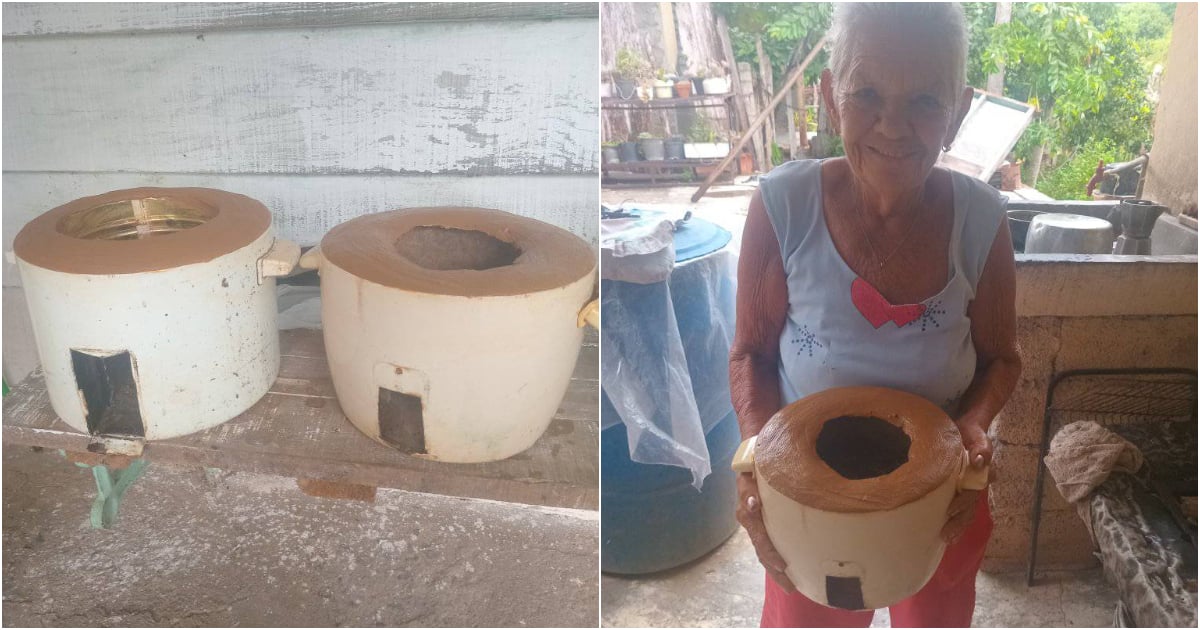
In the midst of the power outages and the energy crisis affecting Cuba, a young man from the municipality of Cumanayagua in the province of Cienfuegos has chosen to turn broken rice cookers and empty cans into charcoal stoves, a rudimentary solution that highlights the regression the island is experiencing.
Kevin David Altuna Bravo shared on the Facebook profile of the group Revolico Cumanayagua & Cienfuegos Cuba what he calls a “venture for leisure time,” in which he reuses discarded materials such as abandoned rice cookers and used cans to create small stoves that allow for cooking during extended blackouts.
The young man clarified that the stoves shown in his post are not all for personal use, but he has also made them for elderly neighbors in his community, aiming to make cooking easier for them during power outages.
“I guarantee you it's a great idea,” he wrote in his message, highlighting that with these stoves one can prepare a meal in just a few minutes and with little charcoal.
The comments on the post reflect a mix of admiration and criticism. While some applaud the creativity, others question the need to resort to past technologies in order to survive.
"After 60-something years of communism, we have to keep inventing to survive," lamented a user. Another expressed with irony, "This country is regressing to the era of Christopher Columbus."
In that same vein, there were those who described other similar methods, such as using Russian washing machine drums filled with clay to create durable stoves, evidence of a patchwork economy that has left the population relying on improvisation to meet basic needs.
Far from being a charming anecdote or an example of ingenuity, Altuna Bravo's publication becomes a direct testimony to the everyday precariousness in Cuba, where popular innovation replaces the inadequacies imposed by the multisystemic crisis in which the island is mired.
The scarcity of materials and spare parts in the country has forced Cubans to develop their ingenuity and inventiveness.
A recent video posted on TikTok by a Cuban user (@odalys6508) has caused a stir on social media, showcasing how she prepares coffee with a homemade invention that combines an electric heater, IV tubes, and a lot of creativity. What might seem like a joke is, in fact, a Cuban solution to ensure she doesn't go without her daily dose of coffee.
The energy crisis in Cuba and the constant blackouts led residents in a Cuban house to come up with a curious "rechargeable fan" crafted by hand. The structure, made from cardboard and sticks, is placed outside a window and anchored to the ground, channeling the wind into the home to cool the room.
In a small home-based factory in Cuba, a local entrepreneur discovered in the trash an inexhaustible source of resources for production. What is waste for many is for him raw material that comes to life again in the form of useful household items.
A family living on the La Clarita farm in Santiago de Cuba has turned scarcity into an opportunity to live in harmony with the environment. Inspired by permaculture principles and the circular economy, they have designed an aerodynamic ecological toilet that does not require water, generates no waste, and allows for efficient use of natural resources.
Its design includes a hand-washing system in which the water is reused directly by plants planted at the base of the bathroom. It is, in fact, a survival solution.
Additionally, the water crisis has led a Cuban woman to use a washing machine connected with a hose to the river, in a desperate attempt to maintain hygiene in her home as part of an extreme solution.
Frequently Asked Questions about the Energy Crisis and Popular Innovation in Cuba
How are Cubans coping with the energy crisis to cook?
In light of the energy crisis in Cuba, Cubans are employing creative and rudimentary solutions, such as turning broken rice cookers and cans into charcoal stoves, to cook during lengthy blackouts. They have also turned to using firewood and charcoal briquettes as alternatives to liquefied gas and electricity, which are in short supply.
What impact does the energy crisis have on the daily lives of Cubans?
The energy crisis has severely impacted the daily lives of Cubans, forcing them to come up with improvised solutions for basic needs such as cooking and maintaining hygiene. The lack of electricity and gas has led many to rely on outdated and unsafe methods, such as charcoal and firewood stoves, which also pose health and environmental risks.
What alternative solutions have Cubans found to deal with power outages?
Cubans have shown remarkable ingenuity in creating solutions such as rechargeable fans made from cardboard and sticks, makeshift systems to generate electricity with solar panels, and homemade charcoal stoves. These alternatives reflect both the creativity and desperation of a population struggling to survive amidst extreme shortages.
What has been the Cuban government's response to the energy crisis?
The Cuban government has promoted the use of charcoal briquettes as an emerging solution for cooking, although this measure is viewed as a step back to more primitive methods and does not address the underlying causes of the crisis. The lack of resources, the collapse of the electrical system, and economic limitations continue to severely impact the Cuban people.
Filed under: