A new video featuring Sandro Castro, the rebellious grandson of Fidel Castro, has created a stir on Cuban social media.
The audiovisual material released this Sunday appears to be part of the promotion for a dramatized production that has divided opinions on the island.
"Chapter 1 of the Kidnapping... To be continued", he wrote succinctly alongside the images, giving the impression that it might be a series.
In the video, recorded on a street in Havana, Sandro is seen portraying an eccentric priest, seated on a construction wheelbarrow while holding a bottle of Cristal beer—his inseparable "Cristach"—with which he performs "blessings" for passersby and neighbors who come closer to take a look or join the scene.
During the performance, his character delivers speeches filled with humor and theatrical gestures while spraying beer on the audience as part of a street ritual.
The climax arrives with the arrival of characters dressed as witches, referred to as "the tarantulas of Pasmepotania."
They "kidnap" him and put him in a carriage, while he shouts that they are taking him "to the dungeons."
Divided reactions: Satirical critique or just a circus?
The news portal La Tijera published an analysis on the phenomenon that Sandro has unleashed on social media.
"Sandro Castro is going further in his challenge to the Castro dictatorial leadership," the platform stated, suggesting that its content carries a political subtext.
However, La Tijera also questions the underlying motives behind their actions.
"Does Sandro Castro Arteaga have presidential aspirations in Cuba? [...] More than political interest, what we see is a young man bored with his elite life, seeking digital prominence while generating thousands of dollars as the face of Cristal beer," he notes.
The post concludes with a critical reflection: “In the meantime, the regime benefits from this distraction, which creates the false impression that the members of its dynasty descend from their Olympus to the people, who have no bread... but do have 'Christ and circus' to entertain themselves.”
Divided opinions: Between laughter and weariness
On social media, the new video has been received with a mix of laughter, perplexity, and, in many cases, outrage.
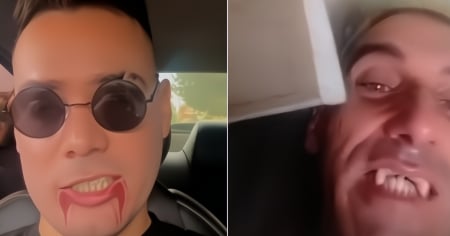
The comments generated by the "Vampirach" phenomenon on Instagram and Facebook have revealed a polarized society regarding the role of Sandro Castro as a public figure.
At least four main currents can be grouped together:
1. The unexpected charisma
A portion of the audience, particularly the younger generation, has started to see Sandro as a charismatic, even popular, figure.
For many, his extravagance and boldness make him relatable: “He has more common touch than Canel and without security,” they comment.
"With that charisma, Fidel Castro deceived an entire country"; "Camilo was made to disappear because he had more grassroots support than Fidel. Take care, Sandrito," others express.
2. Social and political criticism disguised as spectacle
Some users interpret his videos as political satire.
There are even those who see a veiled message in it: "Incredibly, he is winning people over with his nonsense and subliminal messages."
Others believe that there is an intention to provoke and insinuate criticism of the system from within, though without fully committing to it.
3. Frontal rejection and fatigue
Not everyone celebrates it. A significant portion of internet users expresses outrage at what they consider a frivolous and even offensive spectacle.
"The most beautiful thing is that the very people who complain about blackouts and hunger are the ones supporting him and laughing at his antics," lamented one user.
"Asere no, this is no longer funny, please, enough already"; "The people are ready for every abnormality"; "We deserve what we have," have been other reactions.
Many agree that Sandro is mocking the people and criticize both the protagonist and those who support him.
4. The Theory of the "Political Circus"
Another line of thought suggests that everything could be part of a strategy by those in power: allowing Sandro to put on his show as a smokescreen to entertain the population.
“He is a well-placed buffoon,” they denounce.
“If you want to help, distribute food, not beer,” they add, referring to what the average Cuban really needs.
Others go even further: “Then they say that the one profiting from the people's misery is Otaola, but the dictator's grandson comes down from his throne and people laugh at his jokes.”
Sandro for president?
In recent months, the frenzied idea of a Sandro Castro becoming president has sparked a flurry of reactions, ranging from mockery to unease.
"If Díaz-Canel was appointed, why not Sandro?" some say.
Others see it as a continuation of the same power with a different face.
“Maybe he'll do better things for this country,” some say, while others warn: “That crazy person is looking for what is in abundance in this country… and it’s not food.”
Some more cynical users suggest that his fate is already sealed: “At any moment they will make him disappear... dictatorships do not accept competition.”
For others, it's just part of the show: "A regular Cuban would already be in jail for this."
“All empires had their circus… and this one has little time left on the throne. Enjoy the show while you can,” states an internet user.
Despite his last name and the lineage from which he comes, Sandro Castro seems to distance himself from power through satire, exaggeration, and absurdity.
His character in "Vampirach" breaks away from the solemnity of the official discourse and navigates an ambiguous area between criticism and spectacle, a realm few members of his family have dared to enter publicly.
Even within sectors close to the government, his figure generates discomfort: the criticisms he has received from figures linked to the official line not only highlight this unease, but also confirm that Sandro represents a disruptive element within the symbolic machinery of power.
In a context where loyalty is expected unconditionally, her carefree performance becomes a rarity that unsettles both opponents and supporters of the regime.
Frequently Asked Questions About Sandro Castro and His Impact in Cuba
Who is Sandro Castro and why is he causing such a stir in Cuba?
Sandro Castro is the grandson of the late Cuban dictator Fidel Castro and is known for his eccentric videos and performances that often provoke mixed reactions on Cuban social media. His actions, often seen as a mockery of the Cuban people, are perceived as a deliberate provocation and a symbol of the ruling elite's disconnection from the reality of the country.
What type of content does Sandro Castro produce and what is its purpose?
Sandro Castro produces content that blends absurd humor, provocation, and ostentation of his privileged lifestyle. The purpose of his content seems to be to generate visibility and provoke reactions, both mockery and outrage, in a context where his figure is used as a distraction from the regime, diverting attention from the severe economic and social situation facing Cuba.
Do Sandro Castro's actions have any political impact in Cuba?
The actions of Sandro Castro are viewed by some as a form of satirical and veiled criticism of the Cuban regime, although without making direct commitments. However, for others, his actions are merely a frivolous and offensive spectacle that reinforces the perception of impunity among the Cuban elite. In any case, his figure serves to polarize public opinion and keep media attention away from more pressing issues.
How does the Cuban people react to the videos of Sandro Castro?
The reactions of the Cuban people to Sandro Castro's videos are varied. Some see his videos as an act of mockery and provocation, while others view them as a distraction or political satire. There are those who feel that his actions demonstrate the disconnection and disdain of the elite for the suffering of the people, while others simply see it as absurd entertainment.
Filed under: