
Related videos:
The Vietnamese company Agri VMA reportedly expressed concerns in a letter addressed to the Cuban government regarding the inability to access its funds in Cuba.
According to 14 y Medio, Agri VMA reportedly sent a letter to three Cuban ministers to "explain the urgent need to access their funds frozen in an account at the International Financial Bank."
14 y Medio, which had access to the document, reports that the Vietnamese company was attempting to transfer 300,000 dollars to its headquarters in Vietnam.
The letter, dated May 28, 2024, was sent to the Minister of Economy and Planning Joaquín Alonso Vásquez, as well as to the Ministers of Agriculture and Foreign Trade, Ydael Pérez Brito and Oscar Pérez-Oliva Fraga.
The company claimed that it needed the funds to "purchase raw materials and ensure a seamless continuation of our services."
"As you are well aware, due to logistics issues, a few months ago we had to reduce our production activity to 10% because of a lack of raw materials. Maintaining stable and efficient production for both parties is our top priority. However, we understand that unforeseen circumstances or oversights can sometimes lead to delays. With this in mind, I request your support and assistance," reads the document.
Agri VMA recalled that "it has been actively working since 2022 as an animal feed manufacturer in Cuba, with a future plan to establish a factory with a capacity of 30,000 tons of feed per year in the Mariel Special Development Zone."
"The transfer is vital, as it allows us to maintain the high level of service we strive to provide. We highly value the benefit we bring to the collaboration and look forward to your help and support in resolving this matter," they added.
14 y Medio could not verify whether the transfer was ultimately completed.
Last Wednesday, Vietnamese Foreign Minister Bui Thanh Son “called on Cuba to continue coordinating efforts to eliminate difficulties and obstacles, creating favorable conditions for investment and business for Vietnamese companies” on the island.
The statements took place in Hanoi during a meeting between the head of Vietnamese diplomacy and the First Deputy Minister of Foreign Affairs of Cuba, Gerardo Peñalver, according to the official Vietnamese agency.
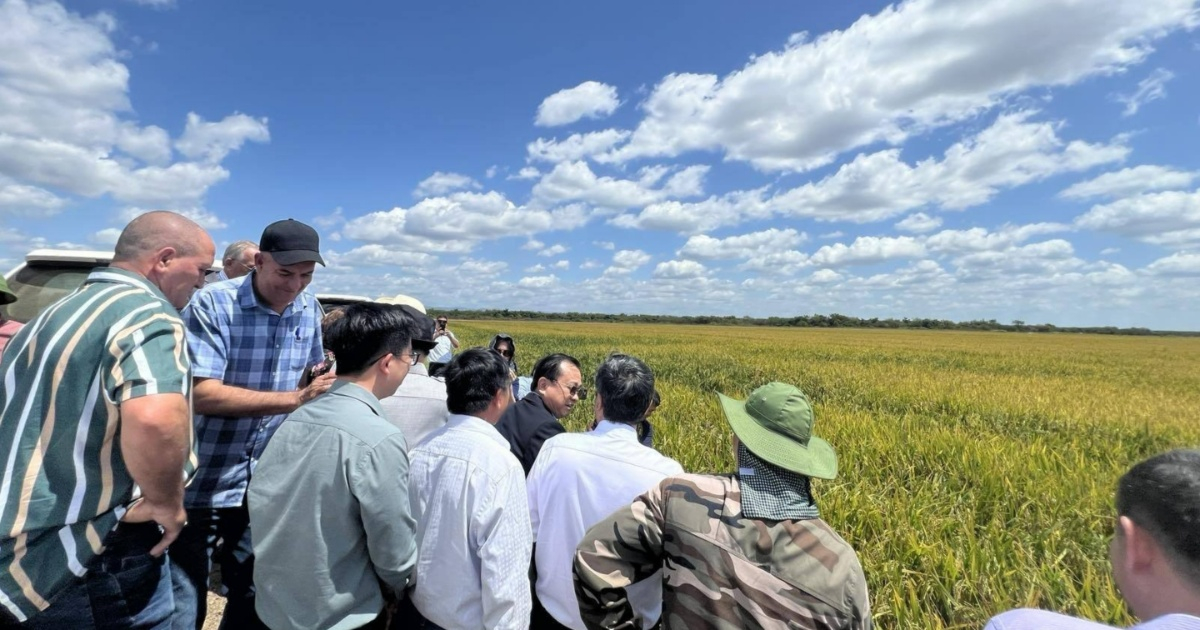
In April, it was announced that Agri VMA became involved in an agricultural project in the municipality of Los Palacios, in the province of Pinar del Río, aiming to cultivate 1,000 hectares of rice.
The Vietnamese company, along with its Cuban partners, aims to turn the region into a high-tech rice production zone, in yet another attempt by the regime to produce food in a country already suffering from extreme poverty.
The project began to take shape in 2023, when Agri VMA assessed the climatic conditions, soil quality, and agricultural infrastructure in Cuba. Although the selected lands face challenges such as erosion and nutrient deficiency, factors like water availability, mechanized planning, and the technical expertise of the farmers made Cubanacán the ideal location for establishing the crop.
As of now, 871 hectares have already been planted, and it is expected to reach the goal of one thousand by the end of May. In an initial phase, 16 hectares were harvested out of season with a yield of 6.5 tons per hectare, a result that the Vietnamese side considers promising.
Frequently Asked Questions about Vietnamese Investment in Cuba and the Economic Crisis
Why did the Vietnamese company Agri VMA complain to the Cuban government?
The Vietnamese company Agri VMA has complained to the Cuban government about the inability to access its frozen funds at the International Financial Bank. This situation has impacted its ability to transfer $300,000 to its parent company in Vietnam, which is necessary for purchasing raw materials and sustaining its production in Cuba.
What impact does the Cuban economic crisis have on agricultural projects such as Agri VMA?
The Cuban economic crisis, characterized by a lack of supplies, fuel, and machinery, has hindered the implementation of agricultural projects such as Agri VMA. Despite these challenges, the Vietnamese company has made significant progress in rice planting in Pinar del Río, demonstrating the importance of international cooperation to overcome the limitations of the Cuban context.
What is the current situation of rice production in Cuba?
The rice production in Cuba is in crisis, reaching only 30% of what was harvested in 2018, which has exacerbated the dependency on imports. Projects like Agri VMA in Pinar del Río are attempts to revitalize national production, while international donations, such as those from Vietnam, help to alleviate the cereal shortage in the country.
What measures is the Cuban government taking to improve the economic situation?
The Cuban government is attempting to implement urgent measures to correct economic distortions, including the restructuring of organizations, support for the non-state sector, and the creation of joint enterprises with foreign investment. However, the lack of deep reforms and economic centralization continue to limit sustainable development.
Filed under: