
Related videos:
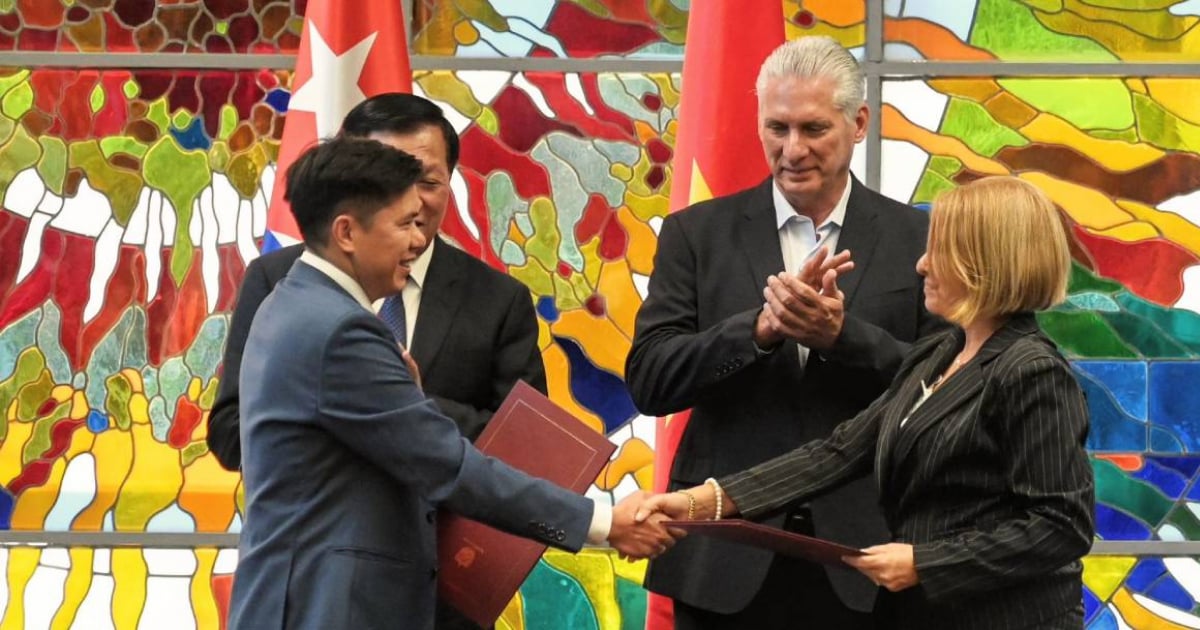
The Cuban regime announced this Monday the creation of a new biopharmaceutical joint venture with Vietnam, at an event led by the leader Miguel Díaz-Canel and the Deputy Minister of Health of the Socialist Republic of Vietnam, Do Xuan Tuyen.
The binational company was formally established following the signing of an agreement between BCF S.A., part of the state group BioCubaFarma, and the Vietnamese firm Genfarma Holdings, during a ceremony held in the "Sol de América" hall at the Palace of the Revolution.
The Cuban leader stated that this agreement "marks a milestone in business and economic-commercial relations" with Vietnam and represents another step in the consensus reached with the General Secretary of the Communist Party of that country, To Lam, during his visit to Havana in 2024.
The President of Cuba stated that the project will have “mutual benefits” and will enable, in an undetermined future, the production of medicines for both nations.
Technological transfer and export vision
The president of BioCubaFarma, Mayda Mauri Pérez, detailed that the new company will focus on technology transfer for the production of medications and biological products, as well as promoting research and development activities in Vietnam.
"The alliance will allow the export of products manufactured in our country, with the purpose of generating income that will be used for the development and production of medicines for the Cuban population," said Mauri Pérez.
Both parties aim for an international projection of the new company, with exports to other countries in Asia and around the world.
Export of medications in Cuba?
The shortage of medicines has reached alarming levels in Cuba. In December 2024, the regime acknowledged that there is a shortage of over 70% of essential drugs in the country.
However, the Cuban authorities have announced that the strength of the newly established joint venture will be the export of medicines, to raise the funds needed to produce those that will be used by Cubans. They apply the same line of reasoning as for the foreign currency generating stores.
Official reports indicate that, of the 651 products that make up the Basic Medicine List in Cuba, 461 are currently completely unavailable or have low availability.
An asymmetric cooperation amidst poverty in Cuba
The announcement of the regime's new venture occurs alongside another joint project between Cuba and Vietnam, this time in the agricultural sector.
It concerns the cultivation of rice in the municipality of Los Palacios, in Pinar del Río, where the Cuban government granted land to a Vietnamese company, Agri VMA, to grow up to 1,000 hectares of the grain.
As this technological and business alliance consolidates, the Cuban population is facing one of the worst food crises in decades, marked by chronic shortages of basic products, a collapse in agricultural production, and an almost total dependence on imports that the country can no longer sustain.
The land allocation to foreign companies for rice production contrasts sharply with the neglect of the Cuban countryside, where thousands of hectares remain unused due to a lack of fuel, machinery, fertilizers, and effective state support.
Paradoxically, some of the rice harvest may end up going to other markets, instead of alleviating the hunger that millions of Cubans are suffering.
Official rhetoric vs. internal realities
This Monday, the Vietnamese deputy minister described the signing of the pharmaceutical agreement as an "honor" and expressed gratitude for the meetings held with Cuban authorities, including representatives from CECMED, the drug regulatory agency.
It also highlighted key areas of cooperation such as family medicine and the prevention of maternal and child HIV.
The optimistic rhetoric contrasts sharply with the actual situation of the Cuban biopharmaceutical industry, which has seen its productive capacities diminished due to a lack of supplies, updated technology, and funds to keep its plants operational.
The creation of a joint venture with Vietnam in the biopharmaceutical sector is part of the Cuban regime's strategy to seek foreign investment in specific areas, while still failing to provide effective solutions to the most urgent needs of the population.
Frequently Asked Questions about the Biopharmaceutical Alliance between Cuba and Vietnam
What is the main objective of the new biopharmaceutical joint venture between Cuba and Vietnam?
The new joint venture between Cuba and Vietnam will focus on technology transfer for the production of medicine and biological products. Additionally, it will promote research and development activities in Vietnam, with the intention of exporting products manufactured in Cuba to generate necessary income for the production of medicines intended for the Cuban population.
How will Cuba and Vietnam benefit from this biopharmaceutical alliance?
The project aims to bring "mutual benefits" to both nations. Cuba will be able to export its pharmaceutical products, generating revenue that will be used to develop and produce medications for its population. Vietnam, for its part, will have access to advanced technologies and biopharmaceutical products, in addition to strengthening its economic and commercial relationship with Cuba.
What impact does this alliance have in the context of medication shortages in Cuba?
The alliance aims to generate income through exports in order to then produce medications for the Cuban population, despite more than 70% of essential medicines being in short supply on the island. This reflects a strategy similar to that of foreign exchange stores, prioritizing income generation over directly addressing the internal shortage of medications.
What other cooperation projects exist between Cuba and Vietnam in the agricultural sector?
In addition to the biopharmaceutical project, there is an agreement between Cuba and Vietnam for rice cultivation in the municipality of Los Palacios, Pinar del Río. This project aims to transform the region into a high-tech rice-growing area, although it faces challenges due to the food crisis in Cuba and reliance on foreign inputs and technology.
Filed under: