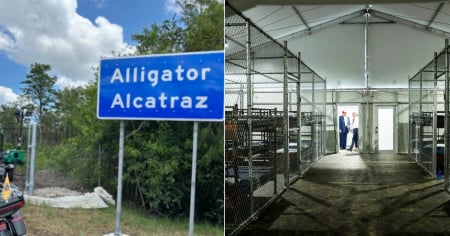
The United States has deported nearly 500 migrants from the detention center Alligator Alcatraz, which has become a key location for aerial deportation operations.
This was confirmed on Tuesday by Florida Governor Ron DeSantis, who highlighted the new strategic role of the facility, located in an abandoned former airport amidst the Everglades.
“They have deported more than 100 (directly) from there, and they have also flown 300 or 400 more from there who have already been deported or are waiting for their deportation from other places in the United States. So it's like a hub,” DeSantis explained during the Florida Sheriffs Association summer conference.
A central hub for deportation from U.S. soil
The center, operated in coordination with the Department of Homeland Security (DHS), allows for the direct deportation of individuals detained in Florida, but also their transfer to other states to be reorganized and boarded on final flights.
“If they are from six or seven different countries, they are moved to other states, such as Louisiana, where they are segregated based on their country to be placed on other flights”, the governor detailed.
The facility, inaugurated by President Donald Trump on July 3rd, was repurposed as a migrant center by the state government after being unused for years.
Today, with a capacity for 2,000 people—which will expand to 4,000—it operates as another gear in the border control apparatus in the United States.
DeSantis defends the strategy as a deterrent measure
The Republican governor justified the increased pace of deportations as an essential element to curb irregular immigration in the state
"Increasing the pace of these flights with deportations is beneficial for Florida because it will serve as a significant deterrent," he noted, also reaffirming his willingness to expand detention infrastructure.
The governor stated he is ready to establish another immigration center at Camp Blanding, a National Guard base in the north of the state, although he clarified that he will not do so “until there is a steady pace” of deportations from Alligator Alcatraz.
DeSantis also noted that between 50,000 and 80,000 migrants in Florida already have a final deportation order, positioning his state at the forefront of the immigration policy promoted by the Trump Administration.
Lawsuits and complaints regarding inhumane conditions
The migration operation is not without controversy.
Two federal judges have requested details from the federal and state governments regarding the management of the center, in the context of two active lawsuits: one filed by advocates for migrants' rights and another by environmental organizations.
Both complaints agree that the authorities have not clarified who is ultimately responsible for Alligator Alcatraz, which would allow them -as they argue- to evade legal obligations regarding environmental issues and human rights.
Meanwhile, the center has been the site of protests.
Dozens of activists and families of detained migrants protested last week in front of their facilities, labeling it a "concentration camp" and a "dog cage."
Since its opening, civil organizations have documented at least 1,000 detentions, with six individuals hospitalized for various reasons.
Frequently Asked Questions about the Alligator Alcatraz Detention Center and Deportations in Florida
How many migrants have been deported from the Alligator Alcatraz center?
From the Alligator Alcatraz detention center, nearly 500 migrants have been deported. Of these, over 100 have been deported directly from the center, while between 300 and 400 have been transferred for deportation from other locations in the United States.
What role does Alligator Alcatraz play in Florida's migration strategy?
Alligator Alcatraz serves as a central node for deportation from U.S. soil. This center enables the direct deportation of individuals detained in Florida and their transfer to other states for reorganization and boarding on deportation flights. Furthermore, it is part of Governor DeSantis's deterrence strategy to curb irregular immigration.
What are the main criticisms of the Alligator Alcatraz center?
The center has been heavily criticized for inhumane conditions and its environmental impact. Human rights organizations and environmentalists have reported that the center was built without proper environmental assessments and that detainees face inhumane conditions. Furthermore, its location in the Everglades, an ecologically sensitive environment, has raised significant concerns.
What future plans are there for the immigration detention infrastructure in Florida?
Governor DeSantis has expressed his intention to expand the immigration detention infrastructure in Florida. Although there are currently no immediate plans to build another center until Alligator Alcatraz is operating at full capacity, DeSantis has mentioned the possibility of establishing a new center at Camp Blanding, depending on the pace of deportations.
Filed under: