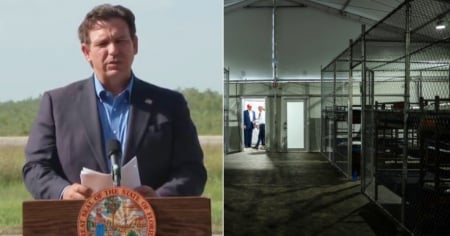
A group of attorneys has requested a federal judge to intervene immediately regarding what they describe as a massive violation of rights, after hundreds of immigrants were detained at the immigration detention center known as Alligator Alcatraz without formal charges, without access to court hearings, and with no federal court acknowledging jurisdiction over their cases.
The center, located on a remote airstrip in the Everglades in the state of Florida, and set up in just eight days at the order of the Republican governor Ron DeSantis, has operated for nearly a month as a sort of legal gray area, where judicial authority and federal responsibility are not recognized.
According to the lawyers, the situation is "unprecedented" and leaves the detainees "isolated and unable to attend court," reported the newspaper Miami Herald.
Organizations like the American Civil Rights Union Foundation and Americans for Immigrant Justice have filed a lawsuit demanding that the Department of Homeland Security identify which court has jurisdiction and disclose any legal agreements that allow the existence of this center.
It is reported that the judges of the immigration court at Krome in Miami are canceling hearings because they lack authority over the detainees, and that the ICE agents themselves are distancing themselves from all responsibility.
The lack of responses has left lawyers searching for solutions. Anna Weiser, the legal representative of two migrants with valid visas, stated that their bond hearing was canceled and that ICE asked her to write directly to the camp, but she received no response at all.
One of its clients was transferred without prior notice to an ICE facility in Louisiana, where he is awaiting deportation, the news outlet reported.
Another similar case is that of G.T.C., a Guatemalan with no criminal record and an asylum application in process. He was detained by state agents while fishing in the Everglades, despite showing documents that prove he is legally undergoing immigration procedures. His hearing was suspended because the court claimed it did not have jurisdiction over detainees at Alligator Alcatraz.
"I don't understand what the legal basis for their detention is," stated their lawyer Zareefa Khan, questioning whether they are truly in federal custody.
The federal government has not publicly responded to the allegations. Meanwhile, Florida's Division of Emergency Management pledged to begin offering on-site legal services this Monday, nearly a month after opening the facility. Too late for many, and without clarifying under what legal framework they operate.
Federal Judge Rodolfo A. Ruiz II must decide whether to compel the government to disclose the chain of command and legally justify the existence of the center.
For the lawyers, the case is clear: "Florida cannot operate an independent immigration detention system without federal oversight. It cannot hold people in detention without charges or access to courts." The question that remains unanswered is who is really in charge.
On Friday, DeSantis confirmed that the United States government had begun to carry out air deportations of irregular migrants from Alligator Alcatraz, and has been doing so for days, although he did not provide details about the nationality of the deported individuals or how many flights have departed from the center.
He noted that the administration of President Donald Trump ordered the expulsion of approximately 800,000 people, of which between 50,000 and 75,000 resided in Florida.
According to various local sources, a significant proportion of the migrants in the detention center are of Cuban nationality. Specifically, it was revealed that more than half were from Cuba, Mexico, and Guatemala.
However, a recent report indicated that some of them had been transferred to other immigration detention centers, which has created uncertainty regarding their legal situation and final destination.
“Either deport us or release us. If not, we want a fair process. We are treated here worse than undocumented immigrants,” recently stated to the television network Telemundo Aris Reyes, a Cuban held at Alligator Alcatraz, detained for driving without a valid license.
This week, the case of another Cuban migrant: Pedro Lorenzo, father of three American citizens came to light, who had already served a sentence for an offense committed in the past.
On July 8, he voluntarily reported to the Immigration and Customs Enforcement (ICE) office in Miramar for a routine check; since then, he has been detained without new charges and without legal information.
A legislative report characterized it as a "detention camp," with severe violations of human rights, including extreme overcrowding, inadequate food, stifling heat, lack of drinking water, and poor medical assistance.
A visit from Democratic congress members on July 12 revealed infested mattresses, collapsed bathrooms, internal temperatures between 83 and 85 degrees, and food portions that were "insufficient and unhealthy."
Frequently Asked Questions about the Legal Situation and Human Rights in Alligator Alcatraz
Why are illegal detentions being reported in Alligator Alcatraz?
Detentions at Alligator Alcatraz are deemed illegal because they are being carried out without formal charges, access to court hearings, or recognition of jurisdiction by any federal court. This has resulted in a massive violation of rights, as reported by lawyers and human rights organizations.
What are the conditions of the detainees in Alligator Alcatraz?
The conditions in Alligator Alcatraz are described as inhumane and degrading, with extreme overcrowding, inadequate food, stifling heat, lack of drinking water, and poor medical assistance. Detainees face difficulties in communicating with the outside world and receiving appropriate legal counsel.
What legal actions are being taken against Alligator Alcatraz?
Multiple legal actions have been filed against Alligator Alcatraz, alleging human rights violations and lack of access to legal counsel. Organizations such as the ACLU and Americans for Immigrant Justice are seeking to have the federal government justify the existence of the center and ensure due legal process for the detainees.
What nationalities are predominant among the detainees in Alligator Alcatraz?
Most of the detainees at Alligator Alcatraz are from Cuban, Mexican, and Guatemalan nationalities. More than 55% of those detained come from these countries, but there are also individuals from more than 40 different nationalities.
What environmental impact does the Alligator Alcatraz detention center have?
The Alligator Alcatraz detention center was built in an ecologically sensitive area without an adequate environmental review, raising concerns about its impact on the Everglades ecosystem. Environmental organizations have filed lawsuits to halt its operations due to the threat it poses to the natural environment.
Filed under: