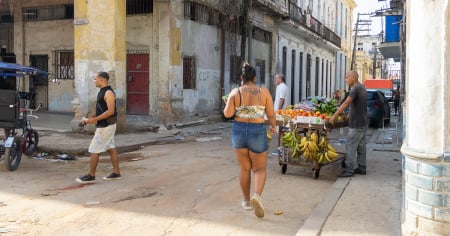
A Cuban has set social media ablaze with a viral video that depicts, with painful irony, the daily struggle of millions on the island: hunger.
Under the username @darlinmedina931, the young woman poses a question that many avoid answering directly: "What about the protein? What's the main dish today?", and then concludes with a heartbreaking sense of humor: "Well, nothing, the one made of ceramics, which is very strong. The plastic."
Although it may seem like a joke, the message resonates deeply with those who understand the Cuban reality, where empty plates are common, refrigerators contain more air than food, and entire families eat poorly or simply do not eat.
“To have a main course here, you have to go to Sabines, look for a white totí that doesn’t eat rice and sings like a rooster,” the young woman jokes with bitter laughter.
Darlin's words are not an exaggeration. According to the Cuban Observatory of Human Rights (OCDH), 89% of Cuban families live in extreme poverty.
In its VII Report on the State of Social Rights in Cuba for 2024, it revealed that 7 out of 10 Cubans have stopped having breakfast, lunch, or dinner due to a lack of money or food. Among those over 70 years old, this figure rises to 79%.
Even worse, only 15% of Cubans manage to have three meals a day.
And it's not that there's a lack of food in the world; it's that salaries in Cuba are not enough to even survive. The Cuban Observatory of Citizen Audit (OCAC) estimates that at least 30,000 pesos a month are needed for food, but the minimum wage barely reaches 2,100 CUP, and the lowest pension, which authorities say will increase in September, will be 3,056 CUP. The math doesn’t add up.
"We survive with whatever comes our way."
In the comments on the OCAC survey, many Cubans claimed that living in Cuba costs between 70,000 and 100,000 pesos per month, just for basic food.
“When it comes to food, the Cuban does not eat, eats poorly, that is, barely survives,” commented a user on social media. Another was straightforward: “Every day prices go up as if it were an auction and nobody in the government is doing anything.”
Meanwhile, the government prioritizes tourism over agriculture, allocating 13 times more budget to the former than the latter, according to the report “Without land, there is no country, and with GAESA, there is no future”.
Today, a carton of eggs can cost more than 3,000 pesos, and a package of chicken can go up to 4,000. And since May, eggs haven't even been available on the ration card. The “bodega,” which was once a lifeline for Cuban families, is now an echo of broken promises.
A doctor on maternity leave shared that she needs two months' salary to buy a can of powdered milk for her daughter. How can one survive? With remittances, with bartering, through the black market, or by skipping meals.
Frequently Asked Questions about the Food Crisis in Cuba
What is the current situation of hunger in Cuba?
The hunger situation in Cuba is critical. According to the Cuban Observatory of Human Rights, 89% of families live in extreme poverty, and 7 out of 10 Cubans have stopped having breakfast, lunch, or dinner due to lack of money or food. Only 15% of Cubans manage to eat three meals a day.
How much money is needed to cover basic food expenses in Cuba?
According to the Cuban Citizen Audit Observatory (OCAC), at least 30,000 Cuban pesos per month are needed for basic nutrition. However, many Cuban people believe that this calculation is conservative, and estimate the actual cost to be between 70,000 and 100,000 pesos per month, due to inflation and the constant rise in prices.
What role does the Cuban government play in the food crisis?
The Cuban government is identified as one of the main culprits of the food crisis. The centralized economic model and the prioritization of tourism over agriculture have stifled local production and increased dependence on imports, which, along with corruption, has worsened the supply shortages in the country.
How do Cubans survive amid the economic crisis?
In the face of the economic crisis, Cubans survive on remittances, bartering, and the black market. Many rely on external assistance, seek food in the informal market, or simply stop eating to save what little they have. Additionally, 60% of households spend all their monthly income on food.
What measures are being proposed to address the food crisis in Cuba?
The Cuban Observatory of Citizen Audit (OCAC) proposes structural measures such as dismantling the GAESA monopoly and liberalizing agricultural trade to stimulate local production. It is also suggested to open the economy to investments from the diaspora and promote agricultural development banking, in addition to enacting deep political changes to ensure a stable food supply.
Filed under: