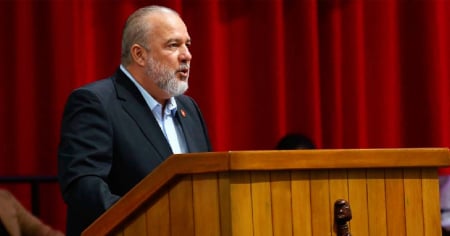
The Cuban Prime Minister, Manuel Marrero Cruz, addressed the National Assembly regarding the resignation of the Minister of Labor, Marta Elena Feitó Cabrera, following the scandal sparked by her comments on poverty in Cuba.
Marrero mentioned that he and other senior officials went to the Ministry of Labor and Social Security on Tuesday, where the minister acknowledged her "error."
"I was wrong, and I was wrong about what I should never have been wrong about, and I don't feel capable of holding myself up as a figure at the head of a ministry," she admitted, according to Marrero.
The Prime Minister described the leader's attitude as "brave."
"It was a minister who has worked hard," he added, insisting that in recent years, Feitó has proposed and defended policies in favor of vulnerable people.
Marrero stated that the ministry's board of directors agreed with the minister's departure, while still acknowledging her merits, but understood "the need to carry out that movement," and insisted that "it is she who requests her release."
However, during his speech before Parliament, he attempted to distance the government from his most controversial statements.
"What the colleague proposed does not align with the government's policy," he asserted.
Although the presence of beggars on the streets of Cuba is an undeniable reality, the official reiterated that the government has established procedures for "caring for individuals with wandering behaviors."
He also stated that "this issue is a real problem, it exists; we cannot wrap it in velvet or sweeteners" and promised that not only will attention be given to it, but efforts will also be made to "resolve" it.
Her words contrast sharply with the daily reality of thousands of Cubans who face hunger, unemployment, and live on the streets without medical care or state assistance.
In all provinces, it is common to see people rummaging through garbage or sleeping in doorways, and complaints about the neglect of the elderly and the sick are increasing.
What the minister said and the public reaction
Marrero's intervention comes after the tsunami of outrage provoked by Feitó Cabrera, who during a parliamentary commission last Monday denied the existence of beggars in Cuba.
According to her, people who beg, wash windshields, or rummage through trash cans do so by "choice," because they "prefer an easy life" to working.
"They're disguised as beggars," he said, describing them as "illegal self-employed workers."
His statements not only denied the widely visible poverty throughout the Island but also criminalized indigence, leading to massive rejection both domestically and internationally.
Hours after her words, the minister submitted her resignation, which was quickly accepted by the Political Bureau of the Communist Party and the Council of State. An official statement accused her of acting with "a lack of objectivity and sensitivity."
Late official reaction
The leader Miguel Díaz-Canel, without directly mentioning the minister, reacted the next day stating that "none of us can act with arrogance, disconnected from the realities our people are experiencing."
Marrero, for his part, tried to minimize the damage insisting that "caring for vulnerable individuals has always been and will always be a priority of the Revolution."
However, many interpreted those statements as part of a political containment effort, more focused on protecting the government's image than on taking concrete responsibilities.
The official's statements were widely rejected by intellectuals, activists, artists, and citizens, who denounced her lack of empathy and disregard for the most vulnerable sectors of society.
The economic crisis, inflation, the lack of food and medicine, and rising inequality have left millions of Cubans in a state of extreme precariousness.
In fact, the Cuban Observatory for Human Rights estimates that 89% of households live in extreme poverty, and the minister herself acknowledged in February of this year that more than 1,200 communities in the country live in conditions of misery.
Despite official speeches, in the streets of Cuba, poverty is not a theory or a communication error: it is a daily reality.
Frequently Asked Questions about the Resignation of the Minister of Labor in Cuba and the Social Crisis
Why did the Minister of Labor and Social Security of Cuba resign?
Minister Marta Elena Feitó Cabrera resigned following the outrage caused by her statements in which she denied the existence of beggars in Cuba and criminalized people who are homeless. Her words provoked widespread rejection both domestically and internationally, leading to her resignation, which was accepted by the Political Bureau of the Communist Party of Cuba and the Council of State.
How did the Cuban government respond to the minister's statements about poverty?
The Cuban Prime Minister, Manuel Marrero, described the resignation of the minister as courageous, but he attempted to distance the government from her statements, asserting that Feitó's words do not align with government policy. President Miguel Díaz-Canel also issued a vague criticism regarding the lack of sensitivity in handling vulnerability, without directly mentioning the minister.
What was the public reaction following the minister's statements about homelessness in Cuba?
The minister's statements sparked a wave of outrage and rejection both on social media and among intellectuals, activists, and ordinary citizens. Many criticized the government's disconnection from the reality of poverty in Cuba, and campaigns were organized to demand the minister's dismissal and effective policies to address the social crisis.
What measures has the Cuban government promised to address poverty and homelessness?
The Prime Minister Manuel Marrero stated that the government has ongoing procedures for supporting vulnerable individuals and that the care of vulnerable people has always been and will continue to be a priority of the Revolution. However, there have been no specific announcements regarding new policies or programs to address the issue of homelessness in Cuba.
What is the current situation of poverty in Cuba according to independent organizations?
According to the Cuban Observatory of Human Rights, 89% of households in Cuba live in extreme poverty. The economic situation on the island is critical, with shortages of food and medicine, and growing inequality affecting millions of Cubans, especially the most vulnerable sectors such as retirees and the elderly.
Filed under: