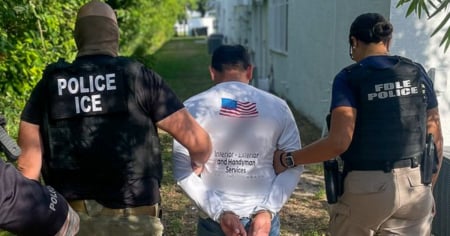
Joaquín Palacios Juncal, an undocumented Cuban immigrant in the United States with an extensive criminal record, was arrested last week by the Immigration and Customs Enforcement (ICE).
“Another child abuser off the streets of America!” warned the Department of Homeland Security (DHS) on its official account on X, announcing the arrest of Palacios, whom it described as a “serial offender” due to his extensive criminal record.
His extensive history includes everything from aggravated child abuse to cocaine possession, assault, possession of a controlled substance, aggravated assault with a deadly weapon, domestic violence, and harassment.
Although the publication does not indicate it, once in ICE custody, Palacios will face a process that will culminate in his deportation from the country, as the Trump administration is doing with the tens of thousands of illegal immigrants with criminal records who have been detained since January.
Mass arrests of undocumented migrants, led by ICE and conducted in coordination with other federal and state agencies and law enforcement, have exceeded 149,000 in just seven months.
Of these, around 50,000 were carried out only in the last eight weeks, representing a drastic acceleration of operations since May, when the White House reprimanded ICE for not acting with enough severity, the newspaper Washington Examiner reported on Friday.
According to the cited statistics, between January and April, a total of 68,714 arrests were made, while there were significant increases in May (25,645), June (34,962), and the first half of July (more than 19,000). The figures represent an average of over 700 arrests per day, double that during the administration of Joe Biden, according to the Migration Policy Institute.
On its part, ICE confirmed in a brief post on X that "the arrests and deportations of illegal criminal immigrants will continue," without making any distinction between offenders and individuals who have not regularized their legal status in the country.
In recent weeks, DHS has intensified its crackdown on arrests in immigration courts, workplaces, and public spaces, generating fear and frustration among immigrant communities that came to the U.S. in search of opportunities and freedom.
In the case of Cubans, the drastic tightening of migration policy by the Trump administration since January has left thousands in a migration limbo, following the elimination of the humanitarian parole, the cancellation of CBP One, and the end of the "catch and release" policy at the border.
Meanwhile, Cubans with irregular status—many of them under the I-220A and B programs—but with no criminal record or final deportation order, have been arrested and confined in the controversial detention center Alligator Alcatraz, located in the Everglades, west of Miami-Dade, from where they are to be deported.
But the arrests have also included a significant number of Cuban citizens with serious criminal convictions or pending criminal charges in the U.S., described as “the worst of the worst” and considered “a threat to public safety” in the country. Some of them have a final deportation order.
According to DHS statistics, there are more than 42,000 deportable Cuban citizens who remain in the U.S. under supervised release or are held in detention centers.
However, the government of Havana refuses to accept Cubans with criminal records in the U.S. or those who have been outside their country since before the migration agreements of January 2017.
Due to the reticence of the Cuban regime, the U.S. government has begun to deport citizens from the island to third countries. Recently, three ineligible Cubans with extensive criminal records were sent to South Sudan and the Kingdom of Eswatini in Africa, while an unspecified number have been transported on deportation flights to Mexico.
As part of the existing bilateral migration agreements between Havana and Washington, last Thursday marked the seventh air deportation operation to Cuba conducted by the Trump administration this year, during which 118 individuals were returned.
With this flight, the total number of 583 returned Cuban immigrants to the island by air has exceeded since the beginning of President Donald Trump's second term, according to figures published by the site CaféFuerte.
Frequently Asked Questions about Arrests and Deportations of Cuban Immigrants in the U.S.
Why was Joaquín Palacios Juncal arrested by ICE in the U.S.?
Joaquín Palacios Juncal was arrested by ICE due to his extensive criminal record, which includes aggravated child abuse, possession of cocaine, assault, and other offenses. The Department of Homeland Security labeled him as a "serial offender," and his arrest is part of an ongoing effort to remove immigrants with criminal backgrounds from the United States.
What consequences do undocumented immigrants with criminal records face in the U.S.?
Undocumented immigrants with criminal records in the U.S. face arrests, detention, and eventual deportation. Under the Trump administration, the focus has been on removing foreign criminals from the country, even deporting them to third countries if their home nations refuse to accept them.
What is the current situation of Cuban immigrants in the U.S.?
The situation of Cuban immigrants in the U.S. is critical due to the tightening of immigration policies. More than 42,000 Cubans have deportation orders, and many face arrests and detentions. The Cuban government has shown reluctance to take back those with criminal records who have been outside the country since before 2017, leading to deportations to third countries.
How does Trump's immigration policy affect immigrant communities in the U.S.?
Trump's immigration policy has generated fear and frustration among immigrant communities in the U.S. With the increase in arrests and deportations, many individuals feel insecure, especially those without criminal records who are seeking opportunities in the country.
Filed under: