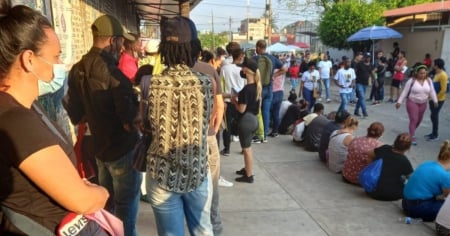
Although the recent resumption of application processing for immigration benefits has brought relief to thousands of Cubans, the humanitarian parole program remains officially revoked in the United States.
The measure announced by the U.S. Citizenship and Immigration Services (USCIS) on June 21 does not signify the return of the program as such, but rather a judicial response that compels the government to complete the processes that were left pending prior to its cancellation.
Since President Donald Trump assumed power again in January 2025, the humanitarian parole —a pathway that benefited over 530,000 people from Cuba, Haiti, Nicaragua, and Venezuela— has entered a realm of intense political hostility.
Only a few hours after his inauguration, Trump signed an executive order revoking the CHNV program, halted new admissions, and ordered the review and cancellation of granted benefits. This included work permits, travel authorizations, and derivative residency applications.
The official announcement was made in March, when the Department of Homeland Security (DHS) published in the Federal Register the revocation of benefits for thousands of migrants. The order set April 24 as the deadline for the validity of documents granted under parole.
From that point on, a period of uncertainty and fear began among the beneficiaries, especially the Cubans, many of whom had not yet completed the required year of residency to qualify for the Cuban Adjustment Act.
USCIS resumes procedures but does not reopen the program
The legal pressure soon arrived. At the end of March, a coalition of beneficiaries and organizations advocating for migration rights filed a lawsuit in the federal court of Boston, demanding that the procedural rights of those who had already entered the U.S. legally through parole be respected.
The federal judge Indira Talwani granted a preliminary injunction that compelled the government to demonstrate that cases were still being processed, despite the general cancellation.
Finally, this Saturday, USCIS informed the court that it had lifted all internal suspensions in its system, and that pending applications would be evaluated and resolved according to the law.
This means that Cubans who were already in the process of adjusting their status —whether through the Cuban Adjustment Act, work permits, or other related avenues— thave the right to have their applications completed. However, humanitarian parole as a migration policy remains canceled, and new applications are not being accepted.
Rights at stake, but under surveillance
According to USCIS, suspended processes have been reactivated in all its offices since June 13. Errors in the phone and virtual assistance system have been corrected, and internal memoranda were sent for agents to resume adjudications.
Nevertheless, the authorities have made it clear that any application indicating possible signs of fraud or risk to national security will be scrutinized more rigorously.
Furthermore, beneficiaries should be aware that this partial reopening is in response to a temporary court order. The lawsuit is still active, and new decisions could change the course of events again.
What can Cubans expect now?
Of the more than 110,000 Cubans who entered the U.S. through the CHNV program, it is estimated that around 20,000 have still not been able to benefit from the Cuban Adjustment Act due to not having met the minimum one-year residency requirement. For them, this reactivation represents an opportunity to make progress, but it does not guarantee permanence.
The DHS has warned that those who do not succeed in regularizing their status may face deportation proceedings. At the same time, the Trump administration retains the authority to issue new regulations that further restrict access to benefits.
A legal path still open, but unstable
In summary, humanitarian parole remains in place only for those who were already in the system. The doors for new applicants remain closed, and those in the process must proceed with caution, ideally with legal advice.
The path is not closed, but it remains narrow and full of uncertainty. The legal battle continues, and with it, the hope of thousands of Cubans to turn their entry through parole into a stable and secure immigration status.
Filed under: