
Related videos:
In the midst of the darkness caused by the prolonged blackouts suffocating the Island, Cubans are reverting to old ways of expressing their discontent through anti-government graffiti.
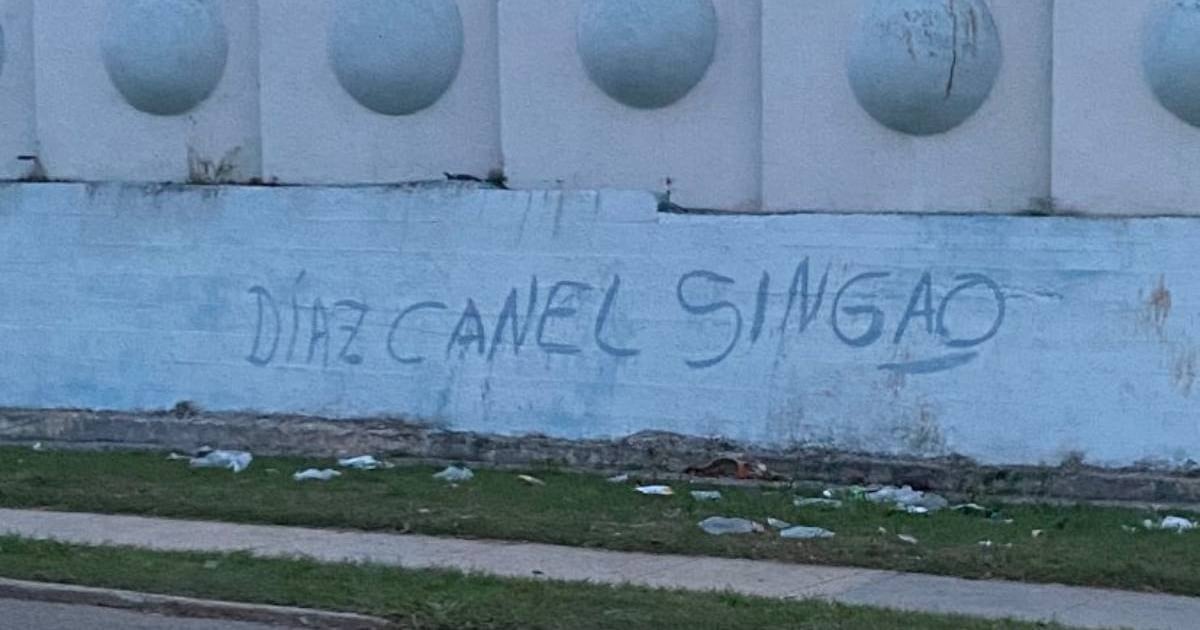
This week, at the intersection of Calle Embil and Sur in Havana, a message was painted on a wall that says "Díaz-Canel Singao," the favored phrase of the opposition on the island.
"If you cut off the power, I'll leave you a little gift. Good morning Cuba, have some coffee, pay your debts, and remember that Díaz-Canel is an idiot," wrote the user @sanmemero on X, alongside a photo of the graffiti.
In another wall, this time in the province of Holguín, the independent 14yMedio reported on the graffiti of the word "Liberty," but with the final "t" added.
The slogan caught attention not only for its political message but also for the spelling mistake at the end of the word.
However, this was interpreted by the neighbors as a sign of urgency and spontaneity.
"Whoever did it probably wrote it just as it sounded in their mind," commented a neighbor who stopped in front of the wall.
Another local explained, “You can't write a word well that is never used.”
The graffiti is part of a growing wave of anti-government messages that have emerged in recent months in various parts of the country, prompted by persistent blackouts lasting up to 20 hours that affect several localities daily.
In mid-June, authorities were compelled to erase at least 20 graffiti from the wall of the Mayabe cemetery, under the watchful eye of Interior Ministry agents and patrol vehicles.
These acts are criminalized under the offense of “enemy propaganda”, which in Cuba can carry a prison sentence of up to 15 years.
Even so, the graffiti multiply like a release valve for a population increasingly desperate due to the crisis and repression.
This Tuesday, the Electric Union of Cuba (UNE) reported a deficit of 1,401 MW in the morning hours and estimates that during the evening peak, there could be a shortfall of up to 1,872 MW, despite the partial activation of engines in the Regla area.
Amidst the repression and censorship, these simple acts—a brush, a wall, and a phrase—have become powerful forms of symbolic resistance.
Frequently Asked Questions about Antigovernment Graffiti in Cuba
Why are anti-government graffiti appearing in Cuba?
The antigovernment graffiti in Cuba is resurging as a form of symbolic protest against the economic crisis, prolonged blackouts, and political repression.
These demonstrations of discontent reflect the growing citizen unrest and the desperation of Cubans due to the difficult living conditions on the island.
What do slogans like "Díaz-Canel singao" and "Down with communism" express?
Expressions such as "Díaz-Canel singao" and "Down with communism" are signs of rejection towards the Cuban government and its political system. These messages have gained popularity as symbols of resistance and social discontent, especially since the protests on July 11, 2021. They represent the desire for change and criticism of the current regime's policies.
What is the response of the Cuban government to these graffiti?
The Cuban government responds quickly by removing the graffiti and increasing surveillance in the affected areas. The authorities regard these actions as "enemy propaganda" and can impose penalties of up to 15 years in prison on those responsible. However, despite attempts at censorship, the graffiti continues to appear as a form of symbolic resistance.
What is the impact of power outages on the daily lives of Cubans?
Blackouts in Cuba have a severe impact on the daily lives of citizens, affecting the operation of basic services, the economy, and overall quality of life. These power outages, which can last several hours, have exacerbated social discontent and led many to express their frustration through graffiti and other forms of protest.
What role do social media play in the spread of these graffiti?
Social media plays a crucial role in the dissemination of anti-government graffiti in Cuba. Through platforms like Facebook and X (formerly Twitter), activists and citizens are able to share images of the graffiti before they are erased by the authorities, keeping the message of resistance and popular discontent alive.
Filed under: