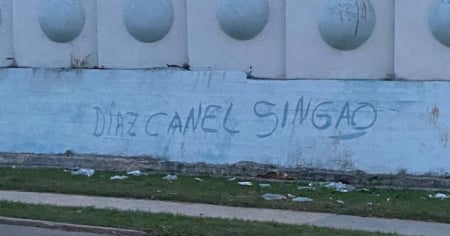
A 31 years of the Maleconazo, the Cuban leader Miguel Díaz-Canel labeled the citizens who took to the streets on August 5, 1994, during one of the largest popular protests in Cuba's history, which occurred amidst the Special Period, as "dark forces."
“Every August 5 reminds us that there will always be dark forces lurking against a genuine Revolution,” he wrote on his official X account (formerly Twitter), alongside an image of Fidel Castro confronting the crowd.
His statement is part of a campaign orchestrated by the regime to reclaim the figure of Castro and neutralize the symbolic weight of the Maleconazo, praising the official response as an act of "unity" and "leadership" in the face of chaos.
But for many Cubans inside and outside the island, that narrative only reopens wounds.
Roberto Morales Ojeda, second in command of the Communist Party, also commented on the matter, along with the official from the Ideological Department Enrique Villuendas, who echoed the triumphalist tone as well and stated on the same social media platform that “on August 5, 1994, there was no need to fire a shot. Neither was there on July 11, 2021.”
The statement triggered a wave of outrage. "Miserable," "false," and "criminal" were some of the responses that flooded his post.
The journalist and researcher José Raúl Gallego strongly refuted this. He recalled that during the 11J protests, gunfire was indeed directed at unarmed protesters, resulting in injuries, arrests, and at least one death. Diubis Laurencio Tejeda was shot in the back in La Güinera. The crime, captured on video, was never investigated independently.
"There were not only gunshots. There were also beatings, arbitrary detentions, and more than 700 people convicted, mostly young individuals, just for asking for freedom," Gallego wrote, citing evidence from the data project Inventario.
Covert repression and safety valve
The regime's narrative tries to whitewash the repression, but history does not forget. On August 5, 1994, thousands of Havana residents took to the streets fed up with misery, blackouts, repression, and the lack of a future. They shouted "Freedom!" and "Down with the dictatorship!" in front of the seawall until the police forces and organized mobs responded with violence.
Many were beaten by shock groups disguised as a "frenzied crowd," such as the Blas Roca Calderío Contingent, and days later, Fidel Castro opened the country's borders in what became known as the Balsero Crisis: over 35,000 Cubans fled in improvised boats toward the United States. Many died at sea.
The message was clear: "If you don't agree, leave."
Today, 31 years later, the causes that motivated the Maleconazo persist and have worsened. The massive exodus, inflation, energy collapse, and the criminalization of dissent are part of the daily landscape for millions of Cubans.
But now, repression has new faces: digital surveillance, online censorship, artificial intelligence to track opponents, and expedited judicial sentences.
The images of mothers crying for their imprisoned children after 11J, the videos of police beating peaceful protesters, and the testimonies of hundreds of exiles refute the official narrative that denies repression.
To try to reduce the Maleconazo to a heroic anecdote about Fidel or to a "counter-revolutionary provocation" is to ignore its deeper root, which is the people's frustration.
Remembering August 5 is not an act of nostalgia, but one of resistance. Because the calls for freedom did not die with the blows, nor were they silenced by the rafters; on the contrary, they resonate every day in the streets, in social media, in prisons, and in the hearts of Cubans who still dream of a different country.
Filed under: