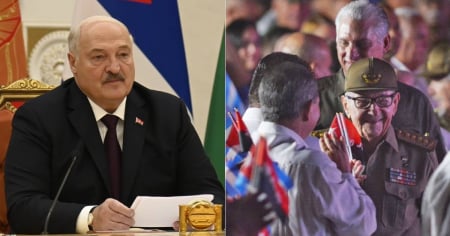
The Chief of the General Staff of the Armed Forces of Belarus and the first Deputy Minister of Defense, Pavel Muraveiko, is on an official visit to Cuba as part of the intensification of military ties between both regimes.
The Belarusian Ministry of Defense confirmed its arrival, although it did not provide details about the agenda or the duration of the trip, as reported by the Belarusian media reform.news.
This new approach is part of a series of high-level exchanges that have characterized the relationship between Havana and Minsk in the past two years.
In January 2024, the Belarusian Defense Minister, Viktor Jrenin, traveled to Cuba and signed a military cooperation agreement with his Cuban counterpart, Álvaro López Miera. The agreement included a bilateral activity plan for 2024 and the potential supply of Polonez missile launchers, with a range of up to 300 kilometers.
Shortly after, in March 2024, another high-ranking Belarusian official visited the Island, which was interpreted as a continuation of the military agreement. In May 2025, the State Military-Industrial Committee of Belarus announced the modernization of S-125 anti-aircraft missile systems belonging to the FAR, upgraded to the Pechora-2BM version by the company ALEVKURP.
The military alliance has also included training programs. By 2023, it had already been announced that Cuban military personnel would be trained in Belarusian territory as part of a strategic project that has been developed in multiple stages.
The strengthening of these ties has been accompanied by diplomatic signals such as the accreditation of the Cuban military attaché in Minsk in January 2025 and the opening of an official residence for the Cuban military diplomatic corps in that city.
Muraveiko's current visit also takes place after the tour that Cuban leader Miguel Díaz-Canel took last June, when he traveled to Belarus to attend the Supreme Eurasian Economic Council at the invitation of Alexander Lukashenko.
In that context, topics of cooperation in defense, energy, and industry were discussed, while the Island was experiencing a severe energy and social crisis.
This new episode reaffirms the positioning of the Cuban regime alongside its closest allies in Eastern Europe, consolidating military cooperation that goes far beyond mere symbolism, with strategic implications in the current global geopolitical landscape.
Triangular cooperation and signs of Cuban commitment in the Ukraine war
La visita del jefe del Estado Mayor bielorruso a Cuba no puede leerse aisladamente. Forma parte de una red más amplia de colaboración entre La Habana, Minsk y Moscú, que se ha ido tejiendo con sigilo desde el inicio de la invasión rusa a Ucrania en 2022.
Although the Cuban regime has been cautious in its explicit positions supporting the conflict, its actions have established a pattern of geopolitical alignment that goes beyond mere rhetoric.
One of the most revealing indications emerged in 2023 when it was announced that Cuban military personnel would be trained on Belarusian territory. The initiative, presented as part of a technical cooperation agreement, can also be interpreted as a gesture of symbolic—and possibly operational—commitment from Havana to its strategic allies.
On the international stage, being part of that kind of training is not an innocuous decision: it involves sharing doctrine, refining joint tactics, and, above all, demonstrating a willingness to engage, even if indirectly, in dynamics of war.
That apparent commitment took a darker turn when in September 2023, the identity of Colonel Mónica Milián Gómez, a Cuban military attaché in Moscow, was revealed, allegedly linked to the recruitment of Cuban citizens to bolster the ranks of the Russian army.
The information, supported by Ukrainian sources and published by CiberCuba, was one of the first pieces of a puzzle that would later reveal a systematic recruitment operation, in which more than a thousand Cubans were sent to war.
According to reports from Ukrainian intelligence, many of those recruited were deceived with false promises of employment or financial benefits.
In May 2025, an exclusive dossier from this media outlet revealed that at least 1,028 Cubans had been officially identified as fighters in Ukraine, some even over 50 years old, thrown into the front lines as cannon fodder.
Despite the magnitude of the scandal, the Cuban regime has publicly distanced itself, labeling these events as actions beyond its control. However, the synchronization between flights, military credentials, and diplomacy suggests a more coordinated structure than the official narrative acknowledges.
In this context, the alliance between Cuba, Belarus, and Russia ceases to be merely diplomatic or symbolic, and transforms into a triangular cooperation with potential military implications. Each gesture, each visit, and each signed agreement reinforce the hypothesis that Havana has chosen to take a more active role in the geopolitical bloc led by Moscow.
Filed under: