
Related videos:
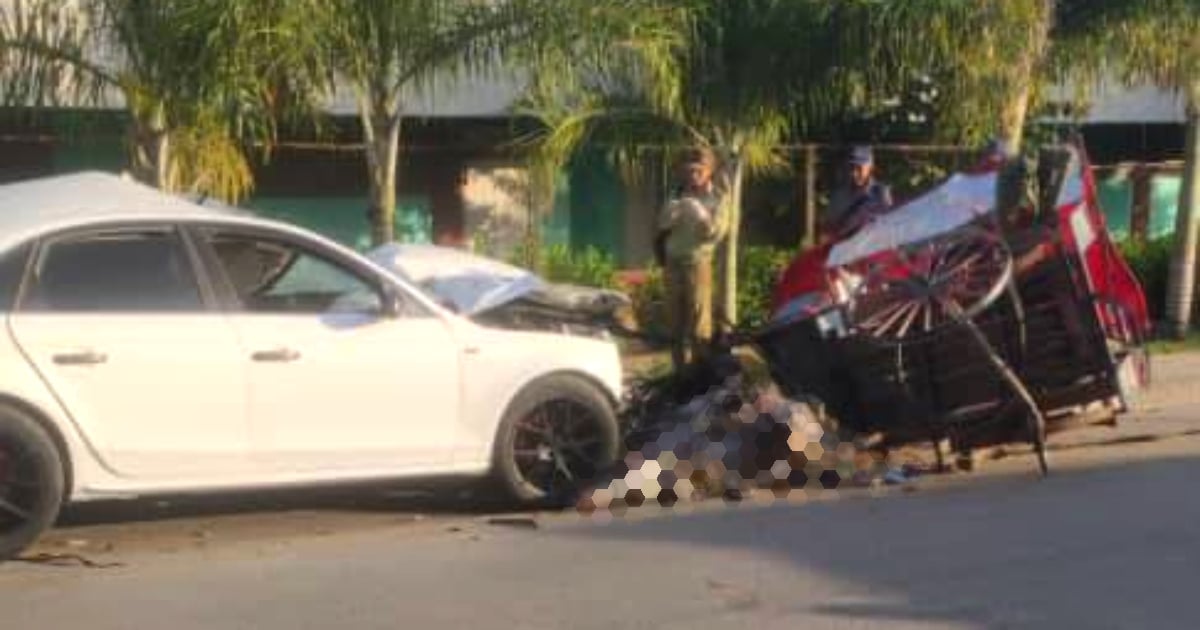
A coachman is in critical condition after being violently struck by an Audi car in the municipality of Contramaestre, Santiago de Cuba province.
The accident occurred on the ascent of the Maffo road, a busy route where animal-drawn transportation is still common, reported the profile of Facebook ‘Reporte Cuba Ya’.
According to witnesses of the incident, the vehicle was being driven by two young men who had recently arrived from the United States.
Both were driving at high speed and in an obvious state of intoxication when they crashed into the horse-drawn carriage. The force of the impact completely destroyed the cart, killed the animal instantly, and left the coachman seriously injured.
Neighbors in the area stated that reckless driving, combined with alcohol consumption, is a constant threat, especially when the drivers are visitors with access to modern and powerful vehicles. "Here, those with money do whatever they want, and nothing happens afterwards," complained a resident.
The carriage driver was urgently transported to a medical center, where he remains in critical condition. So far, the authorities have not provided official details about the incident, the driver’s health status, or any potential sanctions for those responsible for the accident.
This case has generated a wave of outrage on social media, where users demand justice and greater control over those who drive under the influence of alcohol.
Increase in accidents involving horse-drawn carriages amid the transportation crisis in Cuba
The accident that occurred in Contramaestre is not an isolated incident. In recent years, traffic incidents involving horse-drawn vehicles have been on the rise in several provinces of Cuba, amid a deep transportation crisis that forces many people to resort to this precarious means of transportation to move around or make a living.
The presence of horse-drawn carts on the streets and roads of the country has notably increased, even in urban areas or sections where modern and powerful cars are driven, many of which are operated by foreign visitors or affluent Cubans.
This forced coexistence of vehicles from different eras and speeds, in a context of deteriorated infrastructure and limited signage, has proven to be a dangerous combination.
In just the past year, numerous fatal accidents involving horse-drawn carts have been reported: in Cárdenas, a motorcyclist died after colliding with a cart; in Guantánamo, a teenager lost his life in similar circumstances; and on the Southern Bypass of Camagüey, a tourism vehicle crashed into a cart without lights, causing severe material damage.
The causes are diverse: the lack of lighting in horse-drawn carriages, alcohol consumption, reckless driving, and the absence of effective controls for both modern vehicle drivers and those operating these animal-drawn modes of transport.
Filed under: