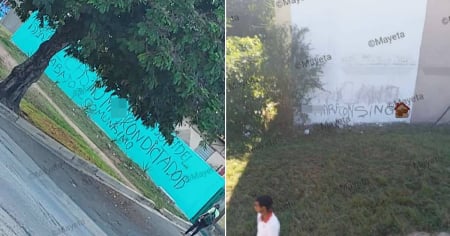
A message painted in a public space in front of the Amadeo Roldán Theater in Havana was hastily covered with yellow paint by the authorities, in a new episode of censorship against critical citizen expressions towards the regime.
The complaint was made by the user on social media San Memero (@SanMemero), who ironically invited participation in the contest “Paint your little piece”. According to his post, the mural contained the phrase: “11J, Day of National Rebellion,” referring to the massive protests on July 11, 2021, but it was removed just a few hours after it was posted.
In the released image, it can be seen that, alongside the covered area, the slogan “26 Julio” remains intact, symbol of the movement founded by Fidel Castro, painted in black and red letters on the 11J poster on the wall of an old fountain in the park at Calzada and C.
The place shows clear signs of deterioration, with peeling paint, cracked walls, and remnants of graffiti. The surface covered in yellow reveals an improvised job, with haphazard brushstrokes that fail to completely conceal what lay beneath.
Other recent manifestations of social unrest in Cuba
On Wednesday, in the bustling neighborhood of Abel Santamaría, in Santiago de Cuba, an offensive graffiti against Miguel Díaz-Canel appeared in the area known as Micro 2.
Independent journalist Yosmany Mayeta reported that the phrase was quickly erased, but not before neighbors and passersby were able to photograph it.
Testimonials from residents indicate that forces from the Ministry of the Interior mobilized quickly to eliminate any trace of the protest. These operations are part of a pattern of control over public space, where state propaganda coexists with a strict silencing of dissenting messages.
More than three years since 11J, the monitoring and repression of spontaneous expressions of discontent remain a priority for the regime. The selective coverage of murals and posters, such as the one that occurred in front of the Amadeo Roldán, highlights not only censorship but also the power's fear that the memory of those protests continues to live on in the streets.
Frequently asked questions about censorship and repression in Cuba
Why does the Cuban regime suppress protest messages like the one from July 11?
The Cuban regime suppresses these messages because they pose a direct challenge to its authority and control over public discourse. The fear that the memory of the protests of July 11th remains alive on the streets drives the censorship of any expression that recalls that event.
What does the phrase "Pinta tu pedacito" mean in the current Cuban context?
"Pinta tu pedacito" is an initiative that uses street art as a form of protest against the Cuban regime. This movement promotes the expression of citizen discontent through graffiti and messages in public places, challenging state censorship and surveillance.
How does the Cuban regime respond to protest graffiti?
The Cuban regime quickly responds to protest graffiti by dispatching forces from the Ministry of the Interior to erase it. The authorities cover the messages with paint, deploy personnel to prevent photography, and seek to identify the authors in order to arrest them.
Why are protest graffiti significant in Cuba?
Protest graffiti is significant because it reflects the growing social discontent and symbolic resistance against the regime. These acts challenge state control over free expression and symbolize a popular awakening in a context of repression and economic crisis.
Filed under: