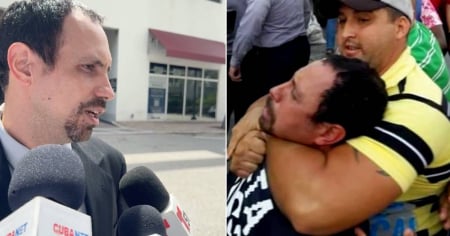
The Cuban scientist Ariel Ruiz Urquiola is a persistent man, and at this point, that is not news but rather a fact of significance. Since Easter (in April), the Cuban political prisoner has been standing every day from 12:00 to 13:00, during the lunch break he takes from Monday to Friday, in front of the Swiss Parliament, seeking the support he needs to invoke universal jurisdiction in this country and ensure that President Miguel Díaz-Canel, Raúl Castro, and Cuban doctor Armando Martínez Fábregas are brought to justice.
This doctor signed the medical discharge for Ruiz Urquiola after he had been admitted to room K on the penal ward of the university hospital in Pinar del Río, where the police transferred him on the sixth day of his hunger and thirst strike, from the Kilo 5 prison. They did it because the provincial prison doctor ordered it based on his professional judgment, not because he requested it. The intention was to force him to abandon his protest. This took place in 2018. It was there that he claims, with medical evidence in hand, that he was injected with the HIV he has been suffering from since that date.
He accuses the three (Díaz-Canel, Raúl Castro, and Martínez Fábregas) of being the intellectual authors of infecting him with HIV, of torture, of administering a placebo to his sister Omara Ruiz Urquiola, an oncology patient; of harassing and confiscating animals from his mother on the farm in Pinar del Río, of preventing him from returning to his country, of expelling him from university... In short, of all the suffering accumulated over the years by the Ruiz Urquiola family.
According to the activist, Switzerland, the country where he resides under political protection, is competent to investigate crimes that it has committed to pursue by signing international treaties, even if they are committed abroad, as long as the perpetrator is in Switzerland and not extradited.
This applies to the UN Convention Against Torture, ratified by Switzerland, whose Article 5.2 mandates the investigation of acts of torture, even if they were committed outside of this territory, as long as the victim resides in Switzerland, as is the case here.
Essentially, Ruiz Urquiola believes that the three (Díaz-Canel, Raúl Castro, and Armando Martínez Fábregas) are intellectual authors and perpetrators of the HIV infestation. In his view, they did this after yielding to international and national pressures for him to be released under an "extrapenal license" in 2018.
In essence, Ariel Ruiz Urquiola argues that deliberate inoculation with HIV falls under "other inhumane acts" and "serious harm to health." Given its political and repressive motivation, he believes it is part of a systematic attack against opponents.
The articles 264a to 264j of the Swiss Penal Code specifically provide for the possibility of prosecuting crimes against humanity for "anyone who, as part of a widespread or systematic attack against a civilian population and with knowledge of that attack, commits murder, extermination, enslavement, deportation, imprisonment, torture, rape, persecution, or other inhumane acts that cause serious suffering or severely undermine physical integrity or health. In this case, the offender shall be punished in Switzerland with a custodial sentence of no less than 5 years."
Ariel Ruiz Urquiola also bases his argument on the fact that the Swiss Penal Code states that Switzerland has jurisdiction when the alleged perpetrator of a crime against international law is present in Swiss territory or the victim is a habitual resident in Switzerland. This applies even if the crime was committed abroad, regardless of the nationality of the perpetrator or the victim.
In this regard, both the deliberate infestation with HIV and torture are considered crimes against humanity, according to Article 264a of the Swiss Penal Code. The perpetrator can be prosecuted even if they are an acting president, as in the case of Díaz-Canel. The immunity of heads of state is not absolute in cases of serious international crimes. Established case law exists from the 2002 Arrest Warrant case and the Pinochet doctrine from the United Kingdom in 1999.
At this moment, Miguel Díaz-Canel, while he holds the position of president, enjoys absolute personal immunity from Swiss courts (except for the International Criminal Court). However, Raúl Castro no longer holds any office that provides immunity, which means he could be investigated and eventually prosecuted if he steps foot in Swiss territory. Finally, the signing physician has no international immunity and could be prosecuted if he enters Switzerland or a cooperating country.
At this moment, Ariel Ruiz Urquiola, with his daily protest outside the Swiss Parliament, is seeking support to file a formal complaint that should be facilitated by the Public Prosecutor's Office, but must be submitted to the Swiss Federal Court. This is something that cannot be done by an individual, but rather falls to an organization or institutions, which is why political will plays an important role here.
So far, no Swiss political group has shown interest in supporting the case of the Ruiz Urquiola family, but he remains hopeful and does not rule out seeking public support.
Filed under: