
Related videos:
This Friday, the newspaper Granma announced the beginning of field tests to provide Wi-Fi on national trains, which it presented as a step towards modernizing transportation.
The event took place on the night of August 7, featuring specialists from the Telecommunications Company of Cuba and the Railway Company of Communication Technologies, Signaling, IT, and Electricity (COSIE).
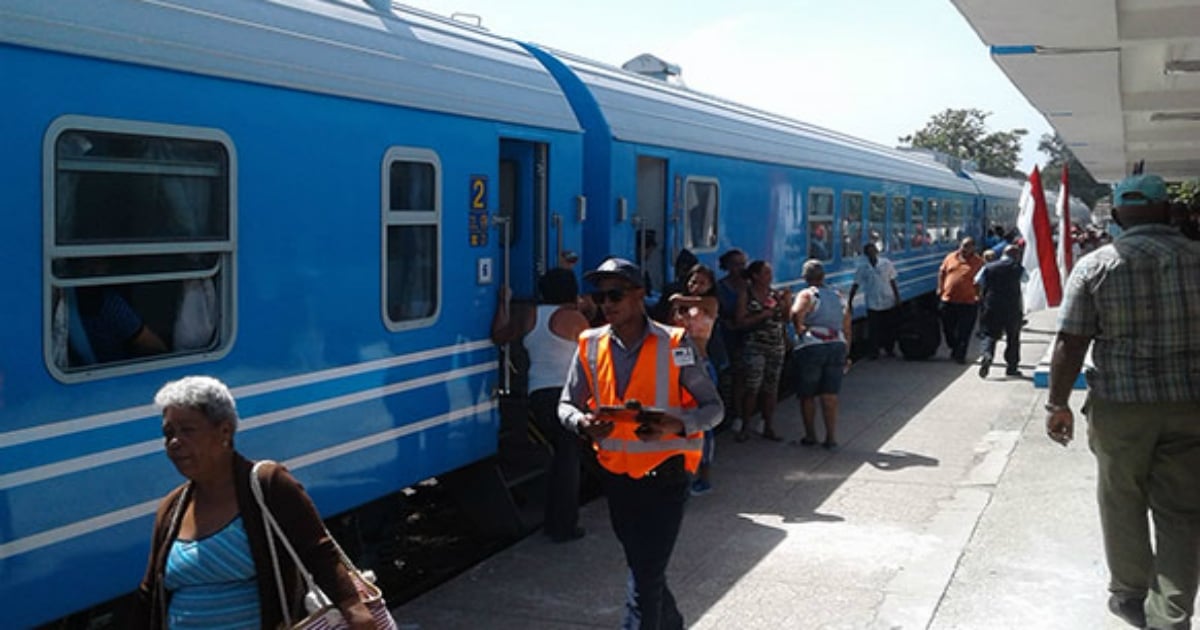
According to the official source, the Integrated Telecommunications Solutions Company (Solintel S.A.), in collaboration with the Telecommunications Company of Cuba and the Communication Technologies for Railways Company (Cosie), claimed to have "successfully validated" the infrastructure and quality of the Wi-Fi service in car 6407 of the train running the Havana-Guantanamo route.
The project, winner of the Innova 2024 competition of the Business Group for Computing and Telecommunications (GEIC), was introduced as an innovation that will facilitate the regulation of radioelectric emissions and enhance the experience for passengers.
According to the official version, this initiative is part of the "digital transformation" process of Cuban transportation and is set within a context of new access to the internet in the country.
But the image that the advertisement tried to project clashes directly with reality: just two days earlier, that same train was involved in an accident that highlighted the chronic deterioration of the railway system on the island
The derailment that exposed the cracks
On August 6, at 2:30 p.m., the Guantánamo-Havana train derailed on the outskirts of Matanzas, in a section near the Bellamar Caves.
More than 820 passengers were traveling when seven cars derailed, affecting about 200 meters of the Central Line and forcing the suspension of rail traffic for over 24 hours.
Five people were injured, three of whom were hospitalized with minor injuries.
Among the injured were two train conductors, one who was struck by a group of passengers during the jolt, and a passenger who suffered blows to the head and elbow. None of the injured are in danger, but all remained under medical observation.
The preliminary investigation points to the deterioration of the track as the cause. The engineer, upon detecting the issue, activated the emergency brake, preventing a greater disaster. However, the extent of the damage necessitated the deployment of repair crews and the transfer of the remaining passengers by bus.
Innovation in a system on the brink of collapse
The contrast is evident: while the propaganda machine emphasizes connectivity on the trains, the basic infrastructure continues to fail.
The Cuban railway system has suffered decades of neglect, with tracks in poor condition, outdated rolling stock, and accidents recurring year after year.
The Wi-Fi project itself faces technical and financial obstacles: areas with no coverage throughout much of the network, the need for specialized equipment, and the lack of a defined business model.
All of this in a country with constant power outages, expensive and limited internet, and public transportation that hardly manages to provide a reliable service.
An announcement years in the making
La promesa de Wi-Fi en trenes no es nueva. The government presented it for the first time in March 2023 como parte de un plan para que los pasajeros pudieran acceder a correo electrónico, navegación web, redes sociales y la intranet corporativa.
It was then ensured that the service would be active in certain sections before the end of the year, but that goal was not met.
In May 2024, Solintel announced the initial field tests, without specifying routes or costs, and acknowledging that funding for a widespread deployment had not yet been secured.
Deadlines were pushed back, the trials continued, and the obstacles remained.
That the validation of Wi-Fi on the Havana-Guantánamo route is announced "successfully" on August 8, immediately following an accident on the same route, is not just an unfortunate coincidence: it reflects the official order of priorities, where the image of modernity takes precedence over addressing structural issues that threaten the safety and lives of passengers.
Wi-Fi on trains could be an improvement for travelers, but its announcement amidst a fragile and dangerous rail system raises more questions than answers.
The contrast between the technological promise and the broken tracks that cause derailments shows that, in Cuba, the discourse on modernization often runs along paths that long require something more urgent than wireless connectivity: safety, maintenance, and reliability.
Filed under: