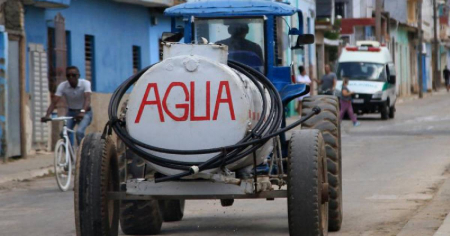
The general director of the Electric Union (UNE), engineer Lázaro Guerra Hernández, stated this Sunday that ensuring the distribution of water in the country is a "priority" for the company, given the dependency of the hydraulic service on electrical supply.
His statements on the official Canal Caribe coincided with the celebration of Hydraulic Worker Day, on the 63rd anniversary of the creation of the National Institute of Hydraulic Resources (INRH).
Guerra assured that any malfunction related to pumping or water distribution "receives immediate attention" from the electrical brigades, in coordination with the hydraulic authorities, to restore service as quickly as possible.
"Any reported malfunction related to water distribution is given the highest priority to ensure that the service, which we know is vital for the population, is restored as quickly as possible," said the executive.
Regarding the national electrical system, it was noted that the disruptions on Saturday were "lower" than anticipated, with a deficit of 1,383 megawatts (MW). For this Sunday, interruptions were forecasted at 770 MW at noon and 1,390 MW during peak hours, figures lower than those recorded in recent days, when outages exceeded 1,600 MW.
The official attributed the slight improvement to the launch of planned generating units and to the decrease in demand caused by the rains.
Thousands of families in Havana are facing a double calamity: the recurring blackouts have shut down the pumps at several supply sources, leaving entire neighborhoods without drinking water amid an energy crisis.
For thousands of Cuban families, the lack of water is not a new issue, but rather part of the daily struggles they face.
In most neighborhoods, especially those on the outskirts or with deteriorated infrastructure, access to drinking water is sporadic, often dependent on water trucks that do not adhere to fixed schedules or routes.
The power outages only worsen this situation, hindering pumping from wells and treatment plants.
This type of crisis, far from being an isolated incident, reflects the systematic degradation of the public services system on the island, in a context where inflation, food shortages, the collapse of transportation, and social insecurity create a bleak picture.
Frequently Asked Questions about the Water Crisis and Blackouts in Cuba
Why does the UNE promise to prioritize the attention to hydraulic breakdowns?
The UNE promises to prioritize hydraulic failures due to the dependence of the water service on the electricity supply. The frequent power outages have halted water pumps, worsening the already critical situation of access to drinking water in Cuba. The UNE, in coordination with hydraulic authorities, has committed to providing an immediate response to these failures to restore the service as soon as possible.
How do blackouts affect the water supply in Cuba?
Power outages are paralyzing the pumps necessary for the water supply, leaving thousands of families without access to drinking water. In Havana, for example, the outages have interrupted pumping at several stations, exacerbating the water crisis amid a backdrop of widespread electricity shortages. This issue is part of a systematic degradation of public services on the island.
What measures is the Cuban government taking to address the water and electricity crisis?
The Cuban government has begun installing solar-powered pumping systems in rural areas to address the water crisis. However, this effort is minimal compared to the scale of the problem. In addition, UNE is working on repairing generator blocks and installing photovoltaic solar parks, although their impact is still insufficient to eliminate the persistent blackouts.
What is the current situation of the electrical system in Cuba?
The electrical system in Cuba is experiencing a critical situation with prolonged blackouts and a power generation deficit exceeding 1,300 MW. The obsolete infrastructure, lack of maintenance, and fuel shortages have led to a collapse of the National Electroenergetic System (SEN), severely impacting the quality of life for the Cuban population.
Filed under: