
Related videos:
The city of Santiago de Cuba is facing one of the worst water crises in years, with key reservoirs below 20 percent capacity and a population largely dependent on a collapsed system that can barely sustain supply amid a prolonged drought affecting the southeast of the province since early 2025.
The main municipality is the most affected with its reservoirs only 17.8% full. However, the overall average in the 16 reservoirs in the area managed by the National Institute of Hydraulic Resources reaches 65% capacity, authorities from the hydraulic sector confirmed.
The problem lies in the fact that 89% of the 470 million cubic meters accumulated in total is located in distant reservoirs such as Carlos Manuel de Céspedes (Contramaestre) and Protesta de Baraguá (Mella), making its transfer to the provincial capital difficult, explained the official newspaper Sierra Maestra.
The Gilbert, Charco Mono, and Gota Blanca reservoirs— the latter having been depleted since April—are practically dry, with less than 20% of their capacity. Only the Parada reservoir maintains somewhat more stable levels, which has necessitated pumping water from the Céspedes dam through the Mogote transfer to prevent Gilbert from being completely depleted.
Nevertheless, the system is unable to keep up with a city that has a predominantly dependent population relying on the deteriorated Quintero system.
Ludmila Rodríguez Barroso, director of Aguas Santiago, acknowledged that 80% of the city relies on Quintero, whose network is riddled with leaks, malfunctioning valves, and massive thefts of water meters, with more than 4,000 units stolen.
Efforts are being made to alleviate the situation through investments in pumping, wells at the Refinery, and the desalination plant at Boca de Cabaña, but the outlook remains critical.
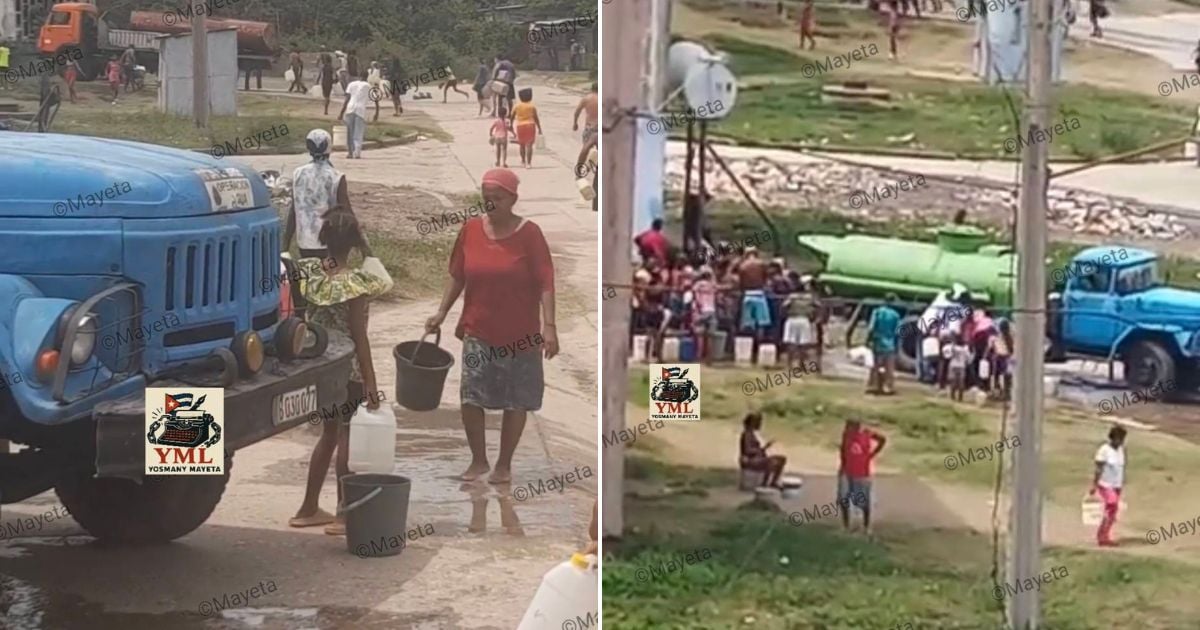
This is compounded by a fleet of tanker trucks reduced to less than half: only 12 out of 30 units are operational at the Water and Sewer Company, which forces reliance on support from other organizations to serve vulnerable communities. However, the response remains insufficient in the face of the magnitude of the crisis.
With increasingly longer distribution cycles, entire areas without stable service, and temporary measures that do not address the root of the problem, the people of Santiago endure a situation filled with desperation and neglect.
The water shortage, far from easing, worsens day by day, while official promises sound as empty as the reservoirs.
In Santiago de Cuba, the second largest city in the country, large areas have gone more than two months without receiving the vital liquid. Recently, Rodríguez herself acknowledged that “there is no water and there is no forecast” for when the service might stabilize.
It was pointed out that only one of the five pipelines in the Quintero system is operational. This has restricted the water flow to just 900 or 1,000 liters per second, far below what is needed to maintain a stable distribution cycle.
Sectors such as Altamira, Van Van, Versalles, El Caney, Boniato, and El Cristo are among the most affected. Some areas have gone more than 60 days without receiving piped water service, relying exclusively on water tankers.
In several communities of the municipality of San Luis, in the eastern province, accessing water is like “crossing Niagara by bicycle” due to drought, collapsed infrastructure, and illegal charges for water trucks, which forces thousands of people to survive without fully enjoying a basic human right.
The water crisis in Cuba continues to deteriorate, with alarming situations in several provinces.
The presence of living animals in the water that reaches the homes of Sancti Spíritus has sparked a wave of outrage on social media, where residents report the appearance of larvae, worms, snails, and even fish coming out of pipes supposedly intended for drinking water.
In Guantánamo, the main reservoir in the area is practically dry, leaving the population without assured supply and creating an emergency situation in the midst of summer.
In the capital, the water shortage has been exacerbated by electrical instability, which directly affects pumping and distribution in the most populated neighborhoods.
Thousands of homes in Matanzas lack a stable water supply due to the simultaneous breakdown of water pumps, while authorities attempt to manage the situation with partial repairs and distribution through tankers.
Nationwide, the figures are striking: more than half a million Cubans are affected by the drought, with provinces like Las Tunas and Holguín experiencing extended supply cuts.
Frequently Asked Questions about the Water Crisis in Santiago de Cuba
What is causing the water crisis in Santiago de Cuba?
The water crisis in Santiago de Cuba is primarily caused by a severe drought, combined with collapsed infrastructure and poor management of the water distribution system. The Quintero system, which supplies most of the population, has significantly reduced its capacity due to low flow in the main sources, such as the Gota Blanca and Gilbert dams, and the breakdown of pumping equipment exacerbates the situation.
How many people are affected by the water shortage in Santiago de Cuba?
In Santiago de Cuba, more than 300,000 people are suffering from severe disruptions in the supply of drinking water due to the intense drought and infrastructure problems. Nationwide, it is estimated that around one million Cubans face daily challenges in accessing water.
What measures are being taken to tackle the water crisis in Santiago de Cuba?
To try to mitigate the crisis, additional pumping equipment has been installed, some powered by solar energy, along with the repair of systems and the removal of leaks. However, these actions have not significantly alleviated the situation, and the population continues to face severe restrictions on access to water.
How long have some communities in Santiago de Cuba been without water?
Some communities in Santiago de Cuba, such as Songo-La Maya, have waited up to 85 days for water service. In other areas, distribution cycles extend to more than 60 days without supply, forcing residents to rely on tanker trucks to meet their basic needs.
Filed under: