
Related videos:
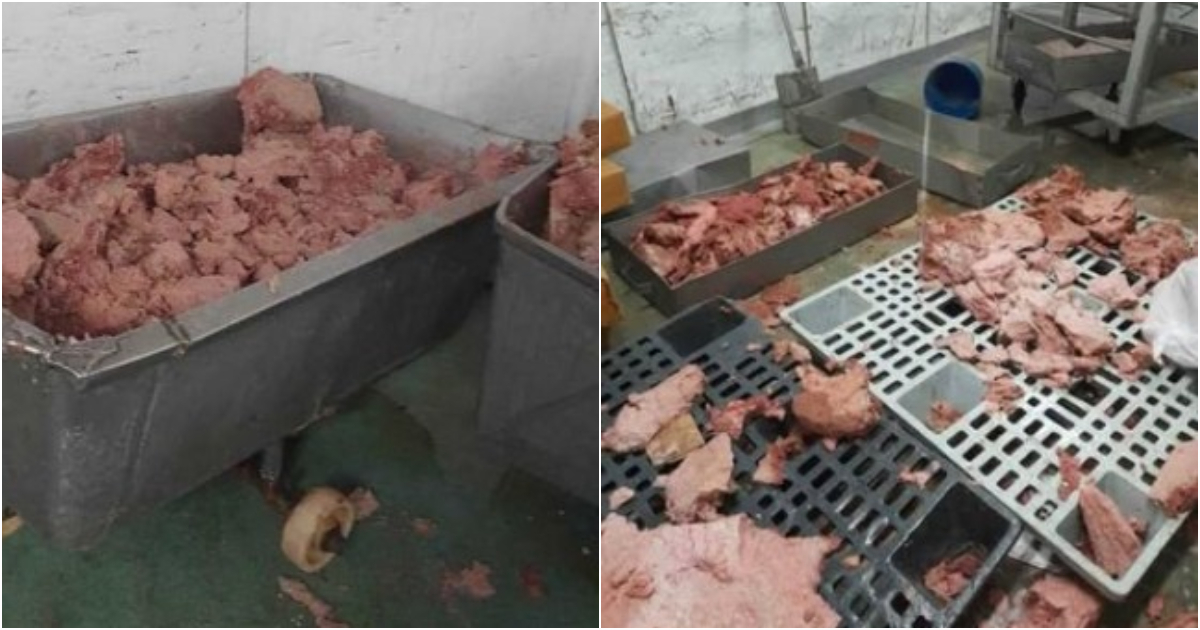
The Basic Packing Unit El Tigre, located in the Havana municipality of La Lisa (Ave. 53 and 158), is facing serious accusations of unsanitary food handling and abuse of authority by its director, Yuliett Curbelo Lugo, according to a citizen who reported it anonymously out of fear of reprisals.
According to the complaint, sent to journalist Mario J. Pentón and published on his social media, the croquette mixture is placed directly on the floor and deteriorated boxes of processed croquettes are reused, mixing them with new mixtures to mask the bad smell and their condition.
The director is accused of treating staff disrespectfully with derogatory phrases like “If you don’t like it, resign” and “Here, we do whatever I want…”, as well as acting as though the entity belongs to her.
The report indicates that workers receive a lunch in deplorable conditions, while the director and her husband, who also works at the center, have access to a different and higher-quality menu.
Moreover, they are accused of using their position to acquire luxuries and allowing irregularities without consequences.
The source indicates that, despite internal complaints, employees cannot leave their jobs due to the need for income, even though salaries are insufficient.
These products —croquettes and hamburger patties— are primarily consumed by impoverished families and those with limited resources, including children, which exacerbates concerns about the reported health risks.
Comments from citizens on social media show widespread indignation and confirm that this case reflects broader issues.
The internet user Leisy Valdés stated that if anonymous reports with evidence were addressed, "the responsible parties would have no choice but to do things reasonably well," but they feel untouchable.
Silvia Quinta noted that these products "aren't fit for even dogs to eat" and that the executives would never consume them.
Other users emphasize that the unsanitary conditions are not isolated: flies, cockroaches, mice, contaminated water, and lack of cleaning products are common in state food production. “Everything conspires to reduce the Cuban population,” said another commenter.
The complaint is also repeated that many bosses behave like "millionaires" and exercise unchecked abuse of authority, while the phrase "if you don't like it, resign" becomes a national slogan.
Many are denouncing the double standards of health authorities, who impose heavy fines on private businesses while ignoring the conditions in state-run facilities.
Others, like Yarisel Sánchez Lima, describe the situation as "disgusting no matter where you look" and warn that most of what the population can consume is "pure pulp."
Some, like Elizabeth Blanco and Deysi Cobiella, claim that they have chosen not to buy processed foods from the government to protect their health and that of their families, even if that means eating only bananas or boiled squash.
According to them, the essential hygiene standards have been lost, and all that matters to the executives is "lining their pockets," while the people face hunger and illness.
This is not the first time information has come to light regarding the poor quality and lack of hygiene in food preparation intended for ordinary Cubans, which is very different from that intended for the ruling elite on the island.
The production director of the Provincial Food Company in Matanzas, Daniel Yon Aguiar, acknowledged in April that there was discontent among the population due to the poor quality of the bread, specifically because of its unpleasant odor, similar to that of cockroaches.
Cubans have found everything from a screw inside the rationed bread to a strange and toxic substance in the baby food distributed in the bodegas.
The Minister of Domestic Trade of Cuba, Betsy Díaz Velázquez, recently showcased the production of banana croquettes and the introduction of a "base broth" among the culinary alternatives as part of the "progress" in the country's commercial network.
According to statements made in July by the official before the National Assembly of People's Power, these "initiatives" are "positive examples" of a creative response to the complex economic and supply situation the island is experiencing.
The food insecurity that the Cuban population is experiencing is increasing exposure to deficiency diseases, affecting physical and cognitive development and weakening the body's defenses.
The organization Food Monitor Program (FMP) alerted this past Monday that the diet of the majority of households is highly repetitive, lacking in micronutrients and fiber, and reliant on ultraprocessed foods such as ground meat and sausages, rather than fresh proteins like fish or beef.
Recent reports indicate that more than nine million people in Cuba cook under inadequate conditions, with limited access to fuels and lacking basic equipment, which not only decreases the variety of foods they can consume but also affects the way in which they are prepared.
In addition, one in four people admits to having gone to bed without dinner, reflecting how hunger has become a daily reality. These figures highlight a chronic food insecurity that directly affects millions of families.
The situation is worsening in a context that many compare to the Special Period, although now with less state support, greater reliance on the informal market, and a rationing system that is almost symbolic.
Frequently Asked Questions about Unsanitary Conditions and Abuses at the State Food Plant in Havana
What are the main accusations against the El Tigre plant in Havana?
The El Tigre plant faces accusations of unhealthy food manipulation and abuse of authority. It is reported that the croquette dough is placed on the floor and that deteriorated products are mixed with new ones. Additionally, the director is accused of mistreating staff and taking advantage of her position to gain luxuries.
How does unsanitary conditions in El Tigre affect Cuban families?
Unhealthy products from El Tigre are primarily consumed by low-income families, including those with children. This heightens concern over health risks, as the most vulnerable families rely on these foods for their daily nutrition.
What reactions has the complaint about the El Tigre plant generated on social media?
The complaint has sparked widespread outrage among citizens. Comments on social media highlight that poor sanitation is a pervasive issue and criticize the double standards of health authorities who neglect these conditions in state-run facilities while fining private businesses.
What measures has the Cuban government taken in response to the current food crisis?
The government has implemented measures such as the sale of croquettes and tostones as food alternatives, due to the lack of essential products like bread. However, the quality of food continues to decline, and the population criticizes these measures as insufficient in the face of the crisis.
Filed under: