
Related videos:
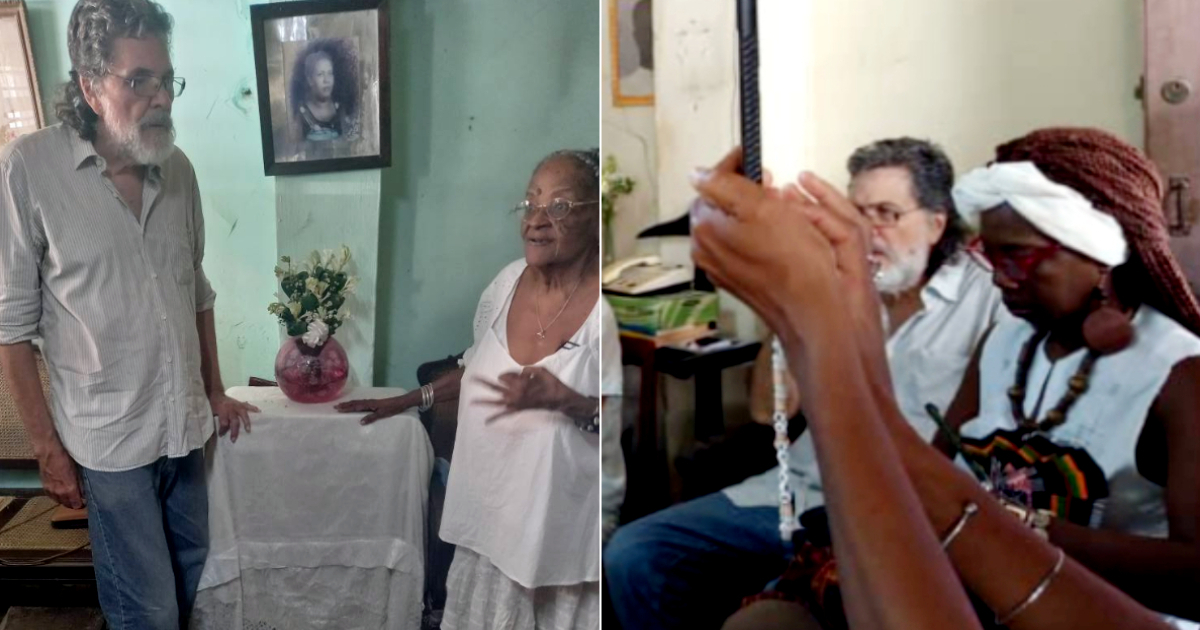
The former president of the Union of Writers and Artists of Cuba (UNEAC) and current president of the Casa de las Américas, Abel Prieto, made an appearance this weekend at a unique event: the commemoration of the centenary of the Joaquina Sandoval Spiritist Center in Havana.
From there, with a glass of liquor in hand, he praised the patriotic loyalty and the "spirituality" of the followers of the doctrine of Allan Kardec, who —in his words— reaffirmed their commitment to the so-called "Cuban Revolution."
Prieto, accompanied by the center's director, known as Bebita, highlighted on his social media the supposed solidarity vocation of spiritualists as an essential value for "helping Cuba in difficult times."
In his speech, the key words of official rhetoric were not absent: patriotism, solidarity, and spirituality. Concepts that the government has used in recent years as substitutes for concrete solutions to the national crisis.
The Political Use of Spirituality
Prieto's emphasis is not an isolated fact. Since 2018, Miguel Díaz-Canel has insisted on "working with the spirituality of the people" as part of his narrative of continuity.
In December 2023, and with eyes wide open, the leader called to "" that made even the Mesa Redonda levitate.
The ruler -appointed by a finger in contact with the beyond of Castroism- has even proposed “spiritual care” for teachers amid an educational crisis, and has claimed that the prosperity of the country depends on the “spiritual wealth” of its citizens.
This approach has been replicated by organizations aligned with the regime, such as the Quisicuaba Project, which in 2024 promised to “save the revolution and socialism” through its spiritual practice.
The alliance between popular religiosity and political power is not new in Cuba: the VII World Spiritist Congress in 2013 already had institutional support and the presence of high-ranking leaders of the Communist Party.
In his enthusiastic discourse, Prieto seemed to forget that spiritualism is not the same as spirituality. The former is a doctrine codified by Kardec—whose works, by the way, were censored in Cuba by the PCC commissioners—that believes in communication with the dead. Spirituality, on the other hand, is a broader personal experience, free from manuals or dogmas.
But in official jargon, both terms are happily mixed together, as if invoking spirits and discussing universal values were the same thing. Ultimately, the confusion is not accidental: in the narrative of power, what matters is not conceptual precision, but the propagandistic utility of the term in question.
Spirituality versus Pragmatism
For Prieto, "spirituality" serves as an antidote to "vulgar pragmatism." However, in daily reality, Cubans face very concrete problems: blackouts, rampant inflation, food shortages, and salaries that do not cover basic needs.
In that context, speaking of "spiritist solidarity" as a national salvation is more of a rhetorical device than an effective public policy. Rather than calling it nonsense, absurdity, or glossolalia, it resembles that "speaking in tongues" characteristic of those who enter a trance or experience "spirit possession."
A propaganda resource
Far from being just a cultural act, the exaltation of spiritism as a patriotic force reflects the regime's inability to provide real answers to the crisis.
While extreme poverty affects 89% of the population, according to the Cuban Observatory of Human Rights, official rhetoric relies on abstract concepts that do little to alleviate the material and social decline of the country.
Prieto, becoming a cultural propagandist for continuity, thus reaffirms the government's shift towards spiritual rhetoric as a remedy for a structural crisis.
The fidelity of spiritualists to the "revolution" may serve as a slogan at a commemorative event, but it does not address the exodus, hunger, or the lack of hope for millions of Cubans.
Filed under: