
Related videos:
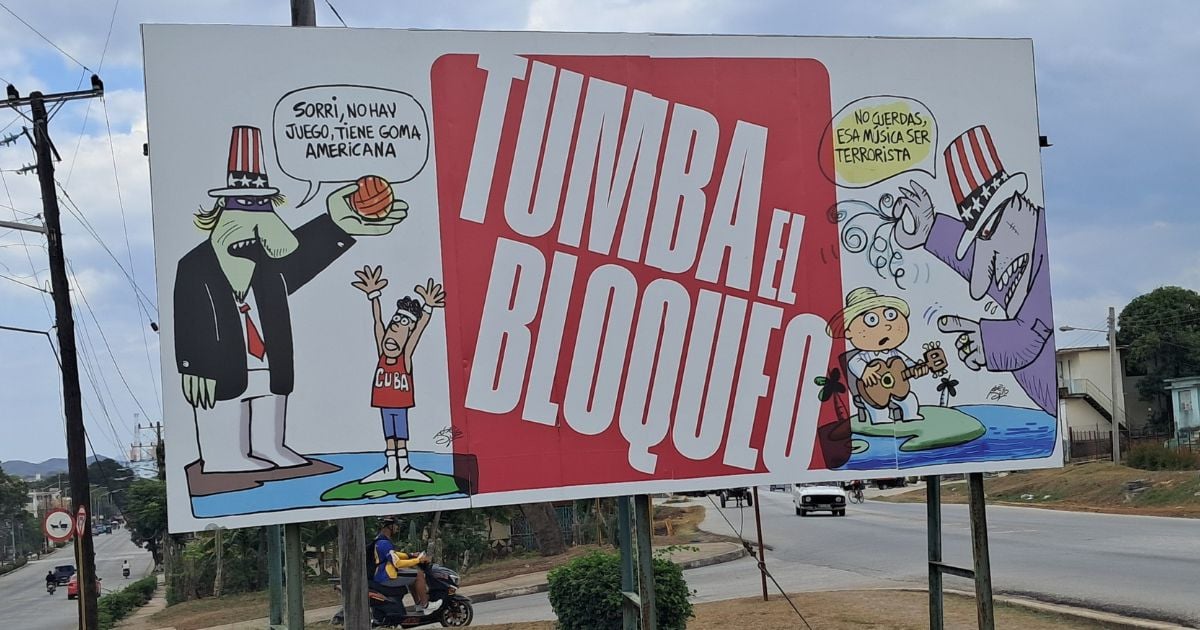
The Cuban Ernesto Almaguer Díaz mocked on social media this Wednesday the absurdity of communist propaganda by showing a poster located in the city of Holguín that intended to use English… but with a flawed spelling.
“When you are going to make a communist poster in another language, at least do it with good spelling. It’s ‘Sorry’, not ‘Sorri’... Do you see that free education can be harmful?” Almaguer wrote on his Facebook account, accompanied by an image of the poster.
The sign is located at the intersection of Carretera Central and Avenida Los Álamos in Holguín, and the word "Sorri" —instead of the correct "Sorry"— was what sparked ridicule on social media.
In his post, Almaguer also mentioned the profile of Edmundo Dantés Junior, an internet user known for exposing the absurdity of the Cuban regime on social media, commenting: “Did you see what you learn at the Universidá?”, reinforcing the sarcastic tone of the post.
For his part, Edmundo Dantés Junior also joined in the mockery from his profile with a sarcastic post in which he wrote: “Useful and perfectly spelled sign that Trumpi is sure to see when passing through the intersection of Carretera Central and Avenida Los Álamos in Holguín... Am sosori.”
The Cuban regime has intensified its strategy of ideological control at all levels of the educational system. A clear example was the confirmation that one of the main priorities for the year 2025 would be political-ideological training, even surpassing scientific or technical training, as noted in various official statements and institutional reports.
In February, during a national workshop with representatives from all Cuban universities, the government reaffirmed that the core of the higher education system would be the "defense of the Revolution", in an effort to train professionals who are politically committed, rather than critical or innovative.
This directive was supported by leaders of the Communist Party, such as Abel Prieto, who warned about the “danger of cultural colonization” and emphasized the need for ideological vigilance in the classrooms.
Recently, the police in Santiago de Cuba quickly replaced a sign that criticized power outages, making it clear that political censorship takes precedence over addressing citizen discontent, highlighting that the defense of the official narrative is prioritized over the acknowledgment of real issues such as the energy crisis.
This pattern is supported by other actions of the government, such as the decisions presented at the National Education Council in December 2024, where it was emphasized that the political training of students would be more important than the scientific approach.
Even at a meeting of the Ministry of Education in April 2025, Miguel Díaz-Canel proposed to provide "spiritual support" to teachers, instead of addressing the exodus of educators and the precarious conditions in schools.
Frequently Asked Questions about Errors in Communist Propaganda and the Situation in Holguín
Why did the communist poster in Holguín generate mockery?
The sign located in the city of Holguín was mocked due to a spelling mistake, writing "Sorri" instead of "Sorry." This error was seen as a reflection of the shortcomings in communist propaganda and sparked criticism toward education and the regime in Cuba. The spelling mistake on the sign triggered ridicule on social media.
Who is Ernesto Almaguer Díaz and why is he relevant to this news?
Ernesto Almaguer Díaz is a Cuban who gained attention on social media for his ironic commentary on communist propaganda featuring spelling mistakes in Holguín. Additionally, he is known for his altruistic gesture of offering blood donations for children with cancer, demonstrating his active role in social causes in Cuba.
What is the economic situation in Holguín regarding dollar stores?
In Holguín, the opening of stores that accept dollars has sparked significant controversy due to the unaffordable prices for the majority of Cubans, whose salaries are in Cuban pesos. This situation has exacerbated social inequality, as only those with foreign currency can access basic products, while stores that accept national currency face shortages.
How is the electricity crisis affecting the residents of Holguín?
The electrical crisis in Cuba has left many provinces, including Holguín, in darkness, causing significant social unrest. The constant blackouts hinder food preservation and the execution of daily activities. The lack of effective response from the government has led to protests and discontent among the population.
What other solidarity actions stand out in Holguín?
In Holguín, significant acts of solidarity have taken place, such as the donation of a home to a mother in extreme poverty and assistance to a street vendor who faced a health issue. These initiatives reflect the unity and solidarity of the community in supporting those in greatest need. The people of Holguín have demonstrated great solidarity in times of need.
Filed under: