
Related videos:
The decision by Banco Metropolitano to have customers reserve an appointment in the Ticket app in order to submit complaints or claims has generated discontent on social media and raised questions, even from voices close to the state media.
According to the institution's announcement on its Facebook page, users will need to request an appointment in advance through the Ticket application, at least 24 hours but no more than a week ahead, to visit the Complaints and Requests Department.
The measure aims to organize the services that will be provided at the central office in Old Havana on Mondays, Wednesdays, and Thursdays from 9:00 a.m. to 1:00 p.m.
"Appointment booking by Ticket to address customer complaints and requests. Free of charge," the statement indicated, almost appealing to the cynicism of "free."
The official journalist Ana Teresa Badía publicly expressed her disagreement: “Is it really necessary for me to schedule an appointment with Ticket and go on the day I am assigned, or can I only complain through the channels that the Metropolitan Bank specifies there?”
The regime's spokesperson was inquisitive in her comment: "Wrong, people use whichever channel they see fit to voice their complaints."
Badía also stated that she will continue to express her opinions on social media despite the criticism received.
The communicator recalled that, according to international trends in communication, no serious organization excludes digital platforms from complaint and response mechanisms, as these are spaces where reputation is managed and crises can be anticipated.
In the meantime, the bank's announcement maintains that, in addition to Ticket, customers have other options such as email, the Bienestar platform, and assistance at bank branches, although the new digital requirement is the one attracting the most criticism.
User criticism didn't take long to surface. Ricardo Castillo pointed out that “the first complaint is precisely that: having to make a reservation to lodge a complaint,” while also recalling that the institution still has not provided a convincing response regarding the use of MLC cards.
Others, like Miladis Fernández, reacted with irony, stating that “there is nothing left to do but laugh because we've cried enough already,” while Gabo Pére jokingly remarked that “we should know if there is a limit to complaints per person, just in case someone goes overboard.”
Jorge Oramas summarized the discontent with a damning comment: “This happens when ineptitude and incompetence take charge.” In the same vein, Irene Orozco exclaimed: “Oh my God, this is the last straw,” and Dayana Díaz reported that she has been waiting for a deposit to her national currency card for a month without it arriving, also denouncing that “complaints are overlooked as a mockery and a lack of respect.”
The discontent also pointed to the centralized nature of the measure. Amarilys Argote questioned, “everyone who cannot access it has to go to the central office, as if that were not precisely to prevent people from complaining.”
And for Delphos M. Millan, the provision reflects “the most ridiculous thing that has been read: that in order to complain, you have to take a number. People complain wherever they want and at any time. They don’t come out of one meme to enter another.”
The reactions reveal an unusual consensus: both citizens and journalists aligned with the government agree that the decision of the Banco Metropolitano is absurd, bureaucratic, and disconnected from the reality of its own clients.
The collapse of the Cuban banking system has generated deep dissatisfaction among citizens, who are facing increasingly significant obstacles to accessing their own money.
The retired journalist Iraida Calzadilla starkly highlighted this reality by recounting how, month after month, she must wait for hours outside Havana banks to collect an incomplete pension, surrounded by those waiting in line and in undignified conditions.
His testimony gives a face to a crisis that particularly affects the elderly, who endure long lines, a shortage of cash, and limited banking infrastructure.
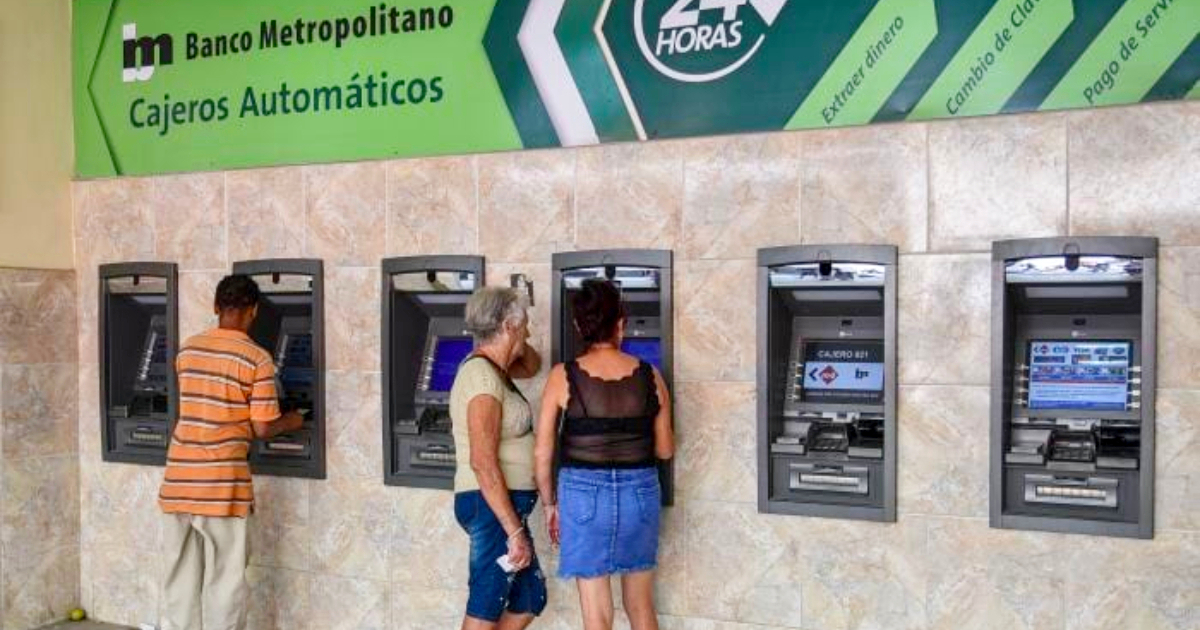
The situation is not isolated. The chaos in Cuban banks has become a daily occurrence, with citizens reporting the impossibility of withdrawing cash, constantly changing limits, and ATMs that are out of funds.
People even avoid electronic transfers for fear of being unable to withdraw their money. The informal economy has been boosted by the buying and selling of turns to access ATMs, while the banking system shows signs of structural collapse, exacerbated by frequent power outages and the lack of effective solutions.
In an effort to alleviate the crisis, the Banco Metropolitano launched a new appointment reservation system through the Ticket platform, aimed at clients familiar with digital tools.
Although this measure aims to reduce queues and facilitate essential procedures, it will only be implemented in 10% of Havana's branches, specifically those least affected by power interruptions. Furthermore, the initiative will not replace the first-come, first-served service, so its actual impact remains uncertain.
Frequently Asked Questions about Banco Metropolitano and the Use of the Ticket App in Cuba
Why does the Banco Metropolitano require an appointment to file complaints?
The Metropolitan Bank has implemented this reservation system to organize customer service in its Complaints and Requests Department. The measure aims to better manage inquiries and reduce crowding, but it has faced criticism because not all Cubans have easy access to the technology required to make reservations through the Ticket app.
What are the main criticisms of the Ticket app in Cuba?
Criticism of the Ticket application focuses on the lack of access to technology for many Cubans, technical failures, and its use as a barrier to accessing essential services amid an economic crisis. The implementation of this system has been perceived as a form of digital exclusion that does not take into account the actual technological and economic conditions of the Cuban population.
What alternatives does Banco Metropolitano offer for submitting complaints if Ticket cannot be used?
In addition to the Ticket application, the Banco Metropolitano mentions the use of email, the Bienestar platform, and in-person assistance at its bank branches as alternatives for filing complaints. However, the effectiveness of these channels has been questioned by users, who encounter logistical and technological challenges in accessing them.
How does the forced digitalization of banking services affect Cubans?
The forced digitization of banking services in Cuba, such as the elimination of printed receipts and the use of applications like Ticket, primarily affects those who do not have access to the internet or mobile devices, such as the elderly. This creates a digital divide that excludes vulnerable segments of the population, complicating access to basic financial services.
Filed under: