
Related videos:
The massive naval deployment of the United States in the Caribbean, with destroyers and amphibious ships approaching the coasts of Venezuela this week, has inevitably rekindled parallels with the invasion of Panama in 1989 that ended the regime of Manuel Antonio Noriega.
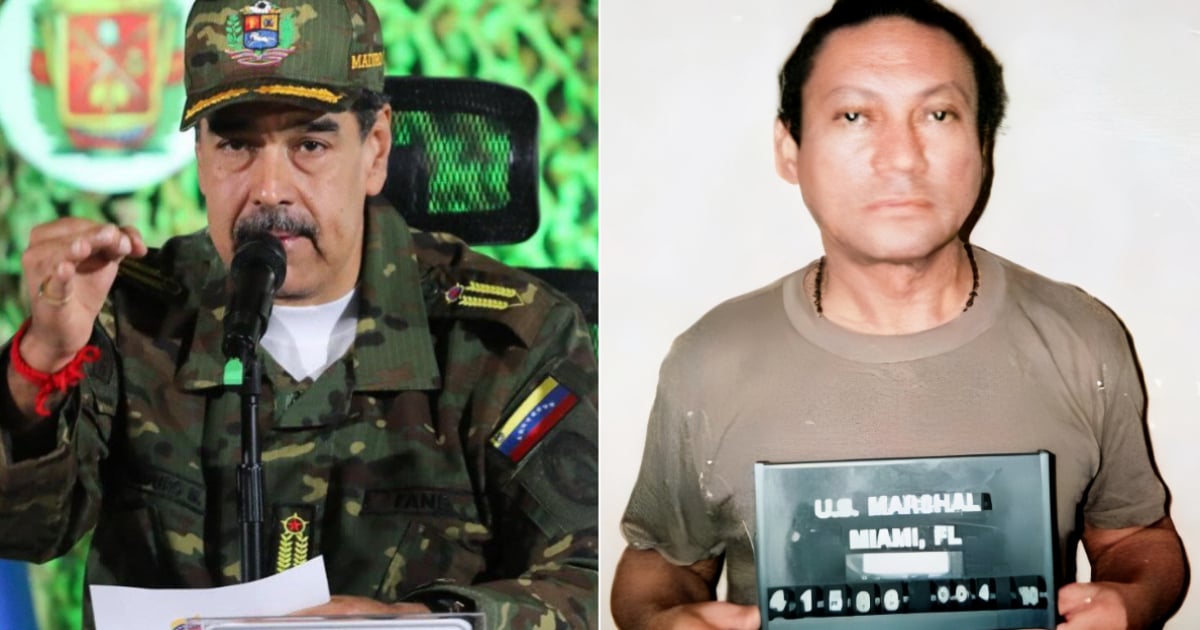
The overarching question that is prevalent in analyses, from El Nuevo Herald to France 24, is whether Nicolás Maduro could face the same fate as the former Panamanian general, who was accused at the time of drug trafficking and turning his country into a "narco-state."
General Noriega and Panama: The Background
On December 20, 1989, then-president George H. W. Bush ordered the Operation Just Cause, a large-scale military intervention that overthrew General Noriega.
A former ally of the CIA, the Panamanian military officer was accused by the United States of drug trafficking, corruption, and of placing the country at the service of the Medellín Cartel.
The invasion mobilized 27,000 U.S. soldiers, supported by hundreds of aircraft and armored vehicles, who crushed the Panamanian Defense Forces within a few hours.
Noriega took refuge in the Apostolic Nunciature until he surrendered on January 3, 1990, when he was transferred to Miami. There he was tried, convicted of drug trafficking, and spent two decades in prisons in the U.S. and Europe.
Although Washington portrayed the operation as a success in the "war on drugs," the action resulted in at least 500 Panamanian deaths according to the Pentagon, and as many as 3,000 according to local organizations, in addition to international condemnation from the United Nations and the OAS for violating international law.
Maduro under pressure
More than three decades later, President Donald Trump has deployed a task force in the Caribbean composed of three guided missile destroyers (USS Sampson, USS Jason Dunham, and USS Gravely) and three amphibious ships (USS San Antonio, USS Iwo Jima, and USS Fort Lauderdale).
Together, they transport 4,500 troops, including an expeditionary force of 2,200 marines, which gives Washington the capability to carry out a landing on Venezuelan shores if it so chooses.
The Pentagon has not revealed the exact mission, but the White House maintains that the deployment aims to confront designated "narcoterrorist" organizations in the region.
Among them is the Cartel of Soles, which U.S. prosecutors claim is run by Maduro and high-ranking officials of his regime. Washington has raised the reward for the capture of the Chavista leader to 50 million dollars, an unprecedented amount in Latin America.
“Maduro is not a legitimate president; he is the fugitive leader of a narcoterrorist cartel,” declared spokesperson Karoline Leavitt, emphasizing that Trump is willing to use “every instrument of American power,” from sanctions to the use of force.
Similarities and differences
The comparison with Panama is unavoidable. Noriega and Maduro were both accused of drug trafficking in federal courts in New York, and both were pointed out by Washington as responsible for turning their countries into platforms for drug trafficking.
But experts warn of substantial differences. Former federal prosecutor Richard Gregorie, who was involved in the indictment against Noriega, pointed out to the Herald that “Panama is not the same as Venezuela. There is more at stake here than drug trafficking,” referring to Caracas's connections with Iran and its wealth in oil and strategic minerals.
On his part, Jon May, Noriega's defense attorney in 1992, agreed that a large-scale invasion would be "suicidal": "It was easy for the U.S. military to crush Panama. Venezuela has a much larger and more motivated army, which would resist strongly."
The factor of electoral legitimacy and the popular will
However, a key element that connects Noriega's case in Panama with Maduro's situation in Venezuela is the disregard for the electoral outcome. In both scenarios, the opposition won at the polls, and the ruling regime nullified that victory to maintain its hold on power.
In Panama, the opposition candidate Guillermo Endara was immediately recognized by the United States and a large part of the international community as the legitimate president, which generated a favorable consensus for the intervention narrative.
In Venezuela, something similar occurred: the opposition claimed to have defeated Maduro in the most recent elections, and international organizations acknowledged their evidence and reported irregularities and manipulation of the Chavista electoral apparatus.
However, the contextual differences are significant. Noriega led a small country, with limited armed forces and little room for international maneuvering.
In contrast, Maduro controls a larger state, with a sizeable army, a well-oiled clientelist network and repressive apparatus, backed by strategic external alliances with Havana, Tehran, and Moscow.
What is indeed consistent in both cases is the absence of internal democratic legitimacy. In Venezuela, the majority of citizens have formally expressed their desire to move on from Chavismo and choose a political change.
This lack of popular support erodes the foundation of the regime and strengthens the narrative that Maduro governs solely thanks to the strength of his military and police institutions.
This factor could be decisive in Washington's calculations. In Panama, the popular rejection of Noriega reduced the political cost of the invasion and facilitated the establishment of an alternative government.
In Venezuela, the clearly expressed will of the people at the polls could serve as an argument to justify more aggressive actions, based on the premise of responding to a regime that has usurped power.
However, the military equation is much more complex. Venezuela is not Panama: its size, energy resources, and geopolitical position make it high-risk territory.
A military action would entail a much greater human, diplomatic, and strategic cost, even though the political and social landscape is less favorable to chavismo than it was at the time for Noriega.
A world in the midst of paradigm shifts
Just as in 1989, when the invasion of Panama began weeks after the fall of the Berlin Wall and the onset of a new international order, today’s global landscape is also undergoing a profound transformation.
The return of "spheres of influence" to the doctrines of great powers is an evident sign: Russia's invasion of Ukraine openly challenged the system based on international law and the principles of sovereignty that defined the second half of the 20th century.
Just as Moscow has launched its challenge against the order established after World War II and reinforced with the fall of the "socialist camp," the administration of Donald Trump –a leader who does not hide his admiration for Vladimir Putin– might feel tempted to play a similar game in the Western Hemisphere and try to eliminate Moscow's influence in its "backyard."
Under this logic, Washington would shift from its historic role as a guarantor of the old order—based on rules and multilateral consensus—to a venture aimed at consolidating regional power, intended to reaffirm its strategic influence in the Caribbean and South America.
In this sense, the naval operation off the coast of Venezuela would not only be seen as part of the fight against drug trafficking but also as a maneuver within the global struggle for spheres of influence, where each power tests its strength to assert territory against its rivals.
Caracas strikes back with militias
In response to the increasing military pressure, Maduro announced this week the mobilization of 4.5 million militiamen to "defend national sovereignty." Chavismo insists that Washington's anti-drug operation is merely a pretext for political intervention.
Meanwhile, allied countries like Cuba, Bolivia, and Nicaragua, gathered in the ALBA, condemned the deployment as a violation of international law.
The ghost of Panama
The shadow of the 1989 invasion once again looms over the Caribbean. Back then, the United States justified its intervention in the name of national security and the fight against drug trafficking. Today, Trump is using similar arguments against Maduro.
The difference lies in the fact that Venezuela, unlike Panama, is a much larger country, with a sizable armed forces, significant energy resources, and a more extensive geopolitical role.
The big question is whether this naval deployment is merely a show of force to pressure the Chavista regime or, as happened with Noriega, could it become the prelude to a military action that alters the political balance of the region.
Filed under: