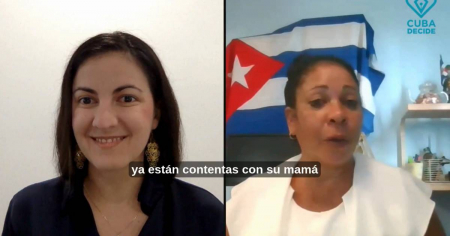
The Cuban activist and newly elected Commissioner of the Inter-American Commission on Human Rights (CIDH) for the 2026-2029 term, Rosa María Payá, urged the member States of the Organization of American States (OAS) this Monday to exert real pressure against the regimes in Cuba and Venezuela, stating that “dictatorships can only be broken under pressure.”
In a message to the Permanent Commission of the OAS, Payá warned that Nicolás Maduro "is starting to feel it" and reminded that the countries in the region have the responsibility to defend the people's right to democracy.
“Dictatorships only respond to pressure, and you, as member states of the OAS, have the responsibility to exert it,” he stated, citing the Inter-American Democratic Charter.
The Cuban opposition figure also shared a video on social media where she highlighted that stopping "the threat posed by the Cuban regime" is key to supporting the democratic transition on the island.
Venezuela under international pressure
Payá's words come at a time of heightened regional tension, marked by the military deployment of the United States off the Venezuelan coast.
Three guided-missile destroyers, USS Gravely, USS Jason Dunham, and USS Sampson, accompanied by submarines, surveillance aircraft, and approximately 4,000 personnel, arrived in Venezuelan territorial waters as part of an operation that, according to Washington, aims to dismantle drug trafficking cartels such as the Tren de Aragua and the so-called Cartel of the Suns, led by high-ranking officials of the chavismo.
The president Nicolás Maduro responded with a defiant speech, announcing the mobilization of 4.5 million militiamen to “defend seas, skies, and lands” against what he described as “the threat of a declining empire”.
Pressure on Maduro intensifies
Tensions have escalated with Washington's decision to offer up to 50 million dollars for information leading to the capture of the Venezuelan ruler, who is accused of narcoterrorism. Cuban-American Congresswoman María Elvira Salazar stated that "the circle is closing around the narcodictator Maduro," while legislator Carlos Giménez urged Maduro to "get out to Cuba before it's too late."
The government of Guyana also expressed its "deep concern" about narco-terrorism in the region, joining the international pressure against Caracas.
In this context, Rosa María Payá's message aims to highlight not only Venezuela but also Cuba, reminding us that both regimes sustain each other through mutual support and that the international community cannot turn a blind eye.
Frequently Asked Questions about the Situation in Venezuela and the Role of Rosa María Payá
What has Rosa María Payá stated about the dictatorships in Cuba and Venezuela?
Rosa María Payá has stated that “dictatorships only break under pressure”, urging OAS member states to apply such pressure against the regimes in Cuba and Venezuela. According to Payá, the international community has the responsibility to defend the people's right to democracy and has emphasized the need to curb the influence of the Cuban regime to support the democratic transition on the island.
How has international pressure on Nicolás Maduro increased?
International pressure on Nicolás Maduro has increased with the military deployment of the United States near Venezuelan shores and the offer of up to 50 million dollars for information leading to his capture, accused of narco-terrorism. The United States has intensified its actions to dismantle drug trafficking cartels associated with the Venezuelan government, prompting Maduro to respond with a defiant speech and the mobilization of militias to defend the country.
What is Rosa María Payá's role in the Inter-American Commission on Human Rights?
Rosa María Payá has been elected as a commissioner of the IACHR for the period 2026-2029. Her main role will be to oversee the human rights situation in the 35 member states of the OAS, issue reports, address individual cases of human rights violations, and promote the observance of rights recognized in the inter-American system. Furthermore, her election has been seen as a significant step towards greater representation of the Cuban dissidence in international organizations.
Why is Rosa María Payá's election to the IACHR relevant for the Cuban opposition?
The election of Rosa María Payá is significant because she is the first Cuban and opposition figure against the regime in Havana to hold a seat on the IACHR. This represents a platform of political and diplomatic legitimacy that allows her to establish herself as a central figure in Cuban opposition activism before the international community. Her presence on the IACHR provides her with sustained visibility and the ability to denounce human rights violations in Cuba with institutional support.
Filed under: