
Related videos:
A freight train carrying bulk honey derailed this Monday at around 3:10 p.m. at kilometer 53.800 of the Hershey Line, near the Jibacoa stop, in the province of Mayabeque.
The incident involved Extra Train 946 -coming from Camagüey- which was operating with locomotive 38093 and transporting its cargo from the sugar mills Batalla de las Guásimas and Carlos Manuel de Céspedes, as explained in a Facebook post by the Minister of Transport, Eduardo Rodríguez Dávila.
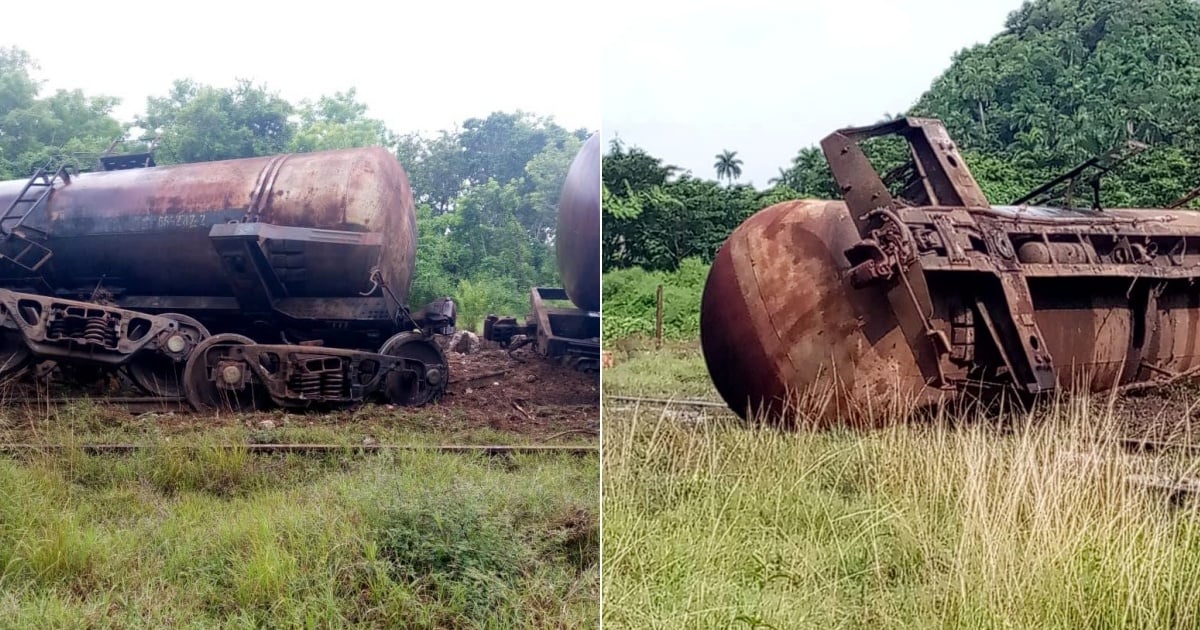
Four of the train's cars derailed, three of which were tankers that overturned, causing a significant spill of the product, while a fourth car also derailed but did not overturn.
In total, the train was carrying twelve cars, ten of which were tankers intended to hold honey.
"The receiving customer was informed immediately, and in coordination with the authorities of Mayabeque and FERROAZUC, actions are being taken to evacuate the product and control the spill," assured the transportation official, who did not provide further details about the "receiving customer" of the spilled product.
Property damage and impact on infrastructure
A preliminary assessment confirmed that there were no injuries or damage to the locomotive, but there were significant impacts on the railway: approximately 300 broken ties and around 400 meters of damaged track are estimated, in addition to the three overturned tank cars.
The honey spill necessitated the activation of procedures for containment and recovery.
The accident also caused a partial halt to train traffic in that section, leading authorities to deploy machinery and specialized technical personnel to begin repair work immediately.
“The work is being carried out intensively to restore train service on the line as quickly as possible,” the minister added.
Actions following the accident
Teams from the Union of Railroads of Cuba, FERROAZUC, Western Railroads, as well as members of the National Revolutionary Police (PNR) and representatives from the provincial government of Mayabeque, arrived at the scene to coordinate the response to the incident.
The priority, in addition to securing the area, was to contain the honey spill and prepare for the withdrawal of the damaged cars.
At the same time, an investigative commission made up of specialists from the Railway Transportation Administration (ATF) and experts from the railway sector is examining the causes of the derailment.
The objective is to determine whether there were technical, human, or structural failures that triggered the incident.
Rodríguez Dávila assured that "all necessary human and technical resources are being mobilized to address the problem," and reiterated that efforts will continue until the full restoration of service on the Hershey Line, a key infrastructure for railway transport in the western region of the country.
A pattern of recent derailments
This incident is not isolated. Just two weeks ago, on August 16th, another train suffered a partial derailment in Havana, right as it was entering the yards of the Central Station.
The train, coming from Holguín and carrying 984 passengers, partially derailed in an area without a platform, near the elevated bridge of the station.
Although no injuries were reported, the incident affected four wheels of the locomotive 52557, triggering emergency protocols. The prompt actions of the crew ensured that passengers were able to disembark without any issues.
The unit was redirected and taken for review, and the station resumed its operations in just over an hour. A committee was also appointed to investigate the case.
Even more serious was the derailment that occurred a week earlier in the province of Matanzas, when seven carriages left the tracks due to a defect in the infrastructure.
The accident left six people injured, including two crew members and a passenger, and damaged about 250 meters of railway. The victims were taken to the Comandante Faustino Pérez Provincial Hospital.
Both recent events reinforce concerns about the critical state of the Cuban railway system, which has been affected by decades of deterioration, lack of maintenance, poor signage, and structural problems.
As noted in the Rutas Nacionales report, these factors are compounded by human errors and acts of vandalism, in a context where such failures “remain frequent.”
The series of incidents raises questions about the safety of rail transportation in Cuba and underscores the urgency of modernizing and strengthening the national network, a demand that can no longer be deferred.
Frequently Asked Questions about the derailment of the Hershey train line in Cuba
What caused the train derailment on the Hershey line?
The causes of the derailment are still under investigation by a commission of specialists. Possible technical, human, or structural failures that may have triggered the incident are being analyzed.
Were there any injuries in the Hershey train accident?
No injuries reported in the derailment of the honey train on the Hershey line. However, there was significant damage to the railway infrastructure and a spill of honey.
What were the consequences of the derailment on the Hershey line?
The derailment caused significant damage to the infrastructure, with approximately 300 broken sleepers and 400 meters of damaged track. Additionally, there was a honey spill, which necessitated the activation of procedures for its containment and recovery.
What measures are the authorities taking following the train accident?
The authorities have mobilized machinery and specialized technical staff to repair the damaged infrastructure and contain the honey spill. Additionally, an investigative committee is working to determine the causes of the derailment.
What is the current state of the Cuban railway system in terms of safety?
The Cuban railway system faces serious deficiencies due to decades of deterioration, lack of maintenance, and structural problems. These factors, along with human errors and acts of vandalism, have contributed to a worrying pattern of recent accidents.
Filed under: