The president of Colombia, Gustavo Petro, described as “murder” the military operation ordered by Donald Trump in Caribbean waters against a vessel coming from Venezuela that, according to Washington, was transporting drugs and operated by the criminal group Tren de Aragua.
"If this is true, it is murder anywhere in the world. We have been capturing civilians transporting drugs for decades without killing them. Those who transport drugs are not the big drug lords, but very poor young people from the Caribbean and the Pacific," Petro wrote on his X account (formerly Twitter).
The military operation of the U.S. in the Caribbean
On Tuesday, Trump confirmed on his Truth Social network that a drug-laden ship from Venezuela was sunk by South Command forces, resulting in 11 deaths. The president described the action as a "surgical" strike against narcoterrorists linked to the regime of Nicolás Maduro.
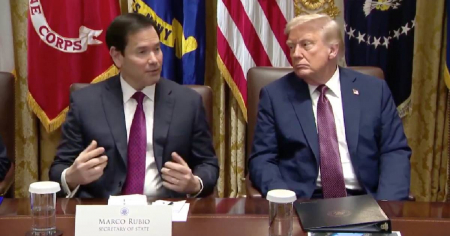
The Secretary of State, Marco Rubio, endorsed the official version and described it as an action against a “narco-terrorist” organization designated by Washington. From Congress, the Cuban-Americans Carlos Giménez, María Elvira Salazar, and Mario Díaz-Balart applauded the operation, which is part of the “zero tolerance” policy of the Trump administration.
However, the reaction in Caracas was diametrically opposed. The Minister of Communication, Freddy Ñáñez, accused Washington of manipulating the evidence and maintained that the video released by Trump had been created using artificial intelligence to justify a “covert aggression.”
Petro breaks the regional silence
Amid the escalating accusations between Washington and Caracas, Petro's voice became the first reaction from a head of state in the region.
His tweet directly questioned the legitimacy of the operation and suggested a different interpretation: the dead would not be "narcoterrorists," but rather poor young people exploited as labor in the drug trafficking networks.
The stance of the Colombian president is not coincidental. Petro has been critical of the model of the war on drugs promoted by the United States and has advocated for a strategy based on public health, alternative development, and financial penalties against major cartels.
"Those who transport drugs are not the big drug lords," he emphasized, contrasting the policy of capture and prosecution implemented in Colombia with the lethal actions of the U.S. in international waters.
Debate on Legitimacy and International Standards
Petro's message opens an uncomfortable debate about the legality of the American operation.
Although Trump framed the attack within the fight against terrorism—having previously designated the Tren de Aragua and the Cártel de los Soles as foreign terrorist organizations—in practice, it was a lethal military action against a drug trafficking ship in international waters.
According to international standards, the fight against drug trafficking is typically framed within police operations and criminal justice rather than military actions. Conventions such as the 1988 Vienna Convention Against Illicit Traffic in Narcotic Drugs establish mechanisms for judicial cooperation, extradition, and confiscation, but do not authorize the use of lethal force against civilian vessels.
International Humanitarian Law (IHL), which governs armed conflicts, does not apply in this case either, as there is no declared war between the United States and Venezuela nor a recognized international armed conflict.
The only legal framework that Washington could invoke is the fight against terrorism, by considering the Tren de Aragua as a designated terrorist organization. However, legal experts warn that this unilateral designation does not replace the basic principles of international law, which demand proportionality, distinction between combatants and civilians, and respect for human life.
A dangerous precedent?
For security experts, the military action ordered by Trump presents a dilemma: if the war on drug trafficking is waged with bombings at sea, the line between criminal justice and military action becomes blurred.
The use of bombings against drug vessels marks a drastic shift from traditional anti-drug operations. If transporting narcotics is equated with a terrorist act and this justifies military action, the line between criminal justice and war becomes blurred, raising the risk of an escalation of violence in the region.
Petro's words reflect this concern: those who die in these operations are often not the heads of the cartels, but rather young people from impoverished communities who serve as crew members.
The incident in the Caribbean not only deepens the tension between Washington and Caracas, but it also opens a regional debate about the limits of the "war on drugs" and the risk that the anti-drug fight could turn into a battleground with unpredictable human costs.
Filed under: