
Related videos:
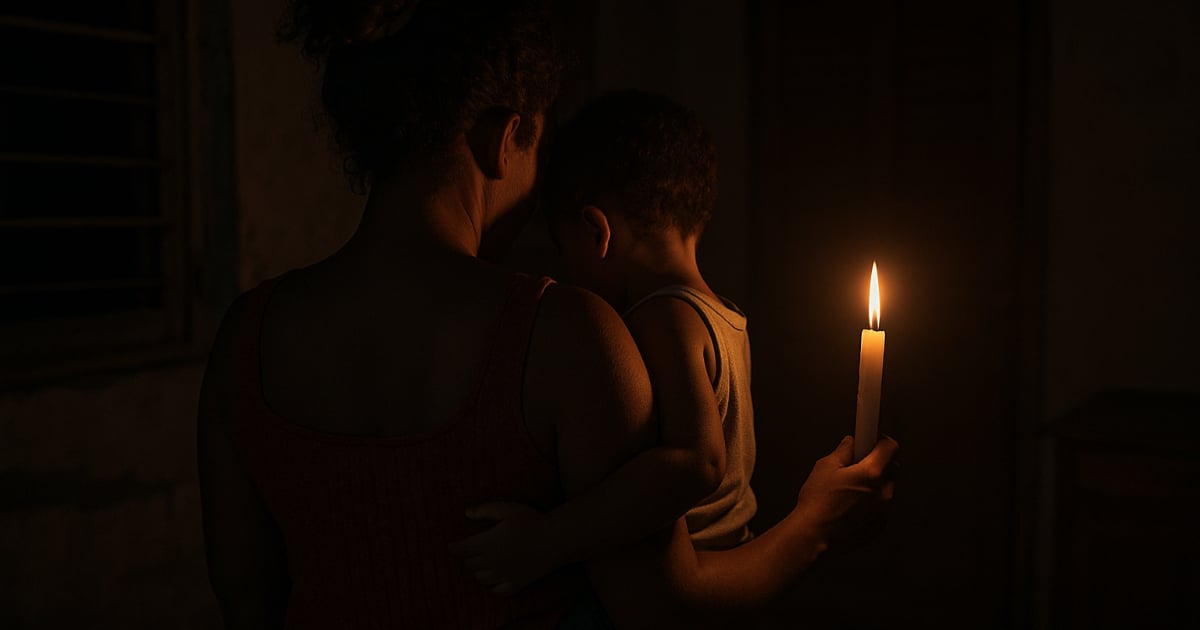
The energy crisis in Cuba continues to show no mercy to the population.
In a notice published on September 3rd, Unión Eléctrica (UNE) acknowledged that the National Electric System (SEN) was affected for 24 hours on Tuesday and that power outages continued without interruption throughout the early morning.
The highest impact was recorded at 8:50 PM, with a deficit of 1,808 megawatts (MW).
According to official data, this morning the availability was only 1,800 MW compared to a demand of 3,090 MW, resulting in an impact of 1,300 MW.
The situation will not improve as the day progresses: the UNE forecasted a 1,350 MW impact by noon, and during peak hours, a deficit of 1,657 MW which will result in 1,727 MW of scheduled blackouts.
Incidents and structural causes
The company's own report reveals a critical picture of unavailability:
Three units of the Renté and Felton thermoelectric power plant are out of service, while two other blocks of the Santa Cruz and Carlos Manuel de Céspedes thermoelectric power plants (Cienfuegos) are undergoing maintenance.
The thermal limitations have left 511 MW out of service.
Due to a lack of fuel, 44 distributed generation plants have ceased operations (245 MW), along with the Patana de Regla, resulting in a reduction of 43 MW.
The unavailability due to a lack of lubricants amounts to 371 MW.
In total, 659 MW are out of service solely due to fuel and lubricant issues, a figure that reveals the precariousness of the energy infrastructure and the dependency on supplies that the government has been unable to secure.
The UNE also reported that the 28 photovoltaic solar parks produced 2,482 MWh, with a peak capacity of 513 MW during midday hours.
However, this contribution is insufficient to alleviate a deficit that far exceeds 1,600 MW.
Despite the official discourse about "new investments in renewable energy," the data shows that alternative generation barely meets a minimal fraction of the demand.
Havana: prolonged blackouts and lack of transparency
The Electric Company of Havana confirmed on Facebook that in the capital, the service was interrupted for 22 hours, with a maximum impact of 117 MW at 8:50 PM. It was not restored until 7:33 AM the next day.
Although it was announced that it would not be necessary to interrupt a block of customers between 10:00 AM and 2:30 PM, it ultimately became necessary to cut the supply in the reserve block due to the "high deficit of the SEN."
The official explanation again blames the "demands of the system," a tired formula repeated ad nauseam to justify blackouts that have become a part of the daily routine for Cubans.
Political responsibility and social discontent
The reports from the UNE and provincial companies focus only on detailing numbers, malfunctioning units, and deficit forecasts, but they avoid addressing the root of the problem: decades of underinvestment in electrical infrastructure, corruption in resource management, and almost complete reliance on outdated and polluting thermoelectric plants.
While the government presents solar parks as an achievement, the reality is that the country remains mired in endless blackouts.
For the population, the official figures mean nothing more than entire nights without electricity, spoiled food, collapsed hospitals, and a household economy that can no longer withstand any more improvisation.
The government’s discourse attempts to present blackouts as an inevitable phenomenon, when in reality they are a direct consequence of failed energy policies.
The SEN is not in crisis due to natural causes, but rather due to the indifference of a system that, instead of providing solutions, merely issues daily reports confirming the collapse.
Frequently Asked Questions about the Energy Crisis in Cuba
What is the main cause of blackouts in Cuba?
The main cause of blackouts in Cuba is the lack of investment in electrical infrastructure, which has resulted in an almost total dependence on obsolete thermoelectric plants and a shortage of fuel and lubricants. Constant breakdowns and the necessary maintenance in power plants further complicate the situation.
What measures is the Cuban government taking to address the energy crisis?
The Cuban government has announced the addition of new photovoltaic solar parks as part of its strategy to diversify energy generation. However, these measures have not been sufficient to meet energy demand, and the lack of concrete actions to renew existing infrastructure keeps the crisis unresolved.
Why do solar parks not solve the energy deficit in Cuba?
Although solar photovoltaic parks have been integrated into the system, their energy production is insufficient to compensate for the severe deficit that the country faces, especially during peak demand periods. Renewable generation only covers a small fraction of the total demand, and the supporting infrastructure remains inadequate.
How do blackouts affect daily life in Cuba?
Power outages severely affect daily life in Cuba, interrupting food refrigeration, the use of basic electrical appliances, and access to digital services. They also have a negative impact on medical services, private businesses, and urban infrastructure, creating an atmosphere of hopelessness and social unrest.
Filed under: