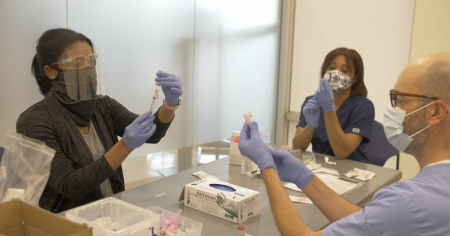
Florida's plan to eliminate certain school vaccination requirements will not take effect immediately and will take at least 90 days to implement, placing its introduction around December.
According to the Associated Press (AP), the state Department of Health explained that the regulation, which will take effect on September 3, 2025, will apply only to vaccines for chickenpox, hepatitis B, Hib influenza, and pneumococcal diseases such as meningitis, unless the Legislature decides to expand the measure to other illnesses such as polio or measles.
The measure represents a significant shift from decades of public policies and scientific studies that have demonstrated the effectiveness of vaccines in stopping the spread of contagious diseases, particularly among children.
Despite this, U.S. Secretary of Health Robert F. Kennedy Jr. has expressed doubts about its safety.
The state's surgeon general, Joseph Ladapo, reiterated this Sunday on CNN, as reported by AP, that the final decision should rest in the hands of the parents: “If they wish, God bless them, they can get as many as they want.
"And if not, parents should have the ability and the power to decide what goes into their children's bodies. It's that simple."
Currently, Florida has religious exemptions to school vaccination requirements.
According to the World Health Organization, vaccines have saved at least 154 million lives worldwide in the past 50 years, most of them being babies and children.
Health experts in Florida warn of the risks. Dr. Rana Alissa, president of the American Academy of Pediatrics in Florida, cautioned that making these vaccinations voluntary "puts students and school staff at risk."
The debate arises amid a resurgence of preventable diseases. Measles is experiencing its worst year in the United States in over three decades, with more than 1,400 confirmed cases—mainly in Texas—and three deaths.
Additionally, whooping cough has caused the death of at least two babies in Louisiana and a 5-year-old child in Washington, with over 19,000 reported cases as of August 23, nearly 2,000 more than the same date last year, according to preliminary data from the CDC.
The state legislature will not reconvene until January 2026, although committees will begin their meetings in October.
Until then, the change will remain on hold and the current school vaccination schedule for other diseases, including measles, polio, diphtheria, whooping cough, mumps, and tetanus, will continue to be in effect.
The debate over school vaccination in Florida has gained momentum in recent months. The Department of Health announced that the new rule to eliminate certain immunization requirements will not take effect immediately but will be implemented around December.
The measure will reduce the requirement for vaccines such as chickenpox, hepatitis B, Hib influenza, and pneumococcus, although the vaccines for polio, measles, and other contagious diseases will remain in place for now.
If fully approved, Florida would become the first state to eliminate all school vaccination requirements, a historic turn against decades of public policies that have viewed these immunizations as a crucial barrier against epidemic outbreaks.
The proposal has been defended by the state's general surgeon, Joseph Ladapo, on the grounds that parents should decide what goes into their children's bodies.
However, the decision raises concerns within the medical community. Health experts warn that this relaxation could increase the vulnerability of students and school staff amid a national resurgence of preventable diseases such as measles and whooping cough.
Even health officials in Florida have admitted to not assessing the risks, acknowledging that there are scenarios where the removal of mandatory schemes could worsen the spread of infections.
Frequently Asked Questions about the Changes in School Vaccination Requirements in Florida
When will the change in school vaccination requirements in Florida take effect?
The change in school vaccination requirements in Florida will not take effect until December 2025, as a period of at least 90 days is required from its commencement on September 3, 2025.
What vaccines will no longer be mandatory in Florida schools?
The vaccines that will no longer be mandatory in Florida schools are those for chickenpox, hepatitis B, Hib influenza, and pneumococcal diseases such as meningitis. However, other vaccines such as those for polio and measles will remain required unless the Legislature decides otherwise.
What risks does making vaccines voluntary in Florida schools entail?
Health experts warn that making vaccinations voluntary endangers students and school staff, as vaccines have proven effective in preventing the spread of contagious diseases. The risk of outbreaks of preventable diseases, such as measles and whooping cough, could increase if vaccination rates decline.
What are the authorities' opinions on the change in vaccination requirements?
The Florida Surgeon General, Joseph Ladapo, and Governor Ron DeSantis support the measure, arguing that parents should have the ability to decide on their children's vaccinations. However, health authorities and experts have criticized the lack of risk analysis and the potential negative impact on public health.
How does the vaccination situation in Florida compare to other parts of the U.S.?
While Florida seeks to eliminate vaccination mandates, other states have strengthened their immunization programs in response to the resurgence of diseases like measles. The situation in Florida could serve as a national precedent, with potential public health consequences if other regions follow suit.
Filed under: