
Related videos:
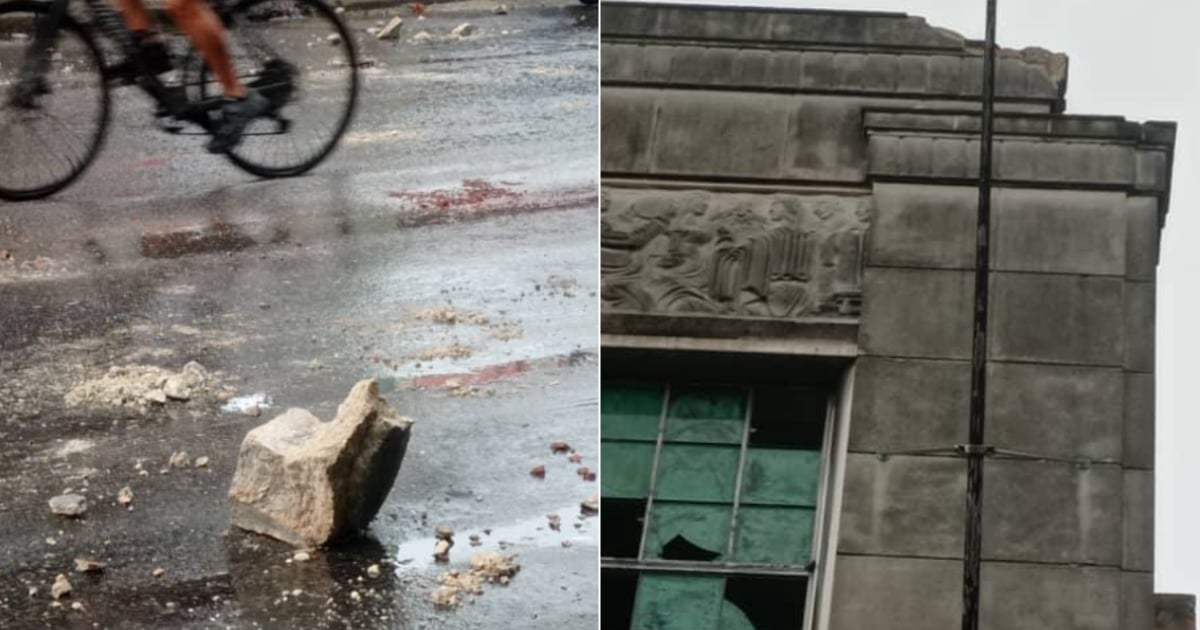
A lightning strike hit the top of the building located at Reina 158, between San Nicolás and Rayo, in the Centro Habana municipality this Monday, which previously housed the headquarters of the now-defunct newspaper El País.
The electric discharge caused fragments of the cornice to fall onto the sidewalk, creating a panic among passersby in the area. Witnesses stated that after the loud noise, several pieces of masonry fell onto the road, but so far, no injuries have been reported.
In images shared on social media by the Municipal Administration People's Council (CAM) of Centro Habana, large stones can be seen on the wet pavement from the rain, while cyclists and pedestrians passed just a few meters from the danger.
The building, designed by architects Cristóbal Díaz and Rafael de Cárdenas and inaugurated in 1941, is one of the prime examples of Art Deco in the Cuban capital.
In its façade, there are reliefs by the sculptor Cándido Álvarez Moreno, dedicated to transportation and communications. However, the passage of time, lack of maintenance, and looting have turned it into a ruin that poses a threat to the safety of those traveling along the busy Calzada de la Reina.
For decades, the building was a symbol of modernity and the strength of Cuban journalism. Following the demise of the newspaper El País, the 'José Luis Gómez' printing house operated there, until the premises were closed and fell into neglect.
Residents of the area recall that in 2019, several families without housing occupied the property in search of a place to live, although they were evicted by the police a few days later.
Heritage specialists have warned about the deterioration of the building, which they consider an architectural landmark that should be preserved. However, the impact of the lightning strike and new debris fall add to the list of damages that threaten to hasten its irreversible destruction.
As of the publication of this report, the municipal authorities had not provided any information regarding safety measures or the fate of the building, which remains in a state of severe disrepair and poses a latent risk to the residents of Havana.
Historical context: The Country, the Cuban press, and Art Deco in Havana
The newspaper El País
Founded in 1902, shortly after the establishment of the Republic, the newspaper El País was one of the leading publications in the first half of the 20th century in Cuba.
Its editorial line defended a liberal and critical stance towards political power, becoming a reference for urban sectors interested in public life and the modernization of the country. Within its pages, topics of politics, economy, and society were discussed, and it had a significant influence on public opinion until the mid-1950s.
The printing and editorial offices of the newspaper moved in 1941 to a modern building on Calzada de la Reina, symbolizing its media influence and commitment to modernity.
After 1959, similar to other independent newspapers, El País was shut down and its property was taken over by the state, losing its original function as a space for free press.
The press in Cuba in the 1940s and 1950s
During these decades, Havana had a diverse and vibrant press, which included titles such as Diario de la Marina, Información, Avance, El Mundo, and Prensa Libre. The competition among newspapers created an environment of plurality, with modern newsrooms and circulation numbers that competed with each other.
These newspapers not only provided information but also set the political and cultural agenda of the country, reflecting a landscape of informational freedoms that contrasts with the current reality of the island.
Art Deco in Cuba
The building of El País is part of the Art Deco movement, which had a significant impact in Havana between the 1930s and 1950s. This architectural style, which originated in France, is characterized by the use of geometric lines, ornamental reliefs, and modern materials such as steel and glass.
Havana has become one of the cities with the highest number of Art Deco buildings in Latin America, with iconic examples such as the Bacardí Building, the América Theater, the Sevilla Hotel, and numerous cinemas and residences.
In the case of the property at Reina 158, its sculptural reliefs and imposing design aimed to stand out in an urban environment that had until then been dominated by eclecticism and colonial heritage.
Today, however, much of that Art Deco heritage faces abandonment and the threat of collapse, as is the case with the former headquarters of El País.
Filed under: