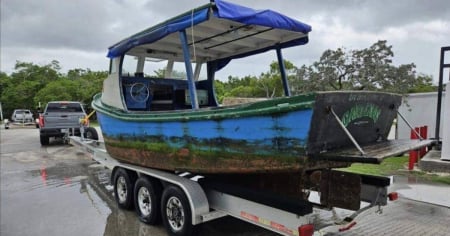
An emotional testimony on Instagram has revived the memory of a dangerous journey that took place three years ago, when a group of young Cubans built a handmade raft and set out to sea in search of freedom.
The post, made by the user identified as "soy danita," has gone viral as it recounts in great detail how on September 14, 2022, they embarked on that journey to the United States, armed only with hope, faith, and an improvised boat.
The young woman recounts that the boat was built by her husband and several friends. For three months, they worked in secret, welding beams, calculating buoyancy, and preparing every detail to set out into open waters.
Fear never disappeared, but the desire to leave Cuba was stronger: "We never saw risks, we always saw the will to arrive. And we never lost faith," he emphasized.
The day of departure was not without tension.
Intense rain and the presence of police on the beach complicated the operation to unload the boat from the truck that transported it. "It was extremely difficult to get that behemoth down from the truck because it weighed a ton," he recalled.
However, they managed to set her out to sea at dawn, equipped with life jackets, water, food, GPS, a locator, and a fuel-loaded engine.
The first night passed peacefully: the sea was completely calm, "like a plate," and the group was making their way toward the Florida Keys, relying on the coordinates they had studied for a month. Danita even managed to talk to her family until she lost signal upon entering international waters.
But at dawn, when they slowed down to approach U.S. territory at night, mechanical problems began. The propeller got tangled in seaweed, and the drive shaft started to fail.
Later on, the worst happened.
The vessel was left adrift just 21 miles off the U.S. coast. They were located by a cruise ship that alerted the U.S. Coast Guard. Following protocol, they were repatriated to Cuba, thwarting their dream of arriving by sea.
The failure of that first voyage did not deter their determination, and they decided to choose another route.
On November 1, 2022, the young woman and her mother traveled to Mexico, where her husband was waiting for them. Together, they crossed the border, and on November 15, they entered the United States. They are now legal residents.
She emphasized that, thanks to God, all the young people who accompanied her on the raft are now in the United States.
"With this story, I want to give you a lesson: if you have a dream, fight for it. Let nothing and no one hold you back. Faith is the last thing to lose," he concluded.
Danita, who now shares her life in freedom, asserts that the journey, despite its risks, allowed them to achieve what they longed for most: a future away from the misery and despair of Cuba.
His account is not only a personal memory but also a portrait of Cuban reality: a country from which its young people flee at the risk of their lives, building rafts with their own hands or crossing jungles and borders to escape.
A story repeated thousands of times, yet it never fails to move or to denounce the daily tragedy that forces so many to take to the sea.
Frequently Asked Questions about Cuban Emigration and Raft Journeys
Why do young Cubans risk their lives on rafts heading to the United States?
Cuban youth risk their lives on rafts in search of freedom and better opportunities, fleeing from the misery and hopelessness they face in Cuba. The story narrated by Danita and the context of other Cubans who have attempted the journey reflect the desperation and desire for a better future away from the Cuban regime. Although the risks are high, many believe it's worth the attempt to attain freedom and a dignified life in the United States.
What challenges do Cuban rafters face during their journey?
Cuban rafters face significant challenges, including mechanical problems with their vessels, adverse weather conditions, and the possibility of being intercepted and repatriated. The journeys are extremely dangerous, as evidenced by the accounts of Danita and other Cubans who have survived these odysseys. The makeshift rafts can drift away, and the presence of the U.S. Coast Guard poses a constant risk of deportation.
How does the immigration policy of the United States affect Cuban migrants?
The immigration policy of the United States has tightened control over Cuban migrants, making it difficult for them to enter and remain in the country. Even those with temporary legal status, such as parole, face the risk of deportation due to restrictive interpretations of the law. Cases like that of Ariel Lara González, who was detained and is facing deportation, highlight the uncertainty that many Cubans seeking asylum and stability in the United States must confront.
What does Danita's story represent for the Cuban community and the world?
Danita's story is a powerful testimony that reflects the reality of many Cubans who risk their lives to escape the oppression in their country. Her tale of bravery and perseverance resonates both within the Cuban community and around the world, highlighting the urgent need for change in Cuba. Danita's journey is not just a personal portrait, but also a condemnation of the conditions that force so many to seek a better future at any cost.
Filed under: