
Related videos:
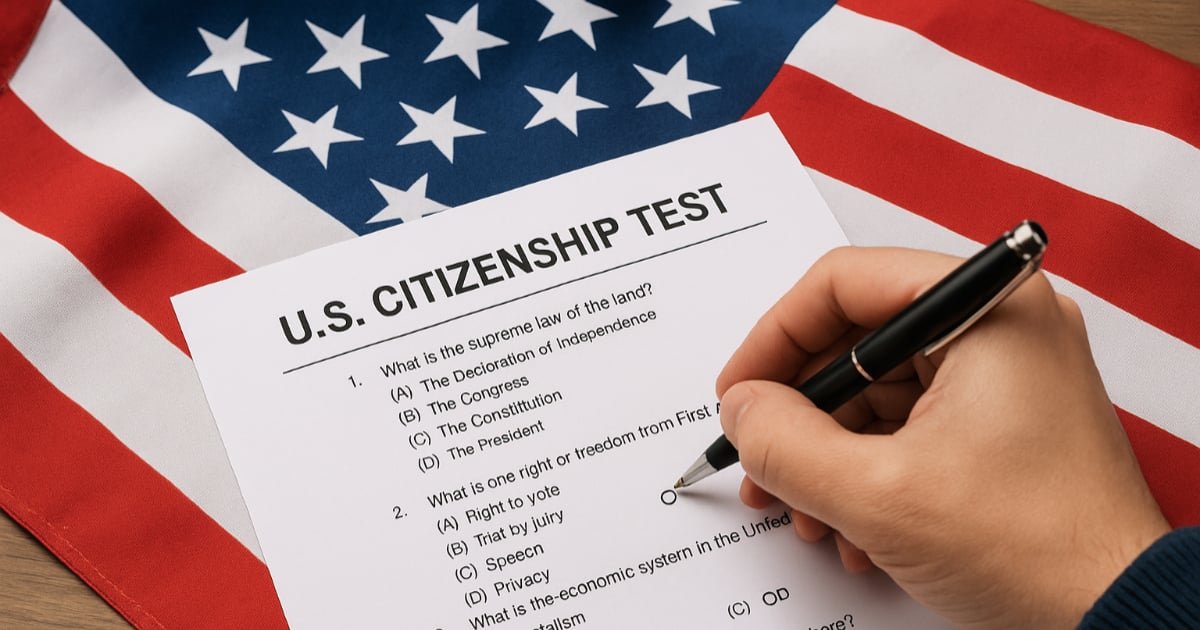
The Trump Administration announced on September 17 the implementation of the new civics test for naturalization in 2025, according to a notice published in the Federal Register by the U.S. Citizenship and Immigration Services (USCIS).
The 2025 exam assesses immigrants' knowledge of the history and government of the United States, in accordance with legal requirements, and is one of the central steps in the naturalization process.
The White House explained that the measure is part of an ongoing effort to "restore the integrity of the naturalization process and fulfill the intentions of Congress."
"Naturalization is a privilege that allows foreign nationals to become full members of American society, with significant rights and responsibilities that all citizens must exercise and respect," the official statement noted.
Applicants must correctly answer at least 12 out of the 20 questions that will be asked orally during the interview. The full bank of the exam consists of 128 questions.
Next, CiberCuba fully reproduces the official questionnaire in English, published by USCIS for the Civics Test 2025.
128 Questions and Answers on Civic Education (2025 Edition)
Below are the 128 questions and answers related to civics education for the 2025 version of the exam. These questions cover important topics about the government and history of the United States. The civics exam is oral, and the USCIS officer will ask you to answer up to 20 of the 128 questions. You must answer correctly at least 12 questions to pass the 2025 version of the exam.
In the civics test, some answers may change due to elections or appointments. Visit uscis.gov/citizenship/testupdates to check for any answers that may have changed. You must respond with the name of the official currently in office at the time of your naturalization interview.
Although USCIS acknowledges that there may be other correct answers to the civics questions, applicants are advised to respond using the answers provided below.
Special Consideration 65/20
If you are 65 years old or older and have lived in the United States as a legal permanent resident for 20 years or more, you can study only the 20 questions marked with an asterisk (*) at the end of each question. You may also take the civics test in the language of your choice. The USCIS officer will ask you to answer 10 of those 20 asterisk questions. You must answer correctly at least 6 out of the 10 questions (or 60%) to pass the 2025 version of the exam.
AMERICAN GOVERNMENT
A: Principles of American Government
1. What is the form of government of the United States?
• Republic
• Constitution-based federal republic
• Representative democracy
2. What is the supreme law of the land? *
• (U.S.) Constitution
3. Name one thing the U.S. Constitution does.
• Establishes the government
• Outlines the powers of government
• Specifies the branches of government
• Safeguards the rights of the people
4. The U.S. Constitution starts with the words “We the People.” What does “We the People” mean?
• Self-government
• Popular sovereignty
• Consent of the governed
• People should govern themselves
• (Example of) social contract
5. How are changes made to the U.S. Constitution?
• Amendments
• The amendment process
6. What does the Bill of Rights protect?
• The fundamental rights of Americans
• The fundamental rights of people living in the United States
7. How many amendments does the U.S. Constitution have?
• Twenty-seven (27)
8. Why is the Declaration of Independence important?
• It declares America's freedom from British control
• It asserts that all people are created equal
• It identifies inherent rights
• It states that the United States is independent (from Great Britain)
9. What founding document declared that the American colonies were free from Britain?
• Declaration of Independence
10. Name two important ideas from the Declaration of Independence and the U.S. Constitution.
• Equality
• Liberty
• Social contract
• Natural rights
• Limited government
• Self-government
11. The words “Life, Liberty, and the pursuit of Happiness” are in what founding document?
• Declaration of Independence
12. What is the economic system of the United States? *
• Capitalism
• Free market economy
13. What is the rule of law?
• Everyone must follow the law
• Leaders must obey the law
• The government must adhere to the law
• No one is above the law
14. Many documents influenced the U.S. Constitution. Name one.
• Declaration of Independence
• Articles of Confederation
• Federalist Papers
• Anti-Federalist Papers
• Virginia Declaration of Rights
• Fundamental Orders of Connecticut
• Mayflower Compact
• Iroquois Great Law of Peace
15. There are three branches of government. Why?
• To prevent any one part from becoming too powerful
• Checks and balances
• Separation of powers
B: System of Government
16. Name the three branches of government.
• Legislative, executive, and judicial
• Congress, president, and the courts
17. The President of the United States is in charge of which branch of government?
• Executive (branch)
18. What part of the federal government writes laws?
• (U.S.) Congress
• (U.S. or national) legislature
19. What are the two parts of the U.S. Congress?
• Senate and House of Representatives
20. Name one power of the U.S. Congress.
• Writes laws
• Declares war
• Creates the federal budget
21. How many U.S. senators are there?
• One hundred (100)
22. How long is a term for a U.S. senator?
• Six (6) years
23. Who is one of your state’s U.S. senators now? *
• Answers will vary (Senators represent the entire state)
24. ¿Cuántos miembros votantes hay en la Cámara de Representantes?
• Cuatrocientos treinta y cinco (435)
25. How long is a term for a member of the House of Representatives?
• Two (2) years
26. Why do U.S. representatives serve shorter terms than U.S. senators?
• To more closely align with public opinion
27. How many senators does each state have?
• Two (2)
28. Why does each state have two senators?
• Equal representation (for smaller states)
• The Great Compromise (Connecticut Compromise)
29. Nombra a tu representante en EE. UU. *
• Las respuestas variarán
30. What is the name of the Speaker of the House of Representatives now?
• Visit uscis.gov/citizenship/testupdates to find out the name of the Speaker of the House of Representatives.
31. Who does a U.S. senator represent?
• Citizens of their state
32. Who elects U.S. senators?
• Citizens from their state
33. Who does a member of the House of Representatives represent?
• Citizens in their (congressional) district
• Citizens in their district
34. Who elects members of the House of Representatives?
• Citizens from their congressional district
35. Some states have more representatives than others. Why?
• (Because of) the state's population
• (Because) they have more people
• (Because) some states have more people
36. The President of the United States is elected for how many years?
• Four (4) years
37. In what month do we vote for president? *
• November
38. What is the name of the President of the United States now? *
• Visit uscis.gov/citizenship/testupdates for the name of the President of the United States
39. What is the name of the Vice President of the United States currently?
• Visit uscis.gov/citizenship/testupdates for the name of the Vice President of the United States
40. If the President can no longer serve, who becomes President?
• The Vice President
41. Name one power of the President.
• Signs bills into law
• Vetoes bills
• Enforces laws
• Commander in Chief of the military
• Chief diplomat
42. Who is the Commander in Chief of the U.S. military?
• The President
43. Who signs bills to become laws?
• The President
44. Who vetoes bills?
• The President
45. ¿Quién nombra a los jueces federales?
• El Presidente
46. The Executive Branch has many components. Name one.
• President
• Cabinet
• Federal departments and agencies
47. What does the President’s Cabinet do?
• Advises the President
48. What are two Cabinet-level positions?
• Attorney General
• Secretary of Agriculture
• Secretary of Commerce
• Secretary of Defense
• Secretary of Education
• Secretary of Energy
• Secretary of Health and Human Services
• Secretary of Homeland Security
• Secretary of Housing and Urban Development
• Secretary of the Interior
• Secretary of Labor
• Secretary of State
• Secretary of Transportation
• Secretary of the Treasury
• Secretary of Veterans Affairs
49. Why do Cabinet members serve for different lengths of time?
• They serve as long as the President desires.
50. What is one part of the judicial branch?
• Supreme Court
• Federal Courts
51. What does the judicial branch do?
• Reviews laws
• Explains laws
• Resolves disputes (disagreements) about the law
• Decides if a law is in conflict with the (U.S.) Constitution
52. What is the highest court in the United States?
• Supreme Court
53. How many seats are on the Supreme Court?
• Nine (9)
54. How many Supreme Court justices are usually needed to decide a case?
• Five (5)
55. ¿Cuánto tiempo sirven los jueces de la Corte Suprema?
• De por vida
• Nombramiento de por vida
• (Hasta) jubilación
56. Supreme Court justices serve for life. Why?
• To ensure independence (from politics)
• To minimize external influences
57. Who is the Chief Justice of the United States now?
• Visit uscis.gov/citizenship/testupdates for the name of the Chief Justice of the United States
58. Name one power that is only for the federal government.
• Print paper money
• Mint coins
• Declare war
• Create an army
• Make treaties
• Set foreign policy
59. Name one power that is only for the states.
• Provide schooling and education
• Provide protection (police)
• Provide safety (fire departments)
• Give a driver’s license
• Approve zoning and land use
60. What is the purpose of the 10th Amendment?
• It affirms that powers not granted to the federal government are reserved for the states or the people.
61. Name one power that belongs to the states and the federal government (shared powers).
• Tax
• Build roads
• Create lower courts
• Borrow money
62. Who is currently the Governor of your state? *
• Answers will vary
C: Rights and Responsibilities
63. There are four amendments to the U.S. Constitution regarding who can vote. Describe one of them.
• Citizens eighteen (18) years and older (can vote)
• You don’t have to pay (a poll tax) to vote
• Any citizen can vote. (Women and men can vote)
• A male citizen of any race (can vote)
64. Who can vote in federal elections, run for federal office, and serve on a jury in the United States?
• Citizens
65. What are three rights of everyone living in the United States?
• Freedom of expression
• Freedom of speech
• Freedom of assembly
• Freedom to petition the government
• Freedom of religion
• The right to bear arms
66. What are we pledging loyalty to when we recite the Pledge of Allegiance?
• The United States
• The flag
67. Name two promises that new citizens make in the Oath of Allegiance.
• Give up loyalty to other countries
• Defend the (U.S.) Constitution
• Obey the laws of the United States
• Serve in the military (if needed)
• Serve (help, do important work for) the nation (if needed)
• Be loyal to the United States
68. How can people become United States citizens?
• Naturalization
• Deriving citizenship
• Being born in the United States
69. What is one reason colonists came to America?
• Freedom
• Political liberty
• Religious freedom
• Economic opportunity
• Escape persecution
70. Who lived in America before the Europeans arrived?
• American Indians
• Native Americans
71. What group of people was taken and sold as slaves?
• Africans
• People from Africa
72. Who wrote the Declaration of Independence?
• (Thomas) Jefferson
AMERICAN HISTORY
A: Colonial Period and Independence
73. When was the Declaration of Independence adopted?
• July 4, 1776
74. Name three of the original 13 states.
• New Hampshire
• Massachusetts
• Rhode Island
• Connecticut
• New York
• New Jersey
• Pennsylvania
• Delaware
• Maryland
• Virginia
• North Carolina
• South Carolina
• Georgia
75. What happened at the Constitutional Convention?
• The Constitution was drafted
• The Founding Fathers created the Constitution
76. ¿Cuándo fue redactada la Constitución de los Estados Unidos?
• 1787
77. The Federalist Papers supported the passage of the U.S. Constitution. Name one of the writers.
• (James) Madison
• (Alexander) Hamilton
• (John) Jay
• Publius
78. Who is called the “Father of Our Country”?
• (George) Washington
79. Who was the first President? *
• (George) Washington
80. What territory did the United States buy from France in 1803?
• Louisiana Territory
• Louisiana
81. Name one war fought by the United States in the 1800s.
• War of 1812
• Mexican-American War
• Civil War
• Spanish-American War
82. Name the U.S. war between the North and the South.
• The Civil War
• The War between the States
83. The Civil War had many important events. Name one.
• (Battle of) Fort Sumter
• Emancipation Proclamation
• (Battle of) Gettysburg
• Siege of Vicksburg
• Sherman’s March
• Surrender at Appomattox
• (Battle of) Antietam/Sharpsburg
• Lincoln was assassinated
84. Name one problem that led to the Civil War.
• Slavery
• Economic reasons
• States’ rights
85. What did the Emancipation Proclamation do?
• Freed the slaves
• Freed slaves in the Confederacy
• Freed slaves in the Confederate states
• Freed slaves in most Southern states
86. Abraham Lincoln is famous for many things. Name one.
• Freed the slaves (Emancipation Proclamation)
• Led the U.S. during the Civil War
• 16th president of the United States
• Delivered the Gettysburg Address
87. What did the 13th Amendment do?
• Abolished slavery
• Freed the slaves
88. What did the 14th Amendment do?
• Defined citizenship
• Stated that all people born in the United States are citizens
• Asserted that citizens are equal under the law
89. What did the 15th Amendment do?
• Granted all men the right to vote
• Stated that voting cannot be based on race
• Stated that voting cannot be based on color
• Stated that voting cannot be based on past condition of servitude
B: 1800s
90. What U.S. war ended slavery?
• The Civil War
91. What did Susan B. Anthony do?
• Advocated for women’s rights
• Advocated for civil rights
92. Name one leader of the women’s rights movement in the 1800s.
• Susan B. Anthony
• Elizabeth Cady Stanton
• Sojourner Truth
• Harriet Tubman
• Lucretia Mott
93. Name one important leader of the Civil Rights Movement in the 1900s.
• Martin Luther King, Jr.
• Rosa Parks
• Malcolm X
• John Lewis
94. What did Martin Luther King, Jr. do?
• Advocated for civil rights
• Strived for equality for all Americans
95. Dwight Eisenhower is famous for many things. Name one.
• General during World War II
• President at the end of the Korean War
• 34th president of the United States
• Signed the Federal-Aid Highway Act of 1956 (Created the Interstate System)
96. Who was President during the Great Depression and World War II?
• (Franklin) Roosevelt
97. Who did the United States fight in World War II?
• Japan, Germany, and Italy
98. When was the Constitution signed?
• September 17, 1787
99. When did the United States enter World War II?
• December 7, 1941
• After the Japanese attacked Pearl Harbor
C: Recent American History and Other Important Historical Information
100. Name one war fought by the United States in the 1900s.
• World War I
• World War II
• Korean War
• Vietnam War
• (Persian) Gulf War
101. Who was President during World War I?
• Wilson
102. Who was President during the Great Depression and World War II?
• (Franklin) Roosevelt
103. Who did the United States fight in World War II?
• Japan, Germany, and Italy
104. Before he was President, Eisenhower was a general. What war was he in?
• World War II
105. During the Cold War, what was the main concern of the United States?
• Communism
106. What movement tried to end racial discrimination?
• Civil rights movement
107. Martin Luther King, Jr. is famous for many things. Name one.
• Fought for civil rights
• Worked for equality for all Americans
• “I Have a Dream” speech
• Led nonviolent resistance
108. What did the Civil Rights Act of 1964 accomplish?
• Prohibited discrimination based on race, color, religion, sex, or national origin
• Ended segregation in public places
109. Why did the United States enter the Persian Gulf War?
• To expel the Iraqi military from Kuwait
110. What major event happened on September 11, 2001, in the United States? *
• Terrorists attacked the United States
• Terrorists hijacked two planes and crashed them into the World Trade Center in New York City
• Terrorists hijacked a plane and crashed it into the Pentagon in Arlington, Virginia
• Terrorists hijacked a plane originally intended for Washington, D.C., and crashed it in a field in Pennsylvania
111. Name one American Indian tribe in the United States.
• Cherokee
• Navajo
• Sioux
• Chippewa
• Choctaw
• Pueblo
• Apache
• Iroquois
• Creek
• Blackfeet
• Seminole
• Cheyenne
• Arawak
• Shawnee
• Mohegan
• Huron
• Oneida
• Lakota
• Crow
• Teton
• Hopi
• Inuit
112. Name one U.S. territory.
• Puerto Rico
• U.S. Virgin Islands
• American Samoa
• Northern Mariana Islands
• Guam
113. Name one of the two longest rivers in the United States.
• Missouri (River)
• Mississippi (River)
114. What ocean is on the East Coast of the United States?
• Atlantic (Ocean)
115. What ocean is on the West Coast of the United States?
• Pacific (Ocean)
116. Nombra un estado de los EE. UU. que limita con Canadá.
• Maine
• New Hampshire
• Vermont
• Nueva York
• Pensilvania
• Ohio
• Michigan
• Minnesota
• Dakota del Norte
• Montana
• Idaho
• Washington
• Alaska
117. Name one U.S. state that borders Mexico.
• California
• Arizona
• New Mexico
• Texas
118. What is the capital of the United States? *
• Washington, D.C.
SYMBOLS AND HOLIDAYS
A: Symbols
119. Where is the Statue of Liberty? *
• New York (Harbor)
• Liberty Island
[Also acceptable are New Jersey, near New York City, and on the Hudson (River)]
120. Why does the flag have 13 stripes?
• Because there were 13 original colonies
• Because the stripes represent the original colonies
121. Why does the flag have 50 stars? *
• Because there is one star for each state
• Because each star represents a state
• Because there are 50 states
122. What is the name of the national anthem?
• The Star-Spangled Banner
123. What do we express loyalty to when reciting the Pledge of Allegiance?
• The United States
• The flag
124. What is Independence Day? *
• A holiday to celebrate U.S. independence (from Britain)
• The country’s birthday
B: Holidays
125. Name three national U.S. holidays. *
• New Year’s Day
• Martin Luther King, Jr. Day
• Presidents Day (Washington’s Birthday)
• Memorial Day
• Independence Day
• Labor Day
• Columbus Day
• Veterans Day
• Thanksgiving Day
• Christmas Day
126. What is Memorial Day?
• A holiday to honor soldiers who died in military service.
127. What is Veterans Day?
• A holiday to honor individuals in the U.S. military
• A holiday to honor those who have served in the U.S. military
128. When do we celebrate Independence Day?
• July 4
Filed under: