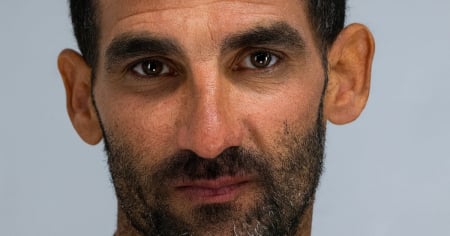
The Cuban Deivy Alemán Oropesa, who decided to self-deport to his country to avoid being detained and forcibly expelled by U.S. authorities, is now back in his home in Palmira, Cienfuegos.
Deivy, who lived in Orlando, Florida, with his wife and daughter, recounted in a video his ordeal: the separation from his sick daughter and the uncertainty of a future that is now crumbling.
"I'm experiencing the toughest moments of my life," he confessed to journalist Javier Díaz from Univisión.
"It has been three days separated from my little girl, without being able to hug her, without being able to support her. We used to go together to practically everything, to the stores, to all her appointments, her mother and I would always go with her together," he detailed.
"I am asking for the help of some congressman, the authorities, who can assist me in advancing my case with the I-130 (the petition my wife submitted) so that I can be there with her as soon as possible (...) expedite the process and be with her again before her upcoming surgery," he added.
In another video shared by journalist Alexis Boentes from Telemundo 51, Alemán Oropesa explained that his decision to self-deport to Cuba was strategic, though painful.
"After having me deported for three, four, six months... it would have been worse. That's what I thought. In order to return with my status, following my wife's petition, I believe this was the best option," he detailed.
One thing that worries him a lot is that he has no way to financially support his wife and daughter from Cuba.
"Here there is no way to work or to find money to help them. The truth is, I don’t know what to do here. And the little girl today… crying, crying, asking for me. It breaks your heart," she confessed.
The young father expressed his gratitude for the support received from the Cuban community in the United States.
"However, the emotional weight does not ease: 'My wife is already quite desperate. And with the girl, we are afraid she might relapse. She can't get too stressed with that problem.'"
The Cuban made a call to congress members and senators to address his case.
"I just want to go support her, as I have always done, by doing things right in the United States. It is a land of opportunities; I love that country. And I truly wish to have my reunion with my family as soon as possible," he concluded.
A father forced into exile
The story of this father began to take a turn on September 8, when he attended a routine appointment with ICE. There, he was informed that he had to leave the United States before September 14, or he would be detained and deported.
"In the appointment with ICE, I was informed that if I stayed, they would have to keep me in detention and would deport me on their own. Otherwise, I had to present my exit ticket this Sunday. I believe the best option is to leave voluntarily," he recounted.
After seven years in the country, working as an Uber driver, with no criminal record and paying taxes, Alemán Oropesa did not expect such an abrupt outcome. However, the deportation order that had been looming over him since his irregular entry through the border eventually caught up with him.
Their departure leaves an economic and human void.
The couple's daughter, a two-year-old American citizen, has already undergone three open-heart surgeries and needs more medical procedures. While the mother focuses on taking care of her, Deivy was the family's sole breadwinner.
"It will be difficult. I'm worried that our daughter might become depressed and have a relapse. I can practically see myself living on the street because how am I going to take care of my little girl and work to pay the rent and the bills," confessed Yisel Miguel Sarduy, the wife of the Cuban, clearly desperate.
Ignored Humanity
Neither the medical tests nor the letters from specialists were able to stop Deivy's departure.
Lawyer Rosaly Chaviano explained that he was under immigration supervision (form I-220B), and that "under the current policies, humanitarian factors are virtually not being taken into account."
The journalist Javier Díaz, who documented the case from the beginning, criticized the rigidity of the system: "It is a sad case where having humanitarian reasons or being an exemplary migrant is of no use at all; if you have a deportation order, you will be deported."
On social media, hundreds of users expressed their outrage over what they consider an inhumane decision. A petition was even created on Change.org to stop the deportation, although time was not on their side.
A hope in the midst of separation
The only light that supports the family is the approved I-130 petition, part of the family reunification process, which could allow Deivy's return in the future.
"The hope I have left is that when I am in Cuba, I receive the reunification request that my wife filed for me. And to be together here as soon as possible," said the Cuban before taking his flight back.
Meanwhile, the family clings to the hope that public pressure and the legal process can expedite the reunification.
But the blow has already been struck: this Sunday, Deivy Alemán Oropesa left behind his wife and his sick daughter in the United States to start from Cuba what he himself describes as "the hardest moments" of his life.
Frequently Asked Questions About the Deportation of Deivy Alemán Oropesa
Why did Deivy Alemán Oropesa decide to self-deport from the United States?
Deivy Alemán Oropesa decided to self-deport to avoid being detained and forcibly deported by the U.S. Immigration and Customs Enforcement (ICE). He had been informed that he needed to leave the country by September 14, otherwise he would be arrested and deported. Faced with this situation, he chose to leave voluntarily, believing that this action could facilitate his return in the future through the family reunification process approved by his wife.
What is the medical situation of Deivy Alemán Oropesa's daughter?
The daughter of Deivy Alemán Oropesa, a two-year-old American citizen, has undergone three open-heart surgeries and needs more medical procedures in the future. Her delicate health condition was one of the main reasons Deivy sought to remain in the United States, to be with his family and provide support during this challenging medical process.
What hope does Deivy Alemán's family have for reunification in the United States?
Deivy Alemán Oropesa's family has an approved I-130 petition, which is part of the family reunification process. This petition could allow for his return to the United States in the future, depending on the progress of his case and current immigration policies. In the meantime, the family hopes that public pressure and the legal process might expedite reunification.
How has the community and social media reacted to the case of Deivy Alemán?
The case of Deivy Alemán Oropesa has sparked a wave of solidarity on social media, where many users have expressed their outrage at the lack of sensitivity from immigration authorities. Petitions have been created on platforms like Change.org to try to halt the deportation, although time was not on their side. Additionally, there have been numerous displays of support from the Cuban community in the United States, which has voiced its backing for the family during this difficult time.
Filed under: