
Related videos:
The regimes of Cuba and Venezuela once again showcased their close political and ideological alliance this week amid increasing tensions with the United States in the Caribbean.
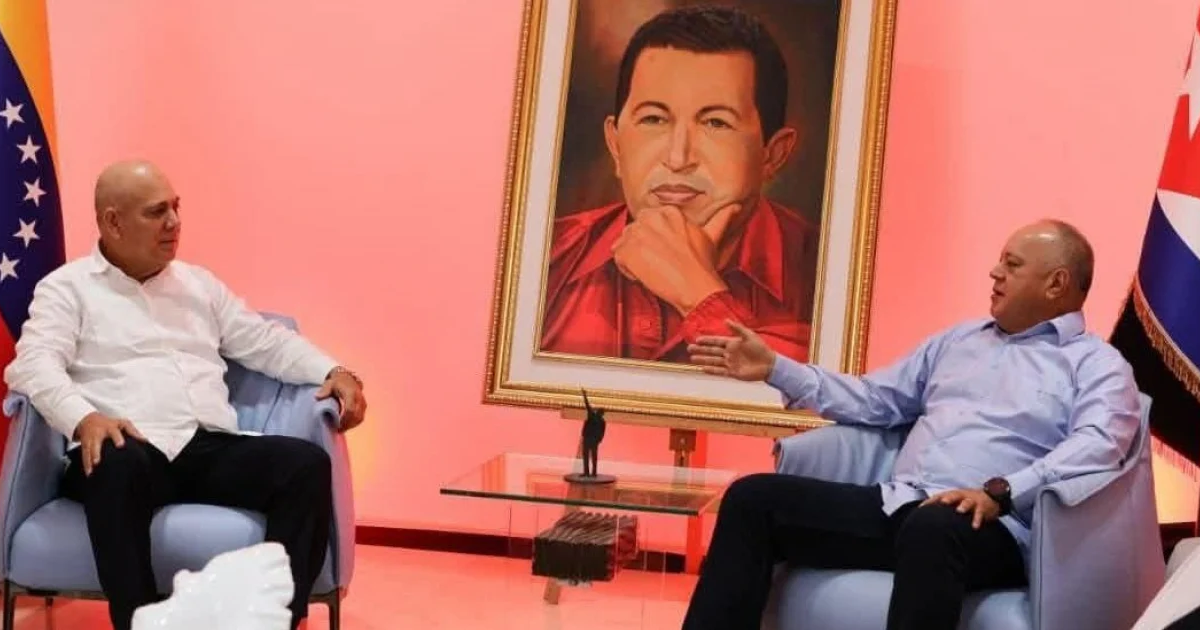
The Communist Party of Cuba (PCC) and the United Socialist Party of Venezuela (PSUV) signed a cooperation agreement in Caracas, which their leaders presented as another step towards unity between both governments, although they did not provide specific details about the content of the pact.
The meeting was led by Diosdado Cabello, the second-in-command of Chavismo and Secretary General of the PSUV, and Roberto Morales Ojeda, Secretary of Organization of the Central Committee of the PCC, one of the most prominent figures of the Cuban elite and a figure mentioned as a possible successor to Miguel Díaz-Canel.
Cabello did not hesitate to invoke the legacy of Hugo Chávez and Fidel Castro to emphasize the brotherhood between the two power structures.
"Your visit is always good news, because we have learned how to stay united," he declared.
For his part, Morales Ojeda stated that the goal is to continue working together in the political, diplomatic, and communication spheres, which confirms that the Caracas-Havana axis continues to operate as a bloc against Washington.
Propaganda and tributes
During his visit to Venezuela, Morales Ojeda praised the "conviction" of the Venezuelan people to defend their sovereignty, a discourse mirroring that which Havana has used for decades to justify its own authoritarian control.
"I believe that the way the Venezuelan people are responding demonstrates their conviction to defend their sovereignty, to defend their independence, and not to allow interference in internal affairs," he stated on the state-owned Venezolana de Televisión (VTV).
Meanwhile, from Cuba, the Ministry of Foreign Affairs issued a warning about what it described as a "direct military aggression" by the United States against the South American country that, according to the official statement, would have "incalculable consequences" for the region.
The Cuban regime insists that Washington's true intention is to seize Venezuelan oil, repeating a narrative that overlooks the severe internal crisis and corruption suffocating both countries.
Climbing in the Caribbean
The warning from Havana coincided with the military buildup by the United States in the area. Washington has eight warships armed with missiles, a nuclear submarine, and ten F-35 fighter jets stationed at a base in Puerto Rico.
The White House directly accuses Nicolás Maduro of leading the Cartel of the Suns, a criminal network linked to drug trafficking that, according to U.S. investigations, has been operating for decades under state protection.
Caracas, true to its style, rejects the accusations and denounces "U.S. propaganda."
In this context, Trump publicly denied promoting a "regime change" in Venezuela, although he reaffirmed the offensive against drug trafficking structures linked to chavismo.
"We are clear about Maduro and his regime, but we will not do anything to change it," stated one of his special envoys, Richard Grenell.
Nervousness in Havana
Beyond the official rhetoric, the military presence of the United States in the Caribbean greatly concerns the Cuban regime.
Aware that its political and economic survival depends on Venezuela, Havana is increasing its declarations of "alert" and requests international support to prevent what it describes as an "illegal" escalation by Washington.
Díaz-Canel, following the line of propaganda from his foreign ministry, stated in X that the true goal of the United States is to "take control of Venezuelan oil."
The reality, however, is that the Castro regime has a lot to lose.
Thousands of advisors in security, intelligence, and health remain in Venezuela as part of the Chavista control apparatus, and in return, Havana receives subsidized oil and other vital resources to sustain its ailing economy.
An isolated block
The signing of this agreement between the PCC and the PSUV only reaffirms the mutual dependence of two authoritarian regimes, both internationally criticized for human rights violations, political repression, and the collapse of their economies.
While millions of Venezuelans and Cubans flee misery, their leaders prefer to showcase party alliances that offer little or nothing to their people.
The unity between Havana and Caracas, far from representing a guarantee of sovereignty, transforms into a shield of power against popular discontent.
In an increasingly tense Caribbean, the alliance between Cuba and Venezuela confirms that both regimes continue to bet on confrontation with the United States as their only means of political survival, even though this further deepens the isolation and suffering of their citizens.
Frequently asked questions about the tensions between Cuba, Venezuela, and the U.S.
What is the objective of the recent cooperation agreement between Cuba and Venezuela?
The goal of the cooperation agreement between Cuba and Venezuela is to strengthen the political and ideological unity between both countries in the face of the United States, although no specific details about its content have been provided. This agreement highlights the persistence of the Caracas-Havana axis in maintaining a common stance against Washington.
How has the United States responded to the actions of Cuba and Venezuela?
The United States has increased its military presence in the Caribbean in response to the actions of Cuba and Venezuela, maintaining eight warships, a nuclear submarine, and F-35 fighters in the region. The White House accuses Nicolás Maduro of leading the Cartel of the Suns and of activities linked to drug trafficking, which has heightened tensions in the area.
Why is the alliance between Cuba and Venezuela important for both countries?
The alliance between Cuba and Venezuela is crucial for both regimes due to their mutual dependence in political and economic terms. Cuba receives subsidized oil and vital resources from Venezuela, while Cuban advisors support Maduro's government in security, intelligence, and health. This dependency is fundamental for the survival of both regimes amidst sanctions and international pressures.
What is Cuba's stance on the accusations made by the United States against Venezuela?
Cuba has rejected the accusations from the United States against Venezuela and has condemned the U.S. military presence in the Caribbean as a threat to regional peace. The Cuban regime argues that Washington's actions aim to seize Venezuelan oil, ignoring the internal crises and corruption affecting both countries.
Filed under: