
Related videos:
The captain of the National Revolutionary Police (PNR), Leonel Mesa Rodríguez, was buried on Saturday with military honors after being found murdered on a stretch of road between Remedios and Caibarién, in Villa Clara.
Mesa Rodríguez, 62 years old, was mourned and laid to rest in his hometown of Taguasco, in Sancti Spíritus.
The ceremony was attended by family members, neighbors, and colleagues, as well as the senior leadership of the Ministry of the Interior (MININT), headed by the minister himself, Army Corps General Lázaro Alberto Álvarez Casas.
The first secretaries of the Party in Villa Clara and Sancti Spíritus also attended, Suseli Morfa González (remembered by the Cuban people as the millionaire psychologist) and Delvy Pérez Martín, respectively.
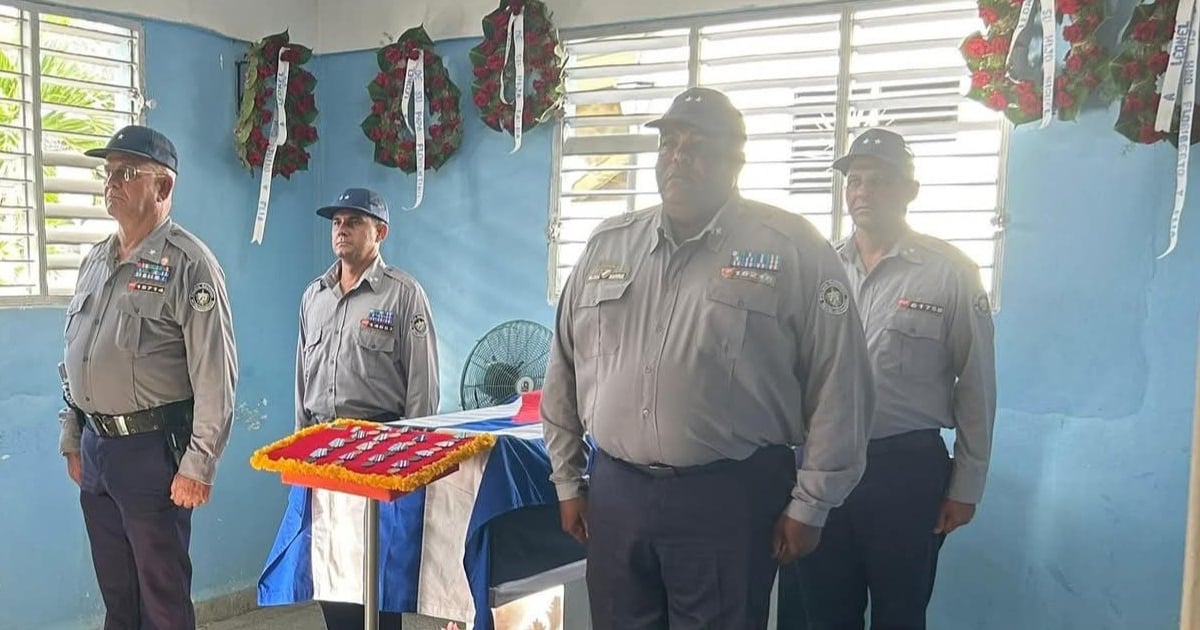
Images shared on social media show the casket covered with the Cuban flag, surrounded by uniformed personnel in a honor guard.
On the walls hung flower wreaths, and beside the casket were his decorations, a total of 12 medals.
Army General Raúl Castro and the ruler Miguel Díaz-Canel sent wreaths, in a gesture that aims to emphasize the political importance the regime places on this case.
A confirmed violent crime
According to a note from the MININT, the lifeless body of Mesa was found in the La Reforma popular council, where he served as a sector chief, with six stab wounds and a gunshot wound to the head.
Next to the body was found the official motorcycle he used for his work.
The government confirmed that it was a direct attack and stated that specialized teams are investigating the incident "for its full clarification."
Before the official report, neighbors and independent media had leaked the news with similar versions.
The portal CubaNet reported having access to two videos showing the agent, covered in blood, lying in the middle of the road while other officers redirected traffic.
In one of the recordings, a bus driver recounted that hours earlier he had seen him talking to someone at the side of the same road.
Funeral and propaganda
The internet messages from government profiles and those close to the deceased were filled with epic accounts of his journey.
At the farewell during mourning, Colonel Eddy Sierra Arias, head of the General Directorate of the PNR, emphasized his "tireless struggle against crime" and his "high sensitivity in providing the people with order and public safety."
Mesa Rodríguez joined the MININT in January 2004, serving as a public order agent, operational vehicle driver, and sector chief for over 10 years. He was promoted to the rank of captain.
She was a militant of the Communist Party and a member of the Party Committee of MININT in Caibarién.
Among the medals he received was the Internationalist Combatant medal from Ethiopia and nine Distinctions for Distinguished Service.
According to Sierra Arias, the highest honor he earned was "the respect, affection, and support of the revolutionary people of Caibarién."
But this official discourse clashes with numerous testimonies on social media that accuse him of a disgraceful past in service of the regime.
Reactions contrary to the regime's position
The officer's death sparked further comments on social media, where neighbors reported incidents in which Mesa acted as a repressive despot in his work.
According to sources cited by the Facebook account La Tijera, Mesa is remembered in the locality of La Reforma for his abuses and repression against the population, which would have led to the imprisonment of individuals not for committing crimes, but for holding political ideals opposed to the government.
"It is worth remembering that on June 6th, he was promoted for 'his work' in the repression against the people," stated the author of the post that revealed his death.
Context of escalating violence
The murder occurred at a time when the country is experiencing a notable increase in violence and crime, aggravated by the economic and social crisis.
Thefts, assaults, and homicides are on the rise in the streets, while the authorities attempt to project control through official funerals, propaganda-laden speeches, and police deployments.
The investigation into the case continues, but the MININT has made it clear that it will use the incident to reinforce the narrative of "resistance" against crime.
Meanwhile, Mesa's crime highlights the contradictions of a system where the police present themselves as guarantors of order, yet citizen insecurity progresses unchecked.
Frequently asked questions about the murder of Captain Leonel Mesa Rodríguez
Who was Captain Leonel Mesa Rodríguez?
Leonel Mesa Rodríguez was a captain in the National Revolutionary Police (PNR), known by his nickname "Cal Viva". He was 62 years old and was the sector chief in Caibarién, Villa Clara. His background included his agricultural roots in Taguasco, Sancti Spíritus, and his work in the Railway Police. He was described by state media as a dedicated police officer, although some neighbors recalled episodes of abuse.
How did the murder of Captain Mesa occur?
Captain Mesa was found murdered on a stretch of road between Remedios and Caibarién, in Villa Clara. He had six stab wounds and a gunshot wound to the head. Next to his body, the official motorcycle he used for work was discovered. The government has confirmed that this was a targeted attack and that specialized teams are investigating the case.
What reactions has the murder of Captain Mesa generated?
The murder has sparked divided reactions. State media describe him as a respected police officer, but on social media, some neighbors have recalled episodes of abuse during his duty. The official rhetoric frames the crime as an attack against the homeland, turning the murder into a political symbol.
What is the context of violence in Cuba at the time of the murder?
Cuba is experiencing a notable increase in violence and crime, exacerbated by the economic and social crisis. The number of robberies, assaults, and homicides has surged, while authorities attempt to project control through official funerals and police deployments. The murder of Captain Mesa highlights the contradictions of a system where citizens' insecurity grows unchecked.
Filed under: