
Related videos:
The Cuban regime's chancellor Bruno Rodríguez Parilla traveled to New York this Saturday, where he held meetings with Cubans residing in the U.S. and American doctors who graduated from the island.
On the same Saturday, Rodríguez Parilla met with "a hundred Cubans residing throughout the entire United States at the headquarters of the Permanent Mission of Cuba to the United Nations to 'dialogue with Cuban authorities, discuss, and work together for the sovereignty and well-being of the Homeland,'" according to a statement from the Foreign Ministry.
"Cuba will always act and defend the rights of Cubans residing abroad and will act with determination to safeguard their well-being, dignity, and integrity," he said at the meeting.
The photos that have surfaced from the meeting only show Rodríguez Parilla speaking and not the Cubans who participated in the gathering.
The regime often uses these types of meetings with its supporters to project an image of dialogue with the diaspora, when in reality it ignores the calls for freedom from a significant portion of the Cuban exile community.
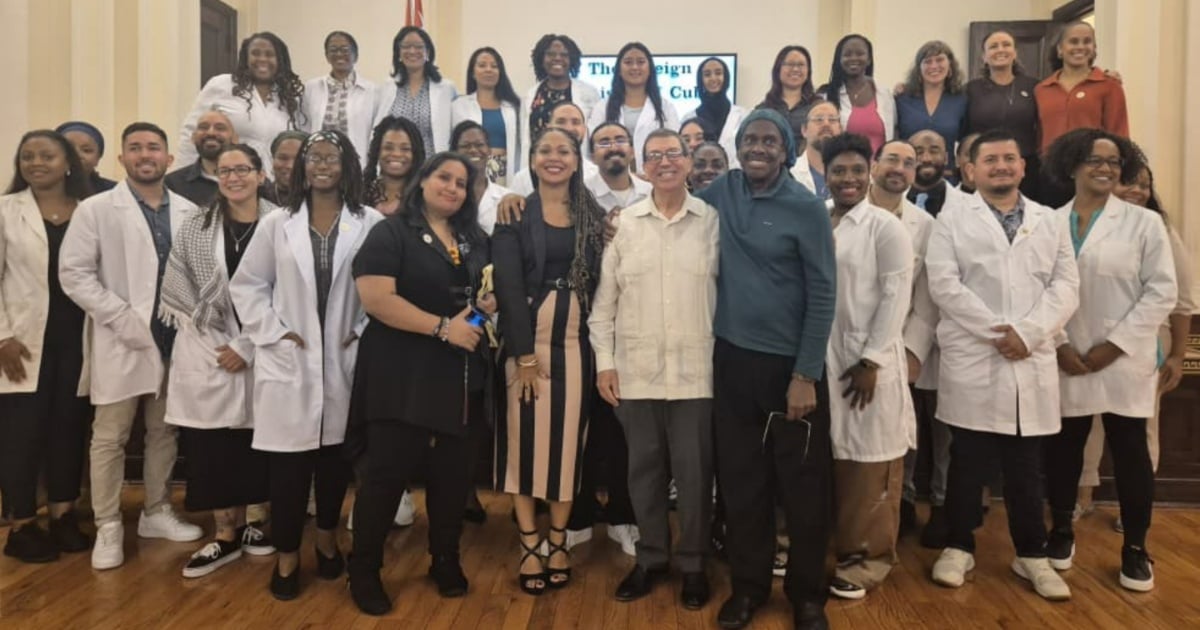
This Sunday, the leader also met with American graduates of the Latin American School of Medicine (ELAM)
"We take pride in engaging with American graduates of ELAM, a testament to the enduring solidarity between the peoples of Cuba and the U.S. We learned about their experiences in this country and encouraged them to keep assisting the American people with a deep humanistic vocation," he wrote on X about the meeting of which photos were indeed shared.
Rodríguez Parilla's trip is part of his participation this week in the high-level segment of the United Nations General Assembly.
This week, Rodríguez Parilla made headlines after stating before the Diplomatic Corps accredited on the island that, if it weren't for the U.S. embargo, Cuba's Gross Domestic Product (GDP) at current prices would have grown by 9.2% last year.
"Two months of blockade have caused damages amounting to 1.6 billion USD, equivalent to the cost of the fuel needed to meet the country’s normal electricity demand," published on the social network X (formerly Twitter), without explaining how these alleged losses were calculated.
He added that just 12 days of embargo would represent losses of 250 million USD, the same amount required to maintain the National Electroenergetic System annually.
However, the figures contrast with the previous acknowledgments from the government itself, which admitted that the Cuban economy contracted by 1.1% in 2024 and did not achieve the projected 3% growth for GDP.
Frequently Asked Questions about Bruno Rodríguez's Visit to New York
What was the purpose of Bruno Rodríguez's visit to New York?
The purpose of Bruno Rodríguez's visit to New York was to participate in the United Nations General Assembly and hold meetings with Cubans living in the United States and American doctors who graduated from Cuba. These meetings aim to project an image of dialogue and solidarity with the Cuban diaspora, although they are criticized for ignoring the demands for freedom from the Cuban exile community.
What topics did Bruno Rodríguez discuss with the American doctors graduated in Cuba?
In his meeting with U.S. doctors who graduated in Cuba, Bruno Rodríguez highlighted the solidarity between Cuba and the United States and urged the doctors to continue assisting the American people with a humanitarian spirit. This type of gathering is part of the Cuban regime's strategy to promote its medical service programs abroad, despite sanctions and international criticism for labor violations.
What is the Cuban regime's stance on the United States embargo?
The Cuban regime blames the United States embargo for the island's economic problems, claiming that, if it did not exist, Cuba's GDP would have grown by 9.2% last year. However, this narrative contrasts with the government's own admission of an economic contraction of 1.1% in 2024 and its failure to meet its economic growth projections.
How does the Cuban regime utilize meetings with the Cuban diaspora abroad?
The Cuban regime uses meetings with the diaspora to project an image of dialogue and connection with Cubans abroad. However, these meetings have been criticized for ignoring the calls for freedom from a significant portion of the Cuban exile community and for focusing their interest on maintaining vital financial flows for the Cuban economy, such as remittances.
Filed under: