
Related videos:
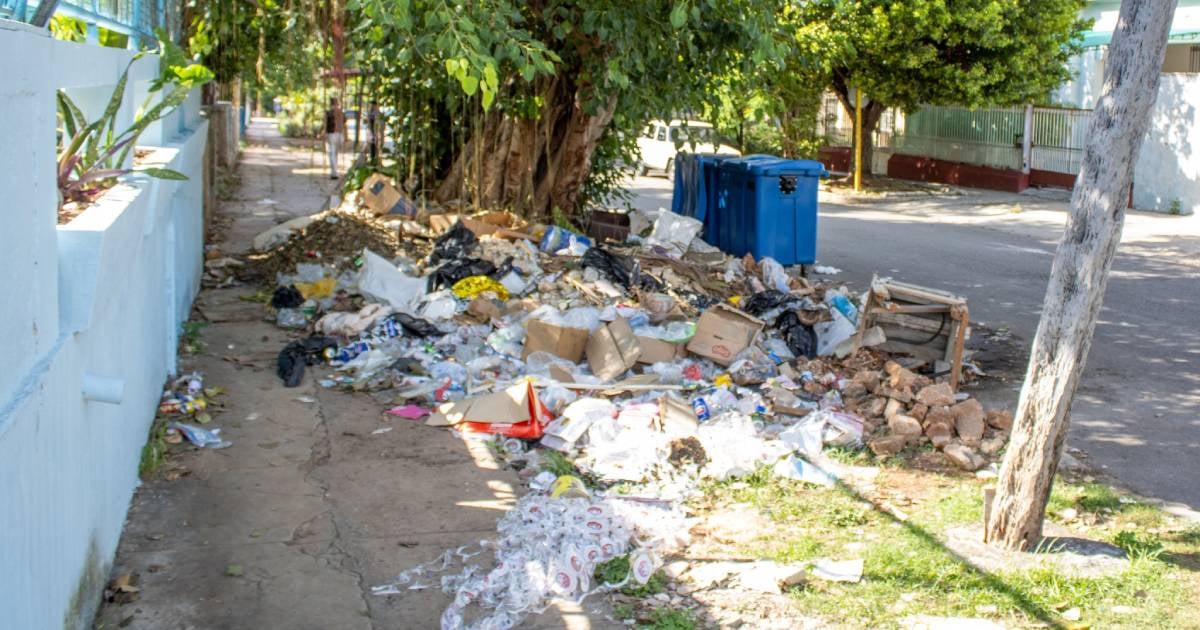
The Minister of Science, Technology and Environment (CITMA), Armando Rodríguez Batista, publicly acknowledged the seriousness of the health crisis in the capital by admitting that "that garbage is not contained: it is scattered throughout Havana", in a post published this Sunday on his Facebook profile.
This is one of the most compelling admissions made by a high-ranking official of the regime regarding a problem that the residents of Havana face daily: the accumulation of waste in streets, ditches, sidewalks, and vacant lots, which recent rains have exacerbated, turning it into a phenomenon of multiple risks—“sanitary, environmental, social, and spiritual.”
In his post, Rodríguez Batista pointed out that the recent rains have revealed "the mounds of garbage that, like silent witnesses of our inactivity, accumulated in corners, vacant lots, and margins."
The minister described how waste floats in the water, adheres to the sidewalks, and mixes “with the mud and with life,” forcing a direct confrontation with a problem that, as he acknowledged, affects everyone and cannot be concealed.
Facebook/Armando Rodríguez Batista
The minister acknowledged that it is not enough to rely on trucks, brigades, and containers; instead, a structural change is needed that involves communities, institutions, and citizens in general.
He proposed to turn Havana into a "living laboratory for the transition to circularity," where waste can be recycled and utilized, rather than becoming sources of infection and urban decay.
Facebook/Armando Rodríguez Batista
A crisis that threatens lives
The official admission comes amid a context where citizens' complaints have revealed images that look like they're straight out of a horror movie. In Centro Habana, a dilapidated building at the corner of Belascoaín and San Miguel has become an improvised dump, accumulating trash and debris that threaten to bury pedestrians.
The drama even reaches hospitals. At the beginning of September, a video circulated on social media showing a giant garbage dump next to the Hermanos Ameijeiras hospital, one of the most emblematic health centers in Cuba, which activists described as an “open-air incubator for pathogens.”
The accumulation of waste has also affected hospitals in Mayabeque and Holguín, where overflowing containers remained for weeks near maternity and pediatric wards, putting mothers, newborns, and hospitalized children at risk.
Garbage and floods: a dangerous cocktail
The collapse of waste collection is worsening with each episode of heavy rain. Last week, torrential downpours turned the streets of Centro Habana, Diez de Octubre, and Vedado into rivers of trash swept away by the currents, while a widespread blackout left the city in darkness.
Neighbors shared images showing containers floating adrift and polluted waters entering doorways and homes, reflecting that the issue of garbage is not merely a matter of urban image, but rather a direct threat to the health and safety of thousands of residents of Havana.
In a country where authorities often minimize or downplay structural problems, the words of Armando Rodríguez Batista represent an unusual recognition of the magnitude of the crisis.
“The waste hits us, it forces us, as a country, to confront a problem that affects many of us”, wrote the minister, calling on institutions, universities, businesses, and communities to come together to reverse the collapse.
Meanwhile, Havana remains trapped between crumbling buildings turned into dumps, hospitals besieged by waste, neighborhoods flooded with garbage, and a populace that survives among mountains of waste that grow day by day.
Filed under: