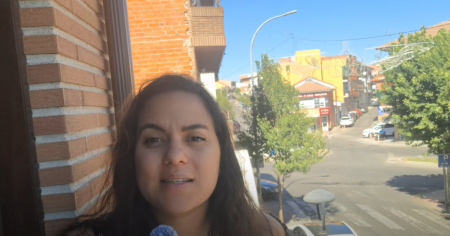
The Cuban user @legmy_ shared a video on TikTok comparing children's birthdays in Cuba and Spain, highlighting the significant differences in menus and customs.
"A respected Cuban birthday cannot be without this," she began, while showing a table filled with small sandwiches, cold salad, and croquettes. "We have the typical small sandwiches, which are soft bread filled with a homemade spread. The cold salad, which is my favorite, is also homemade, with pasta, ham, mayonnaise... well, a whole bunch of things that are absolutely delicious," she explained.
He also mentioned the classic birthday cake: “Almost every birthday, the cake is this type of meringue that is like the traditional meringue of a lifetime with that sponge cake, you know what I mean.” And, of course, croquettes were a must.
One of her most vivid memories was of the traditional birthday boxes: “In Cuba, there were birthdays when they would put a little candy in, but it wasn’t guaranteed. That was when it was your turn, a little box with everything inside. As you can imagine, everything got mixed up together: you would get a croquette smeared with meringue, the cold salad smeared with meringue, everything mixed with everything. I hated when my croquettes got smeared with meringue and the cold salad got smeared with meringue. I would leave that part on the plate and wouldn’t eat it.”
When comparing children's birthdays in Spain, he noted that he has observed different customs: “From my experience, at children's birthdays here in Spain, because as an adult I haven't been to any... if you have one, invite me. They usually have a wide variety of snacks, like those with ham, chorizo, cheese, Nutella...” He added that the cake is served on a separate plate and mentioned one thing that is always present: “I dare say that if there's one thing that cannot be missing at birthdays here in Spain, it's pellys,” and he also showed the traditional candy cones.
The video generated reactions from other Cuban users who shared similar memories, especially about the "embarradas" croquettes and the little boxes that marked their childhood.
Some recalled fondly its taste and what it represented: “Those little boxes were so good,” wrote one person, while another added, “The croquetas covered in cake were the best, hahaha.” There were also those who pointed out, “You’re missing the half guava cake in the box, you’re one of the new Cubans now.” For others, the mix of flavors was an essential part of the memory: “I loved the meringue-covered salad, nothing like the birthday parties in Spain.” Even someone questioned why these traditions aren’t kept alive: “But what’s the problem? Just cook it and enjoy it.”
A previous testimony also addressed cultural differences regarding children's parties from a different perspective. A Cuban in Spain shared her experience of her first cultural shock while organizing her daughter's birthday at a play center. When inviting the parents of her daughter’s classmates, she received messages asking how much each person should contribute. “On the day of the birthday, they would hand me five euros… I was so embarrassed. I would keep my hand out, but they came over as if it were nothing, it was very normal to them,” she recounted. Later, she understood that some groups organize collections to avoid each child bringing an individual gift.
The tradition of the "cajita" holds a special significance for those who grew up in Cuba. The cajitas included croquettes, cold salad, bread with spread, cake, and soda, all inside a cardboard box that children eagerly anticipated, even though in the end, everything tasted "relatively the same."
That emotional weight was evident when a young migrant broke down in tears after trying a Cuban birthday treat in Florida, as it reminded her of her mother and the sacrifices they made to celebrate her childhood. This seemingly simple gesture sparked a profound nostalgia shared by many families separated by migration.
The experiences of @legmy_ and other users highlight how something as ordinary as a children's party can transform into a powerful symbol of identity and memory for Cubans living abroad.
Frequently Asked Questions about Children's Birthdays in Cuba and Spain
What are the main differences between children's birthdays in Cuba and Spain?
In Cuba, children's birthdays are marked by typical menus that include small sandwiches, cold salad, croquettes, and a meringue cake, all served together in a "cajita." In Spain, on the other hand, a wide variety of snacks such as ham, chorizo, cheese, and Nutella are offered, and cakes are served on separate plates. Additionally, it is common to find cones of candies at parties in Spain.
What is a Cuban birthday "cajita"?
A Cuban birthday "cajita" is a cardboard box that contains a selection of typical foods associated with these celebrations: croquettes, cold salad, bread with spread, cake, and soda. This assortment of foods, though mixed together, evokes a sense of nostalgia for many Cubans, as it was an essential part of their childhood.
Why do Cubans feel nostalgia for birthday "cajitas"?
Birthday "cajitas" are a symbol of childhood and Cuban tradition. They represent moments of celebration in a context of economic limitations, where the flavors and mix of foods evoke memories of family and community. For many who have emigrated, these cajitas are an emotional connection to their past in Cuba.
How are children's birthday parties organized in Spain compared to Cuba?
In Spain, birthdays are typically organized with a variety of snacks and treats, and the cake is served on individual plates. In some places, it is common for the parents of the invited children to contribute money for a joint gift, instead of each child bringing an individual present. This collective system is different from the Cuban approach, where the host takes on all expenses.
Filed under: