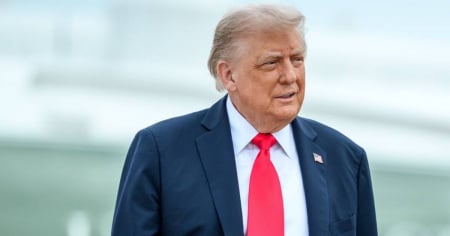
President Donald Trump participated in one of the tensest moments of the large funeral for Charlie Kirk in Arizona, openly contradicting the legacy of the young conservative leader who was murdered on September 10 in Utah.
Before more than 73,000 attendees gathered at the State Farm Stadium, Trump emphasized in his speech Kirk's conciliatory vocation, describing him as "a missionary with a noble spirit and a great purpose" who held no grudges against his opponents.
However, the leader deviated from the script to create distance.
"That's where I disagreed with Charlie. I hate my opponent," he declared without hesitation. "And I don't want what’s best for him."
Although he apologized to Erika Kirk, the activist's widow, he reiterated that this attitude is part of his DNA and that he would hardly be able to change it.
"You can talk to me and the whole group, but maybe you can convince me that it's not right. Even so, I can't stand my opponent," he insisted.
The contrast with Erika Kirk
Minutes earlier, Erika Kirk had shocked the audience by publicly forgiving her husband's killer, quoting the words of Jesus from the Gospel: "Father, forgive them, for they know not what they do."
From the stage, the new executive director of Turning Point America emphasized that Charlie’s mission was to save new generations from "anger, resentment, and hate."
The contrast between the widow's message of reconciliation and Trump's declaration of hate marked the day, highlighting the combative style of the president in contrast to the speech aimed at honoring the life of the young leader.
A state ceremony for the MAGA movement
The funeral brought together the leadership of the conservative movement aligned with Trump.
Vice President J.D. Vance, Secretary of State Marco Rubio, Chief of Staff Susie Wiles, Secretary of Health Robert F. Kennedy Jr., Director of National Intelligence Tulsi Gabbard, and Donald Trump Jr., among others, spoke.
The very magnitude of the event, with extraordinary security measures, transformed the ceremony into a political act in addition to being a religious one.
In parallel, the Secret Service arrested an armed man in the vicinity of the stadium before the event began.
The day before, the Arizona prosecutor's office filed charges against Joshua Runkles, who entered the premises with a gun and a knife, alerting authorities to his suspicious behavior.
Political violence and discourse of vengeance
Kirk, co-founder of Turning Point USA and host of The Charlie Kirk Show, was shot in the neck during a conference at the University of Utah Valley.
The murderer, Tyler Robinson, 22 years old, was captured days later after turning himself in with the help of his family.
Trump blamed the "radical left" for the crime and referred to Kirk as a "martyr of truth and freedom."
Additionally, he demanded the death penalty both for the perpetrator of the activist's murder and for the person responsible for the crime against the Ukrainian refugee Iryna Zarutska in North Carolina.
The president recalled that Utah has the death penalty and urged the governor to apply it in this case. His message emphasized the idea of exemplary punishment, in line with his history of advocating for a "tough on crime" approach in response to episodes of violence.
A strained political climate
The death of Charlie Kirk adds to other recent political assassinations in the United States, such as that of former Minnesota House Speaker Melissa Hortman and UnitedHealthcare CEO Brian Thompson.
These facts reflect an escalation of violence in a country where polarization is intertwined with increasingly normalized hate speech.
Trump himself has survived two assassination attempts during his electoral campaign in the past year, which fuels his rhetoric of constant confrontation.
In highlighting his "greatest difference" with Kirk, the president not only revealed his personal style but also the essence of his administration: a power grounded in confrontation and in the demonization of the opponent.
Frequently Asked Questions about Charlie Kirk's Funeral and Donald Trump's Statements
How did Donald Trump react during Charlie Kirk's funeral?
Donald Trump displayed a combative attitude during the funeral by openly declaring that he hated his opponents, in stark contrast to Charlie Kirk's conciliatory message. This statement highlighted a clear difference from the legacy of the young conservative leader, whom Trump described as a "missionary with a noble spirit and a great purpose."
What was Erika Kirk's message at her husband's funeral?
Erika Kirk surprised the audience by publicly forgiving her husband's killer, citing the words of Jesus: "Father, forgive them, for they do not know what they do." Her message emphasized Charlie's mission to save new generations from anger, resentment, and hatred.
What security measures were implemented during Charlie Kirk's funeral?
The ceremony featured extraordinary security measures, including the arrest of an armed man in the vicinity of the stadium before the service began. This highlighted the political tension and the need for enhanced security at large-scale events such as this funeral.
What was the impact of Charlie Kirk's assassination on the political landscape of the U.S.?
The murder of Charlie Kirk sparked a wave of condemnation and reopened the debate on political violence in the United States. His death adds to other recent political assassinations and reflects an escalation of violence in a country marked by increasing polarization and hate speech.
Filed under: