
Related videos:
The five-time Olympic champion Mijaín López, regarded as one of the greatest legends of Greco-Roman wrestling, broke away from the official narrative of the Cuban regime and openly acknowledged the deep crisis that sports are facing on the Island.
In an interview granted to the AFP from Sao Paulo, the Iron Giant called for the opening of Cuban sports to the world and defended professionalization as a way to regain lost greatness.
"Cuban sports are going through a very delicate moment," admitted López, 43.
"Sports is a business all over the world."
López, 43 years old, retired in Paris after winning his fifth consecutive Olympic gold medal.
A year later, he is emphatic: "Sports at the international level is a business. There are sponsors, there are brands, and in Cuba, that development hasn’t arrived."
The wrestler called for "a quick change" so that athletes can access sponsors and professional opportunities.
His words directly confront the legacy of Fidel Castro, who for decades maintained a stance of outright rejection of professional sports, which he labeled as "mercantilist" and "corrupting."
Bajo esa lógica, se impidió a generaciones de deportistas cubanos competir en ligas internacionales o firmar contratos con clubes extranjeros, empujando a muchos a la deserción.
The cost of intransigence
Mijaín highlighted the emigration of athletes, the decline of training facilities, and the lack of material conditions as factors that have hindered Cuba's performance in recent Olympic cycles.
"We have lost many talents (...) and the training centers have deteriorated," he admitted.
Thousands of athletes have left the country in the last two decades in search of better conditions and professional opportunities.
Meanwhile, the regime seeks to maintain a narrative of loyalty and sacrifice.
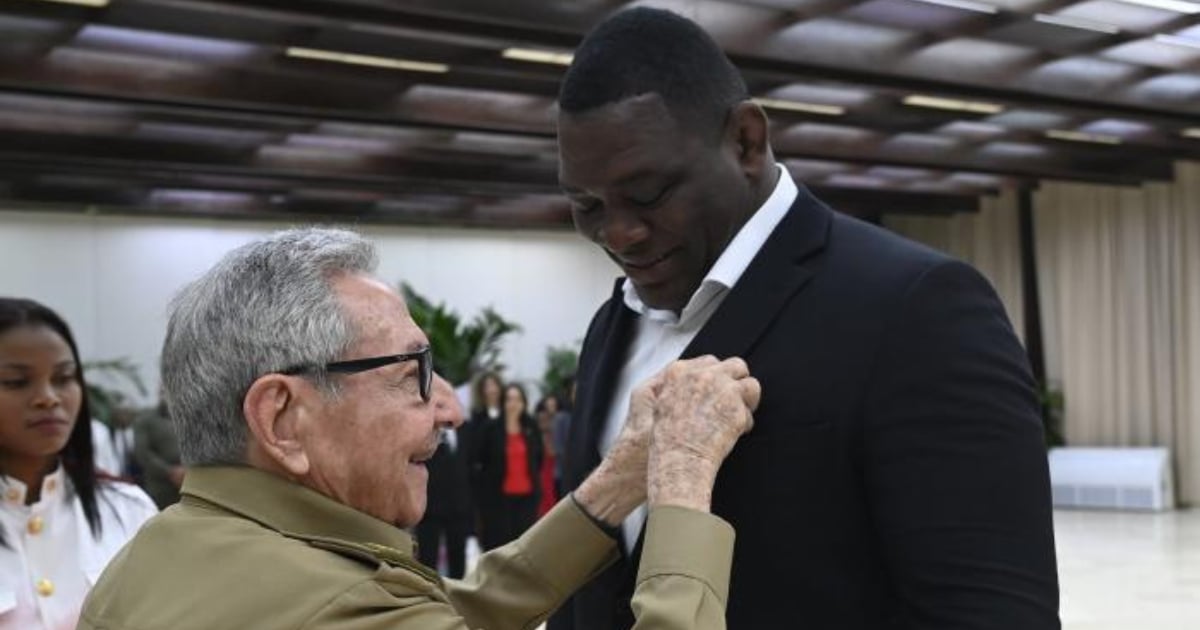
Just a few months ago, Raúl Castro and Miguel Díaz-Canel led an event to honor López as a Hero of the Republic of Cuba, praising his loyalty to the values of the revolution.
However, the reality presented by the champion himself contradicts the official triumphalism: the country is unable to halt the decline in athletic performance.
From glory to downfall
A traditional sporting powerhouse in Latin America, Cuba concluded its participation in the Paris 2024 Olympic Games with just two gold medals, one silver, and six bronze—its worst result since returning to the Olympic stage in 1992.
The 14 titles won in Barcelona are now a distant memory, a figure that marked the pinnacle of a sports system that, for decades, was a source of pride for official propaganda.
The setback is not only reflected in the medal tally.
Discipline after discipline—from boxing to baseball, including wrestling—sinks into mediocre results, exacerbated by the constant brain drain and the inability of athletes to break into the international sports market.
An uphill Olympic cycle
At the threshold of a new Olympic cycle, López's warnings are clear: if there isn't a genuine move toward professionalization and attracting external resources, Cuban sports will continue to decline.
His words, uncommon for someone of his stature within the system, highlight the contradiction between governmental stagnation and the urgent need for reforms.
The acknowledgment of the crisis by a figure like Mijaín López highlights the responsibility of the Cuban state, which has condemned sports to a state of precariousness by keeping the doors to professionalism closed.
The myth of athletes trained "only through sacrifice and without market" has collapsed: López himself, a prime example of perseverance and discipline, points out that without openness, Cuban sports will continue to lose its place in the world elite.
Filed under: