The Venezuelan leader Nicolás Maduro responded on Wednesday to the president of the United States, Donald Trump, after Washington confirmed the authorization for the Central Intelligence Agency (CIA) to conduct covert operations within Venezuela.
The reaction from Maduro included a message in his characteristic "Bolivarian English," in which he urged to avoid a war in the Caribbean: “Not war, peace” (“No to war, peace”).
The Spanish newspaper El País described Maduro's words as part of his "deliberately clumsy English," a characteristic already common in his speeches to try to connect with the international audience.
The statements were made just hours after Trump confirmed that his administration authorized the CIA to carry out covert and potentially lethal actions against structures linked to drug trafficking within Venezuelan territory.
According to The New York Times, the measure was approved through a classified presidential order known as presidential finding, which allows the agency to act independently or in coordination with potential military maneuvers in the Caribbean.
During a press conference, Trump explained that the decision aims to curb the flow of drugs and the entry of irregular migrants from Venezuela.
"They have emptied their prisons into the United States. We have a lot of drugs coming from Venezuela, and much of that drugs enter by sea, but we will also stop them on land," the president stated.
The U.S. president also stated that “Venezuela feels the pressure” and that he will not allow “other nations to continue burdening the United States with their criminals and mentally ill individuals.”
According to a report by NTN24, the U.S. military offensive includes the deployment of B-52 bombers from the Air Force over the Caribbean Sea, Southern Command maneuvers, and the presence of about 10,000 troops in the region, based in Puerto Rico, along with eight warships. The operations, aimed at combating drug trafficking, have resulted in at least five vessels sunk and 27 people dead, according to data cited by El País.
In response to the announcement from the White House, the Palace of Miraflores issued a statement expressing its "extreme alarm" over the "bellicose and extravagant" remarks made by President Trump. Maduro, in an event broadcast nationwide from the Teresa Carreño Theater, flatly rejected what he termed an attempt at "regime change" driven by the CIA and recalled the coups in Chile and Argentina in the 20th century.
"The people of Latin America do not want, do not need, and repudiate the coups d'état by the CIA," the leader stated, before calling on American society to mobilize "to prevent a war in the Caribbean."
Meanwhile, key figures of chavismo such as Diosdado Cabello reacted with sarcasm. “We should thank the United States because it has formally announced that the CIA will begin operations in Venezuela”, said the leader, recalling the bounties offered by Washington: 50 million dollars for information leading to the capture of Maduro and 25 million for Cabello, who is accused of drug trafficking.
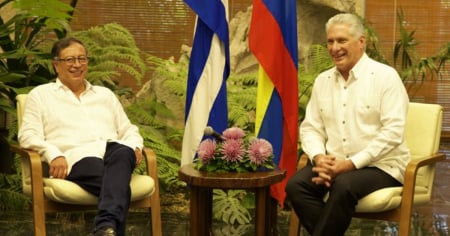
The Colombian president Gustavo Petro also expressed concern about a possible escalation of violence in the region and warned that U.S. anti-drug actions could extend into Colombian territory. “If missiles fall there or if a violent activity by CIA agents or marines begins on land, that would indeed be my responsibility,” said the president as quoted by NTN24.
The new phase of tension between Caracas and Washington reinforces the atmosphere of uncertainty in Latin America, where old ghosts of interventions and covert operations are resurfacing. While Maduro seeks to project an image of resistance and pacifism in the face of the American military threat, the White House continues to exert pressure on a regime accused of drug trafficking and human rights violations. The Caribbean once again becomes the visible stage for a power struggle echoing the Cold War.
Filed under: