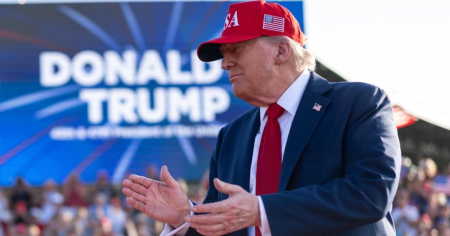
The President of the United States, Donald Trump, confirmed this Wednesday that he authorized operations by the Central Intelligence Agency (CIA) in Venezuela and suggested the possibility of a land intervention to stop drug trafficking and the entry of irregular immigrants from that country.
During a press conference alongside the FBI director, a journalist asked him why he had authorized the CIA to enter Venezuela and if he could provide more information on the matter.
"Well, I can't do that, but I authorized it for two reasons, really," Trump replied.
"Number one, they have emptied their prisons in the United States of America. They entered through the border because we had an open border policy. As soon as I heard that, I said: many of these countries are not the only one, but they are the worst abusers," stated President Donald Trump, referring to the influx of undocumented migrants from various Latin American countries.
"They have allowed thousands and thousands of prisoners and patients from mental institutions, psychiatric hospitals emptied in the United States. We are bringing them back, but that is really bad," the leader added, assuring that his administration is working to return the individuals released by those governments.
The president stated that the situation is particularly grave in the case of Venezuela: “They did it at a level that probably not many countries have reached, but not like Venezuela; they acted in a low and dirty manner,” he said.
At another point in his remarks, Trump linked the authorization to the fight against drugs: "And the other thing is drugs. We have a lot of drugs coming from Venezuela, and much of the Venezuelan drugs come by sea. But we are going to stop them by land as well," he warned.
The president's statements align with the information revealed this Wednesday by The New York Times, which detailed that his administration authorized the CIA to carry out covert and lethal operations in Venezuelan territory and the Caribbean.
According to that report, the decision is part of the strategy designed by Secretary of State Marco Rubio, aimed at
Trump, who did not provide further details about the nature of the operations, stated that "Venezuela is feeling the heat" and that his administration will not allow "other nations to keep burdening the United States with their criminals and mentally ill."
This Wednesday, it was revealed that two B-52 strategic bombers from the United States Air Force flew over the Caribbean Sea off the coast of Venezuela, as part of anti-narcotics military exercises coordinated by Southern Command (SOUTHCOM), according to official U.S. sources.
Frequently Asked Questions about CIA Operations and Possible U.S. Intervention in Venezuela
Why did Donald Trump authorize CIA operations in Venezuela?
Donald Trump authorized CIA operations in Venezuela to stop drug trafficking and the entry of illegal immigrants from that country. Trump believes that Venezuela has allowed criminals and the mentally ill to enter the United States. Furthermore, he connects these actions to a broader strategy to increase pressure on Nicolás Maduro's regime.
What military actions has the United States taken in the Caribbean against drug trafficking originating from Venezuela?
The United States has deployed more than 15 warships, nuclear submarines, and F-35 fighter jets in the Caribbean. These actions have led to the sinking of Venezuelan vessels allegedly involved in drug trafficking. The Trump administration has justified these actions as part of a "zero tolerance" policy against drug trafficking and transnational terrorism.
What is Venezuela's position, along with other allied countries, regarding the actions of the United States?
Nicolás Maduro has activated a decree of "state of external commotion", granting himself extraordinary powers to mobilize the Armed Forces and take control of strategic services in the event of aggression. Meanwhile, Cuba has expressed its political support for Venezuela, but has ruled out any military involvement. The situation has generated concern in the region over the risk of armed conflict.
What does Trump's declaration of "armed conflict" against drug cartels imply?
The declaration of "armed conflict" allows Trump to deploy the military for operations against drug cartels, designated as terrorist organizations. This marks a significant shift in the drug policy of the United States, enabling more direct and aggressive military actions, especially in regions such as the Caribbean and South America.
Filed under: