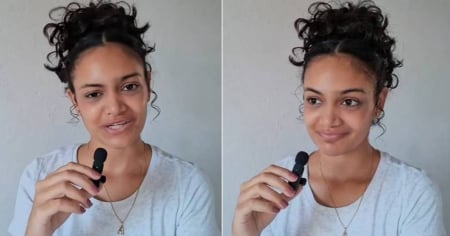
The Cuban content creator Hades Ernesto Jesús Rey Dueñas, known on Instagram as @mad.erne.zz, revealed in a video posted on that social media platform that he was on the verge of being expelled from his university in Cuba for showcasing the actual conditions in which scholarship students live.
"Almost got me expelled from university for making a video. Let me tell you the story that you probably shouldn't know," said the young man.
In his second week as a Physics student in another province, he decided to record a video titled “a day in the life of a scholarship student (...) I showed the real conditions, the food, the rooms, the bathrooms. The latter were so dirty that even my dad, a tough guy, said upon seeing it: That's terrible.”
Shortly after publishing the material, the young man received a call from an unknown number. "It was the dean... Indiscipline, video, and he warned me that there would be an analysis on Monday."
Minutes later, a deeper voice said, "Ernesto, good afternoon. I am the vice chancellor. There is a new communication law. State institutions cannot be recorded. Delete the video or the consequences will be more serious," he recalled.
The student, who at that moment was aiming to graduate in Physics, decided to delete the video in the face of the threat of sanctions: “I smartly deleted it,” he commented. However, that did not stop the pressure from the academic authorities.
"On Monday, the dean, the vice dean, and finally the vice rector arrived for the analysis. They greeted me with arrogance, and I took my seat feeling even more belittled. He told me that my content was counter-revolutionary, subversive, and manipulative. He said he would investigate whether the counter-revolution was paying me for my videos. I wish, my friend, I wish," the young creator recounted.
Since then, he claims he was marked at the university. “My main professor hated me. He looked for the slightest excuse to expel me. But I’ll tell you more about that in another video.”
The Cuban reflected on his experience denouncing censorship within the state educational system. "I learned that in some systems, the truth is the gravest crime. And your silence is the price of a paper that is worth less than your dignity."
At the end of his video, Ernesto leaves an open question to his followers: “Do you think I was right to delete the video?”
Her testimony has gone viral on social media, as it highlights once again the control and censorship the Cuban regime exerts over freedom of expression, even within the country's universities, where young people face penalties for publicly revealing the everyday reality that the system tries to hide.
Ernesto no longer studies at the Cuban university; he prefers to educate himself in other disciplines on his own and dreams of starting his professional life in a more competitive and freer society.
Frequently Asked Questions about Censorship and Repression in Cuban Universities
Why was the Cuban student Hades Ernesto nearly expelled from the university?
Hades Ernesto was on the verge of being expelled from the university for posting a video that showcased the dire conditions in which scholarship students live in Cuba. The university deemed the video counter-revolutionary and subversive, and demanded that he remove it to avoid harsher penalties.
What measures do Cuban authorities take against students who criticize the system?
Cuban authorities exert control and censorship over students who criticize the system, resorting to threats of expulsion, interrogations, and psychological pressure. Furthermore, they implement laws that prohibit the recording of state institutions as a way to silence any public criticism.
How does censorship manifest in Cuban universities?
Censorship in Cuban universities is manifested through constant monitoring by State Security, the repression of any form of student protest, and the control of internal communications, such as the elimination of messaging groups that coordinate dissenting activities.
What impact do ETECSA's measures have on Cuban youth?
The measures taken by ETECSA, such as the rate hike, severely impact Internet access for Cuban youth, limiting their ability to study, communicate, and engage in digital activities. The lack of connectivity exacerbates censorship and isolates students from critical information and the outside world.
Filed under: