
Related videos:
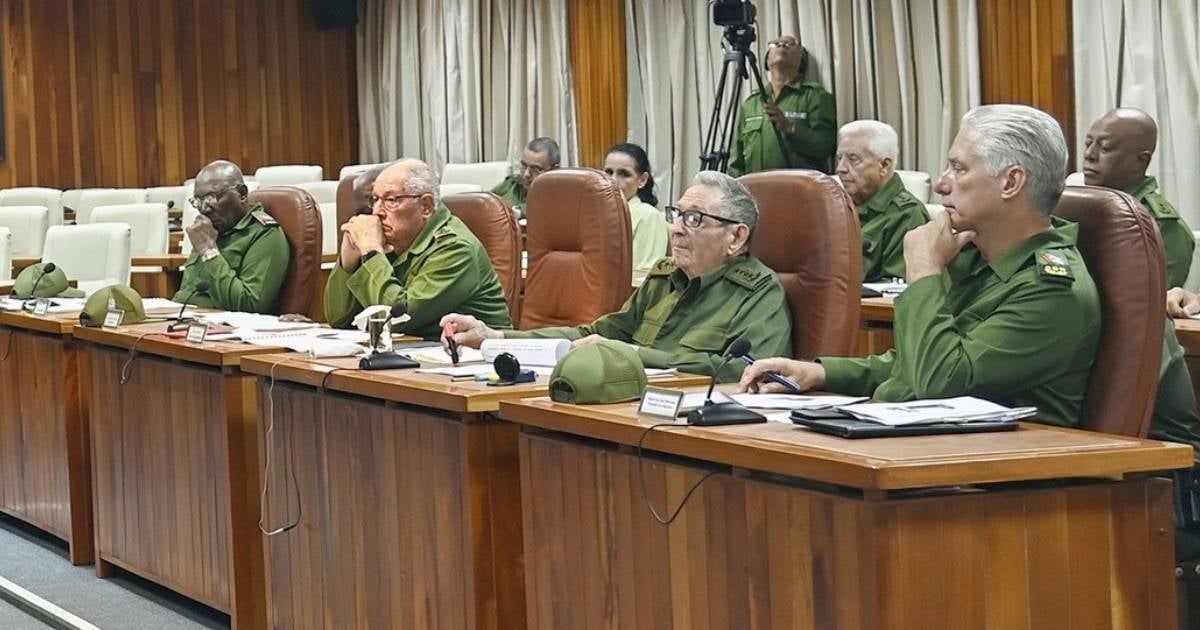
The Army General Raúl Castro Ruz, 94 years old, reappeared in the center of power in Cuba by presiding over a session of the National Defense Council (CDN) held this Wednesday at the Ministry of Revolutionary Armed Forces (MINFAR), as reported by the official newspaper Granma.
The brief note published by the Communist Party's body specifies that the meeting took place "to approve the decisions and plans of its working and support bodies" and that "the activity was presided over by Army General Raúl Castro Ruz, leader of the Revolution, and the President of the Republic, Miguel Díaz-Canel Bermúdez."
However, Castro's presence at the meeting contradicts what is established in Article 219 of the Cuban Constitution, which expressly states that "the National Defense Council is composed of the President of the Republic, who presides over it, and who, in turn, appoints a vice-president and the other members determined by law".
The very wording of Granma confirms that Díaz-Canel did not lead the command body that, by law, he should preside over, which implies a direct violation of the constitutional text and an unmistakable sign of who still holds real power on the island.
The meeting took place at MINFAR, a historic stronghold of Raúl Castro's influence, who was accompanied by his grandson Raúl Guillermo Rodríguez Castro (“El Cangrejo”), along with high-ranking officials from the FAR and the Ministry of the Interior.
Despite his announced political retirement in 2021, the military leader retains a central role in the state's control structures, particularly in the defense sector and in the GAESA business conglomerate, which remains under the influence of the Castro regime.
The presentation of the general as “chief at the forefront of the Revolution” instead of “historical leader” or “former president” reinforces the perception that Raúl Castro has not really stepped away from command, and that his influence continues to shape the decisions of Díaz-Canel's government.
In the midst of the severe economic crisis, power outages, and social discontent affecting the country, this public appearance sends a clear message to the Cuban people and to the outside world: power in Cuba remains under the control of the general and the military apparatus, beyond formal positions and promises of transition.
Frequently asked questions about Raúl Castro's resurgence in Cuban power
Why did Raúl Castro preside over the National Defense Council if the Constitution does not allow it?
Raúl Castro's presidency in the National Defense Council is considered a violation of the Cuban Constitution, which establishes that the president of the Republic must preside over this body. This fact demonstrates that, despite his retirement, Raúl Castro continues to maintain real control over power in Cuba, especially in the military realm.
What does the reappearance of Raúl Castro imply for the government of Miguel Díaz-Canel?
The reappearance of Raúl Castro reinforces the perception that Díaz-Canel does not have complete control of the country, and that real power remains in the hands of Raúl Castro and the military apparatus. This also highlights the fragility of Díaz-Canel's leadership at a time of economic and social crisis in Cuba.
What is the importance of Raúl Castro's public appearances?
Raúl Castro's public appearances aim to reaffirm his leadership and project an image of continuity and stability in the Cuban regime. They also serve to counter rumors about his health and to demonstrate that he remains a central figure in the island's political power.
How does Raúl Castro's influence affect Cuba's political future?
The influence of Raúl Castro on Cuban politics delays any possibility of significant change in the political system of the island. His presence reinforces the continuity of the socialist regime and military control, making political and economic opening in Cuba more difficult.
Filed under: