
Related videos:
The United States has begun to rigorously implement a policy that could revoke visas for Cuban citizens linked to the Communist Party of Cuba (PCC) or those who have participated in anti-American demonstrations promoted by the island's regime.
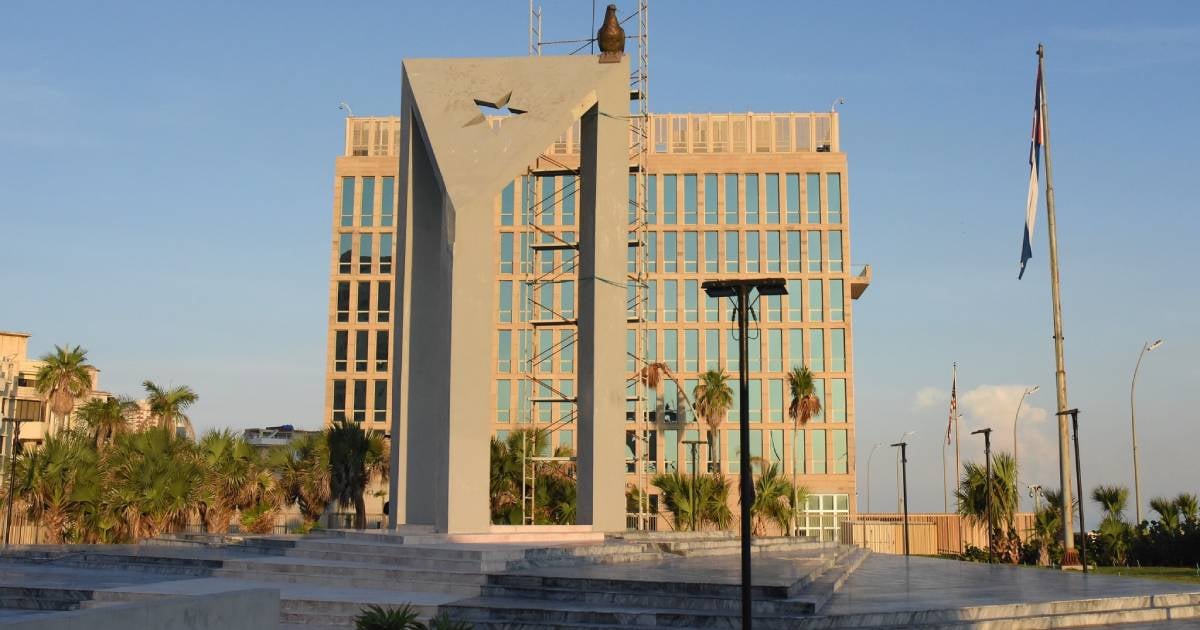
The warning comes from a report by journalist Mario J. Pentón from Martí Noticias, who revealed that the United States Embassy in Havana recently revoked the visa of a Cuban citizen after receiving “new information” that made them “ineligible” to enter the country.
A U.S. State Department official, quoted by Pentón, confirmed that “participating in the demonstrations organized by the regime in front of the United States Embassy in Cuba, sharing anti-American propaganda on social media, and expressing hatred towards democratic values” are sufficient grounds for the immediate revocation of a valid visa.
“People are going to start to doubt whether it is worth being a member of the Communist Party of Cuba and participating in anti-American demonstrations,” said the official, speaking on condition of anonymity.
The diplomat also recalled that “having a visa to enter the United States is not a right, it is a privilege. If you wish to come to the United States, you must be respectful of our country.”
The measure is supported by Section 221(i) of the Immigration and Nationality Act (INA), which allows Washington to revoke an already issued visa if new information arises that calls into question the holder's eligibility. This can include anything from suspicions of fraud or misrepresentation of information to indications that the individual poses a potential threat to public or national security.
The case, also confirmed by the magazine El Toque, reflects the increasing strictness of the U.S. Embassy in Havana that has been in place for months, with particular attention to applicants or beneficiaries with labor or ideological ties to the Cuban state apparatus.
Employment ties and visa denials
The Charge d'Affaires of the Embassy, Mike Hammer, had indicated in May that immigration regulations are being applied more rigorously that prevent granting visas to individuals with recent ties to the PCC or state institutions.
“We want to prevent the repressors from being on the streets of South Beach, enjoying a mojito. That cannot be allowed, it's not fair,” Hammer stated at a press conference in Miami.
These measures have resulted in dozens of visa rejections for Cubans who, without having been communist militants, worked in state entities or in companies controlled by the regime.
Cases like that of Amarilys Pérez, a Cuban American citizen whose parents were rejected despite having submitted affidavits denying any political affiliation, illustrate the human impact of this policy.
“Working to survive should not be confused with ideological activism,” Pérez stated in a letter sent to CiberCuba.
Families caught between the law and distance
The tightening of consular filters also impacts the family reunification program, a legal path that has allowed thousands of Cubans to reunite with their loved ones in the United States for years.
However, according to testimonies gathered by this outlet, even those who meet all the legal requirements are now facing automatic rejections for having had state employment or indirect ties to the PCC.
Immigration lawyers in Miami, such as Willy Allen, have described the pattern of exclusion applied in Havana as “concerning.” “There must be a more decent way to investigate individuals, rather than accusing for the sake of accusing, and denying for the sake of denying,” the expert told CiberCuba.
A clear political message
Although the State Department avoids commenting on individual cases, the recent visa revocations and consular denials send an unequivocal message: the United States will toughen its stance toward those who maintain ties with the political or ideological apparatus of the Cuban regime, even if those connections were purely professional.
Meanwhile, uncertainty is growing among thousands of Cuban families who are waiting for a consular appointment or the reactivation of their cases, fearful that a past job or a social media post could abruptly close the door to the American dream.
Filed under: