
Related videos:
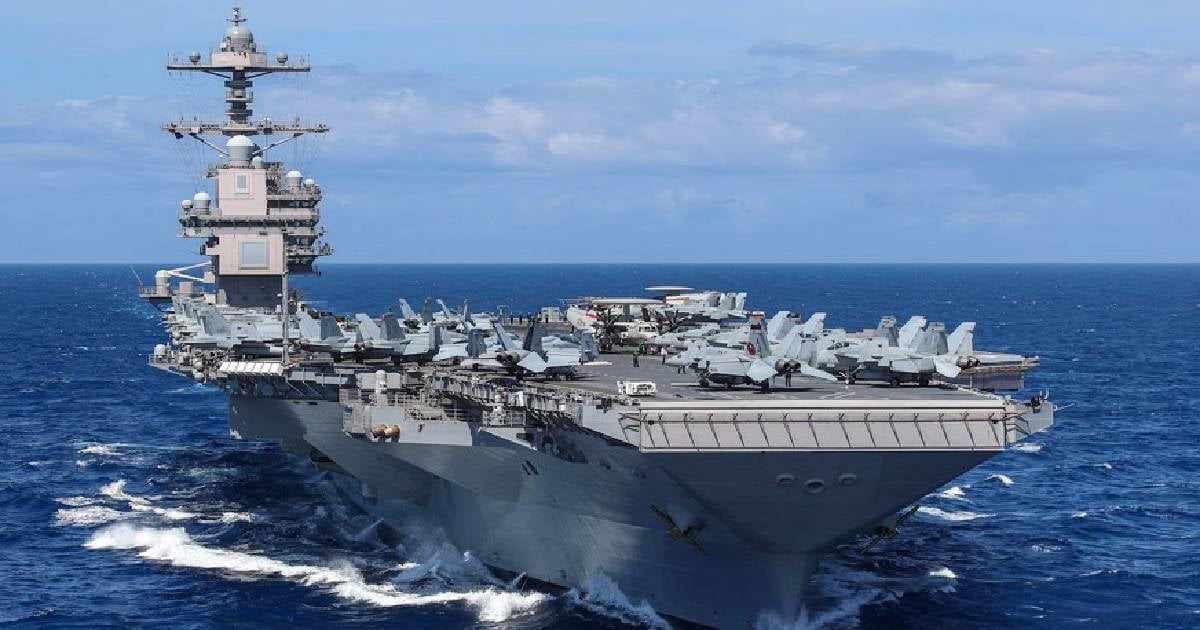
The United States ordered the deployment of the USS Gerald R. Ford aircraft carrier and its strike group in the Caribbean as part of a military offensive against drug trafficking and transnational criminal organizations in the Western Hemisphere, reported television network Fox News.
According to the Pentagon, the measure is in response to a directive from President Donald Trump to "dismantle transnational criminal organizations and counter narcoterrorism in defense of national security."
The Secretary of War, Pete Hegseth, ordered the deployment of the strike group from the aircraft carrier Gerald R. Ford to the area of Southern Command (USSOUTHCOM), which covers Latin America and the Caribbean.
The group includes the nuclear aircraft carrier USS Gerald R. Ford, the largest in the United States Navy fleet, and the destroyers USS Mahan, USS Winston S. Churchill, and USS Bainbridge.
According to the Pentagon spokesman, Sean Parnell, the mission aims to “strengthen the United States' ability to detect, monitor, and dismantle illicit activities that threaten the security of the Western Hemisphere,” as cited by Fox News.
In this regard, the Venezuelan government stated that it is preparing for a deployment that is "getting closer every day" to its shores, referring to the U.S. naval presence in the Caribbean Sea, highlighted the agency EFE.
The jurisdiction of the United States Southern Command covers 31 nations and 12 territories with special status in Latin America and the Caribbean, which include: Antigua and Barbuda, Argentina, Barbados, Belize, Bolivia, Brazil, Chile, Colombia, Costa Rica, Cuba, the Dominican Republic, Ecuador, El Salvador, Grenada, Guatemala, Guyana, Haiti, Honduras, Jamaica, Nicaragua, Panama, Paraguay, Peru, Saint Kitts and Nevis, Saint Lucia, Saint Vincent and the Grenadines, Suriname, Trinidad and Tobago, Uruguay, and Venezuela.
The USS Gerald R. Ford is currently in the Mediterranean waters accompanied by three destroyers, according to information provided by three official sources to NBC News.
Although it remains in that region, the journey to the Southern Command area would take only a week once the movement begins.
Its arrival would mean doubling the U.S. military presence in the area, which currently includes eight vessels, one submarine, and approximately 6,000 military personnel.
The aircraft carrier would add another 5,000 personnel to that deployment.
The decision comes after a series of U.S. military operations in the Caribbean, which have included attacks on vessels allegedly connected to the Tren de Aragua, a Venezuelan organization classified as a terrorist group.
In the most recent of these operations, six alleged narcoterrorists were killed, as confirmed by Hegseth.
The official warned on X: "If you are a narco-terrorist trafficking drugs in our hemisphere, we will treat you like Al Qaeda. Day and night, we will track your networks and eliminate you."
The White House has increased pressure on the regime of Nicolás Maduro, whom Trump accuses of leading a drug cartel.
The president also confirmed that he authorized covert CIA operations in Venezuela, arguing that the South American country "has released prisoners to the United States and allowed the flow of drugs through maritime routes."
Meanwhile, Democratic and Republican lawmakers have expressed concern about the legality of the operations and are pushing for a resolution to prohibit the use of armed forces in "hostilities" against Venezuela without Congressional authorization.
Filed under: