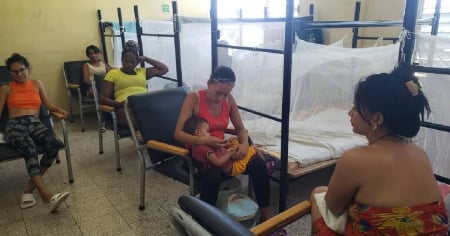
The Cuban government acknowledged deficiencies in the implementation of its management and response protocol for cases involving minors in vulnerable situations.
The analysis of "self-criticism" arises from the outrage of thousands of Cubans on social media upon seeing images of several children sleeping in the gardens of the Gran Muthu Habana Hotel, located in the Miramar neighborhood of Havana.
During a follow-up meeting on social policies, led by Cuban Vice Prime Minister Eduardo Martínez Díaz, Minister of Labor and Social Security Jesús Otamendi Campos, and Minister of Education Nayma Trujillo Barreto, authorities acknowledged that there was a lack of promptness in responding to repeated reports about minors living in abandoned conditions.
A summary of the debate was broadcast by the Noticiero Estelar, which emphasized the need for a “more systematic and comprehensive” approach to prevent similar situations from occurring again.
Among the agreed measures, the government announced:
- the reinforcement of monitoring in vulnerable areas of Havana
- the creation of emergency shelters for minors in at-risk situations
- the enhancement of citizen reporting channels
Authorities acknowledged that in some cases, the affected children come from homes lacking family structure and that the protection mechanisms "did not act with the required immediacy."
The case, which went viral on social media after images of children sleeping outdoors in the hotel gardens were published, forced the regime to publicly address the issue and review its own child care system, once again highlighting the deterioration of the social network in Cuba and the lack of preventive response from institutions in light of the rise in extreme poverty and homelessness.
Other points of interest in the meeting
- The government identified that in Havana, 484 students in the education system do not regularly attend school for various reasons.
- Nationwide, it was revealed that more than 17,000 school-age children faced “material conditions unfavorable for attending school.”
- The authorities acknowledged that there was a lack of monitoring/systematic search ("pesquisar") in the areas with the highest incidence of child abandonment in Havana.
- Officials acknowledged that the phenomenon "is multicausal" and warned that it will not be resolved immediately.
- It was noted that the absence of family is one of the root causes of the problem, which calls for "differentiated" responses for minors with intellectual disabilities or in special circumstances.
- Within the broader framework of social policy, they assert that Cuba has a "Comprehensive Policy for Children, Adolescents, and Youth" that coordinates multiple state institutions to address the needs of vulnerable minors in an integrated manner.
- In this regard, 1,236 communities in vulnerable situations have been identified, and 96% of them believe they are "in a process of comprehensive transformation."
Filed under: